Pakistan, Saudi Arabia discuss new port development projects, Karachi–Jeddah Sister Port pact

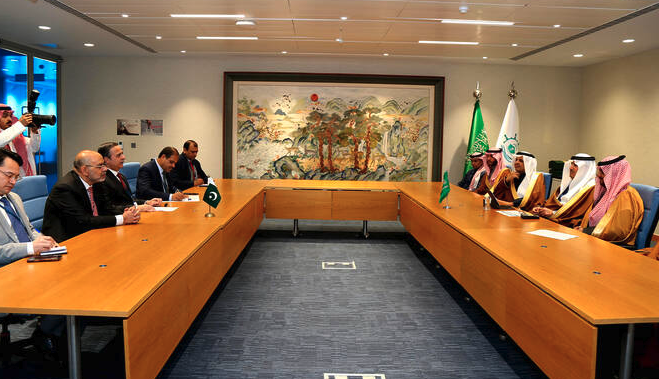
Pakistan and Saudi officials hold talks Pakistan’s federal minister for maritime affairs, Junaid Anwar Chaudhry, said the discussions with the Saudi transport minister in London on the sidelines of International Maritime Organization Assembly in London, UK, on November 26, 2025
Short Url
Updated 27 November 2025
Follow

Pakistan, Saudi Arabia discuss new port development projects, Karachi–Jeddah Sister Port pact

  • Saudi delegation to soon share draft MoU for long-term maritime partnership, Pakistan’s maritime minister says after meeting Saudi transport minister
  • Proposal for joint ventures between Pakistan National Shipping Corp and Saudi Arabia’s national shipping line, Bahri, also under discussion

KARACHI: Pakistan and Saudi Arabia held wide-ranging talks in London on Thursday focused on new shipping and port development projects, including a proposed Sister Port agreement between Karachi Port and Jeddah Islamic Port, Pakistan’s maritime ministry said.

The two countries have expanded economic and security engagement in recent years, with maritime logistics and port development emerging as a growing area of collaboration. Saudi Arabia is investing heavily in its port infrastructure under Vision 2030, while Pakistan is seeking foreign partnerships to modernize its shipping capacity and upgrade facilities in Karachi and along the Arabian Sea.

Pakistan’s federal minister for maritime affairs, Junaid Anwar Chaudhry, said the discussions with the Saudi transport minister in London on the sidelines of International Maritime Organization Assembly focused on broadening maritime ties across shipping, logistics, training and investment. 

“Pakistan and Saudi Arabia agreed to further enhance maritime cooperation,” a statement from the maritime ministry said, adding that both sides reviewed “new cooperation in shipping and port development.”

The two sides also discussed a Sister Port agreement between Karachi Port and Jeddah Islamic Port, a move aimed at boosting cargo movement, harmonizing port procedures and enhancing connectivity between two of the region’s major maritime gateways. 

As part of Pakistan’s efforts to align its maritime sector with global standards, Chaudhry said the two leaders examined “investment opportunities under Maritime Vision 2047,” the country’s long-term plan to expand its port capacity, digitalize shipping systems and build a competitive merchant fleet.

The minister also said a proposal for joint ventures between the Pakistan National Shipping Corporation and Saudi Arabia’s national shipping line, Bahri, was under active consideration. 

He added that the two countries had agreed to expand commercial linkages between private-sector operators, noting that both sides reached agreement on “increasing B2B maritime cooperation.”

Chaudhry also reported progress on seafarer training, a priority for Pakistan as it seeks to expand employment opportunities for its maritime workforce abroad. He said there had been “positive progress” regarding “training opportunities for Pakistani seafarers on Saudi vessels.”

According to the handout, the Saudi delegation informed Pakistan that Riyadh would soon share a draft memorandum of understanding aimed at building a long-term maritime partnership.


Saudi POS transactions see 20% surge to hit $4bn: SAMA

Updated 05 December 2025
Follow

Saudi POS transactions see 20% surge to hit $4bn: SAMA

RIYADH: Saudi Arabia’s total point-of-sale transactions surged by 20.4 percent in the week ending Nov. 29, to reach SR15.1 billion ($4 billion).

According to the latest data from the Saudi Central Bank, the number of POS transactions represented a 9.1 percent week-on-week increase to 240.25 million compared to 220.15 million the week before.

Most categories saw positive change across the period, with spending on laundry services registering the biggest uptick at 36 percent to SR65.1 million. Recreation followed, with a 35.3 percent increase to SR255.99 million. 

Expenditure on apparel and clothing saw an increase of 34.6 percent, followed by a 27.8 percent increase in spending on telecommunication. Jewelry outlays rose 5.6 percent to SR354.45 million.

Data revealed decreases across only three sectors, led by education, which saw the largest dip at 40.4 percent to reach SR62.26 million. 

Spending on airlines in Saudi Arabia fell by 25.2 percent, coinciding with major global flight disruptions. This followed an urgent Airbus recall of 6,000 A320-family aircraft after solar radiation was linked to potential flight-control data corruption. Saudi carriers moved swiftly to implement the mandatory fixes.

Flyadeal completed all updates and rebooked affected passengers, while flynas updated 20 aircraft with no schedule impact. Their rapid response contained the disruption, allowing operations to return to normal quickly.

Expenditure on food and beverages saw a 28.4 percent increase to SR2.31 billion, claiming the largest share of the POS. Spending on restaurants and cafes followed with an uptick of 22.3 percent to SR1.90 billion.

The Kingdom’s key urban centers mirrored the national decline. Riyadh, which accounted for the largest share of total POS spending, saw a 14.1 percent surge to SR5.08 billion, up from SR4.46 billion the previous week. The number of transactions in the capital reached 75.2 million, up 4.4 percent week-on-week.

In Jeddah, transaction values increased by 18.1 percent to SR2.03 billion, while Dammam reported a 14 percent surge to SR708.08 million.

POS data, tracked weekly by SAMA, provides an indicator of consumer spending trends and the ongoing growth of digital payments in Saudi Arabia. 

The data also highlights the expanding reach of POS infrastructure, extending beyond major retail hubs to smaller cities and service sectors, supporting broader digital inclusion initiatives. 

The growth of digital payment technologies aligns with the Kingdom’s Vision 2030 objectives, promoting electronic transactions and contributing to the nation’s broader digital economy.