

Afghans say last path to safety shuts as US halts visas after DC shooting

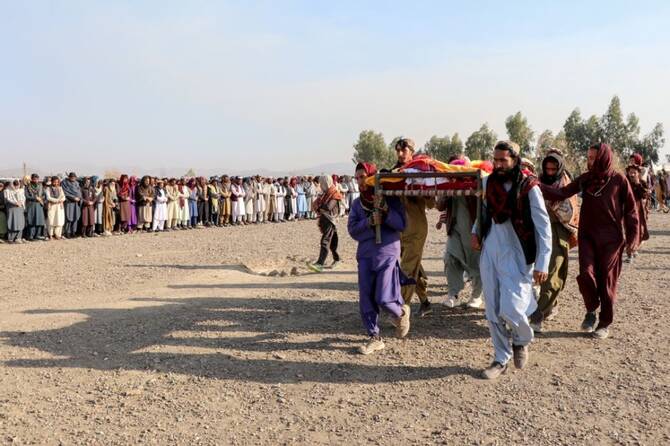
Afghan mourners and relatives of victims carry the coffin during a mass burial ceremony for nine children and one woman who were killed by a Pakistan air strike, in the Gurbuz district of Khost Province. (AFP)
Short Url
Updated 27 November 2025
Follow

Afghans say last path to safety shuts as US halts visas after DC shooting

  • For Afghans sheltering in Pakistan, tens of thousands of whom are awaiting US resettlement decisions, the announcement felt like their last safe route had closed

KABUL/ISLAMABAD: Afghans who fled the Taliban and have waited years for a US resettlement decision say their last path to safety has shut since Washington froze all Afghan immigration cases following a shooting near the White House.
The US Citizenship and Immigration Services (USCIS) said late on Wednesday it had halted processing for Afghan nationals indefinitely, hours after an Afghan man shot and critically wounded two National Guard soldiers in Washington.
President Donald Trump called the attack “an act of terror” and ordered a review of Afghans who entered the country during Joe Biden’s presidency.
For Afghans sheltering in Pakistan, tens of thousands of whom are awaiting US resettlement decisions, the announcement felt like their last safe route had closed.

’IF I GO BACK YOU WILL HEAR NEWS OF MY ARREST OR MY DEATH’
“I was deeply distressed when I heard this news. We have completed all the required review procedures,” said Ahmad Samim Naimi, 34, from Afghanistan’s Panjshir province, who had worked as a TV presenter and press adviser under the previous, US-backed government.
He fled to Pakistan after the Taliban began detaining journalists and former government workers, and had applied for resettlement in the United States.
“If I go back, one day you will certainly hear news of either my arrest or my death,” he said.
Remaining in Pakistan has become increasingly difficult as the authorities have launched a crackdown on Afghans without formal refugee status. Pakistan has deported more than half a million Afghans in the past year and intensified detentions in major cities. Even Afghans with valid visas or UNHCR documents have been stopped at checkpoints, evicted or asked for bribes.
Pakistan’s information and interior ministries did not immediately respond to requests for comment, nor did Afghanistan’s refugee and foreign affairs ministries. The Taliban have previously said Afghanistan is now at peace and safe for citizens to return home.

’RISK OF DESTRUCTION’
Rights groups say former government workers, journalists, soldiers and people linked to Western forces face detention, disappearance or execution under Taliban rule, while women face sweeping restrictions on movement, work and education.
Another applicant for US resettlement living in Pakistan, a 40-year-old former civil servant from Kabul who declined to give his name for security reasons, said the freeze had erased everything he had built his family’s future around.
“I cannot put myself and my family at risk of destruction,” he said about returning to Afghanistan.

SINGLE INCIDENT SHUTS A DOOR FOR MANY
US forces and aid bodies employed thousands of Afghans as interpreters and local staff during America’s longest war, which ended when the Taliban seized power in 2021.
After abandoning Kabul, the Biden administration announced Operation Allies Welcome to offer refuge to Afghans at special risk of persecution because of their association with the United States.
But there have been long waits, including for those granted priority treatment — “P1” for those who worked directly for the US government and “P2” for those who worked on US-funded projects or for media, aid or civil society organizations.
Officials identified the suspected Washington gunman as Rahmanullah Lakanwal, 29, who arrived under Operation Allies Welcome and was granted asylum earlier this year. Authorities say he served in the Afghan army and had no criminal record.
Shawn VanDiver, president of AfghanEvac, a volunteer group seeking to assist Afghans who helped US forces, said about 200,000 Afghans had arrived in the United States since 2021 through refugee and special visa programs after vetting.
“These folks don’t deserve this — they’re just trying to get their shot at the American dream,” he said. “This is going to cause a lot of harm across the Afghan community in the United States.”
He said another 265,000 Afghans are still being processed abroad, including about 180,000 in the Special Immigrant Visa pipeline for those who worked for the US government. Many are waiting in countries such as Pakistan, Qatar and North Macedonia, while others remain inside Afghanistan.
Naimi said he still hopes Washington will reconsider: “I hope that the United States will reconsider the cases of those with P1 and P2 status and restart the process.”


Georgia’s street dogs stir affection, fear, national debate

Updated 3 sec ago
Follow

Georgia’s street dogs stir affection, fear, national debate

TBILISI: At a bus stop in central Tbilisi, two tagged dogs dozed on a bench as some commuters smiled at them and others cast angry glances.
In the streets of the Georgian capital, such scenes are part of daily life: community-fed “yard dogs,” yellow municipal tags on their ears, lounge outside bakeries, metro entrances and school gates.
The free-roaming canines stir both affection and fear. What to do with their swelling numbers — in the tens of thousands in Tbilisi alone — has become a nationwide dilemma.
Stray animals tied the top spot for public concerns in a poll by the National Democratic Institute, with 22 percent of respondents naming it the most pressing issue.
Many welcome the dogs as a symbol of Tbilisi, a showcase of Georgian hospitality and the warm street life that draws tourists to the capital.
“Street dogs in Georgia have made a more positive impact on tourism and the image of Georgia than people and culture alone,” said journalist Elena Nikoleisvili, 51, who helps street dogs.
“If anything, these adorable creatures should be the symbol of the capital — like the cats of Istanbul.”
On cafe terraces, regulars slip bones under tables as mongrels curl up between patrons’ feet, while each neighborhood and cul-de-sac has its own local canine mascot.

- ‘Drop in the ocean’ -

Others worry about safety.
“They bark and scare folks,” said plumber Oleg Berlovi, 43.
“Two weeks ago, a dog bit my kid and we needed shots. Animals are great, but they need looking after.”
According to the World Health Organization, dogs are the main vectors in human rabies cases globally.
Georgia still records a handful of human deaths from the disease each year and administers tens of thousands of post-exposure treatments, according to the Global Alliance for Rabies Control.
City officials say the answer is steady, humane population control.
“The state’s policy is to manage these animals by the most humane methods possible and to reduce to a minimum the number of stray dogs on the streets,” Nicoloz Aragveli, who heads Tbilisi city hall’s animal monitoring agency, told AFP.
A recent count put the capital’s stray dog population at about 29,000, and around 74 percent have been neutered, Aragveli said.
“We plan to do more so that we reach 100 percent,” he said.
The city runs weekly school lessons and a door-to-door registration drive to raise awareness and track owned pets.
Legislative changes have also tightened penalties for abandoning animals and for violating care and ownership rules — steps officials say will help halt the flow of pets to the streets.
But journalist Nikoleisvili said the authorities only responded after a public backlash, and “could do much more.”
The number of dogs that have been neutered in Tbilisi — around 50,000 over the last decade — is “a drop in the ocean,” she said.

- ‘Guilty party’ -

Volunteers, like theater director Zacharia Dolidze, who builds kennels, also play a big role in caring for the dogs.
“There are days I make 20 kennels. I’ve built about 2,500 in seven years,” the 40-year-old said.
He collects regular donations to help pay for materials.
Shelter operators say there are big gaps in addressing what they call one of Georgia’s biggest issues.
“You can make regulations, but if you cannot enforce them, that’s not going to help,” said Sara Anna Modzmanashvili Kemecsei, who runs a shelter that houses about 50 dogs.
In many regions, “there are absolutely no neutering campaigns.”
“I can’t really see that the government is on top of the issue, so there are lots of volunteers,” she said. “They are really good at managing these animals.”
Politics has also injected fresh uncertainty.
Last year, the government pushed a “foreign influence” law that complicates NGOs’ access to funding from foreign donors such as UK animal welfare charity Mayhew, which runs a program to vaccinate and neuter strays in Tbilisi.
Volunteers meanwhile continue to juggle feeding, sheltering and basic care.
Nino Adeishvili, 50, is a geologist and university lecturer who looks after around 10 dogs.
Her group organizes rabies shots and fundraises on Facebook for deworming, flea treatment and food.
“On the street, a dog is still unprotected,” she said.
“The guilty party is the human.”
