SAN JUAN: Dominican Republic President Luis Abinader announced Wednesday that he has authorized the US government to operate inside restricted areas in the Caribbean country to help in its fight against drug trafficking.
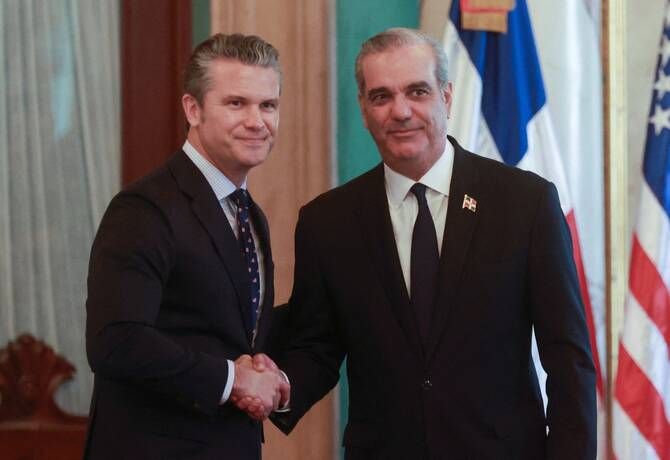
For a limited time, the US can refuel aircraft and transport equipment and technical personnel at restricted areas within the San Isidro Air Base and Las Américas International Airport, said Abinader, who made the announcement with US Defense Secretary Pete Hegseth at his side.
Hegseth was in Santo Domingo Wednesday to meet with the country’s top leaders, including Abinader and Minister of Defense Lt. Gen. Carlos Antonio Fernández Onofre.
It is the first major public agreement that the US has struck with a Caribbean nation as it seeks friendly allies to support its attacks against alleged drug-smuggling boats in the region and beyond. Since the strikes began in early September, at least 83 people have been killed.
Hegseth said the Dominican Republic was a regional leader willing to take on hard challenges.
“That’s why I’m here today. That’s why we decided to come here first,” he said. “The Dominican Republic has stepped up.”
Hegseth said the US would respect the Caribbean country’s sovereignty and laws as US service members and aircraft prepare to deploy to the Dominican Republic. He did not provide additional details.
Meanwhile, Abinader said the scope of the agreement is “technical, limited, and temporary.”
“The purpose is clear: to strengthen the air and maritime protection ring maintained by our Armed Forces, a decisive reinforcement to prevent the entry of narcotics and to strike a more decisive blow against transnational organized crime,” he said.
After a news conference where no questions were allowed, the office of the president issued a statement with more details, noting that several KC-135 tanker aircraft would be present to support air patrol missions, expanding monitoring and interdiction capabilities over a large portion of the maritime and air domains.
“They would also provide refueling services to aircraft from partner countries, thus ensuring sustained operations for monitoring, detecting, and tracking verified illicit smuggling activities,” according to the statement.
Additionally, C-130 Hercules cargo aircraft would facilitate aeromedical evacuations, firefighting, weather reconnaissance, and disaster relief, the office said.
Abinader noted that the Dominican Republic has seized nearly 10 times more drugs per year in the past five years than in the previous decade thanks to close collaboration with the US
“Our country faces a real threat, a threat that knows no borders, no flags, that destroys families, and that has been trying to use our territory for decades,” he said. “That threat is drug trafficking, and no country can or should confront it without allies.”
Hegseth praised Abinader, saying that the Dominican Republic “understands the importance of standing up to narco-terrorists and narco-traffickers who flood our countries with drugs and violence.”
“We’re deadly serious about this mission,” Hegseth said, asserting that the US has the best intelligence, lawyers and process. “We know…where they’re leaving from, where they’re going, what they’re bringing, what their intentions are, who they represent.”
Some experts believe the ongoing strikes are a tactic to try and pressure Venezuelan President Nicolás Maduro to step down given that the US military has built up its largest presence in the region in generations.
Hegseth’s visit comes a day after Gen. Dan Caine, chairman of the Joint Chiefs of Staff and US President Donald Trump’s primary military adviser, met with Trinidad and Tobago Prime Minister Kamla Persad-Bissessar.
The prime minister has praised the strikes, drawing criticism ever since stating in early September that she had no sympathy for drug traffickers and that “the US military should kill them all violently.”
On Wednesday, Persad-Bissessar told reporters that US marines were recently in the twin-island nation to do some work at an airport roadway and to train with local soldiers.
“They are not here on the ground,” she said. “We are not about to launch any campaign against Venezuela.”
She said that Trinidad has not been asked to be a base for any attack against Venezuela, and that Venezuela was not mentioned in conversations with the US on Tuesday.
Trinidad and Tobago is just a few miles away from Venezuela.
Prior to visiting Trinidad and Tobago, Caine stopped by the US territory of Puerto Rico to visit American troops there and boarded at least one US Navy ship.
Caine and Hegseth had previously traveled to Puerto Rico in September.
Earlier this year, the US approached the tiny Caribbean island of Grenada with a request.
Grenadian Prime Minister Dickon Mitchell told Parliament earlier this month that any decision possibly allowing the Trump administration to install a temporary radar at the island’s international airport “will not be a secret, nor will it be one that violates domestic or international laws.”
No public announcement has been made since then.


![]()

Dominican Republic grants US access to restricted areas for its deadly fight against drugs
Short Url
https://arab.news/pfh7n
Dominican Republic grants US access to restricted areas for its deadly fight against drugs
- For a limited time, the US can refuel aircraft and transport equipment and technical personnel at restricted areas within the San Isidro Air Base and Las Américas International Airport


Latest updates


© 2026 SAUDI RESEARCH & PUBLISHING COMPANY, All Rights Reserved And subject to Terms of Use Agreement.