Pope’s visit is a blessing for Lebanon’s forgotten psychiatric patients

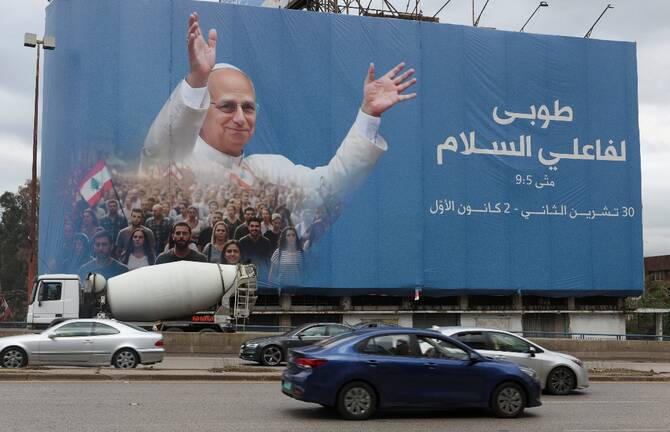
Cars drive past a billboard depicting Pope Leo XIV, ahead of his planned visit to Lebanon, in Beirut, Lebanon. (Reuters)
Short Url
Updated 26 November 2025
Follow

Pope’s visit is a blessing for Lebanon’s forgotten psychiatric patients

  • Established in 1952, the church-run hospital is one of only a few mental health facilities in Lebanon, a country where people diagnosed with psychiatric illnesses can experience social stigma and where state hospitals are severely underfunded

JAL EL DIB: Staff at Lebanon’s De La Croix Psychiatric Hospital are delighted that Pope Leo’s visit will give its carers and residents, often abandoned by their families, recognition at last.
Established in 1952, the church-run hospital is one of only a few mental health facilities in Lebanon, a country where people diagnosed with psychiatric illnesses can experience social stigma and where state hospitals are severely underfunded.
De La Croix is run by nuns from the Franciscan order, who care for around 800 patients. Leo will visit the hospital in Jal el-Dib, north of the capital Beirut, on December 2, the last day of his first trip abroad.
The building is being freshly painted and about 50 patients are practicing for a choir recital in his honor.
“His Holiness the Pope, just by visiting De La Croix Hospital, that’s proof that he cares,” said Sister Rose Hanna.
“There are many families who don’t visit, or people who don’t care about this marginalized group,” she said.

LIVING BY A MIRACLE
The hospital has survived decades of instability in Lebanon but the last six years have been particularly challenging.
Lebanon’s financial collapse emptied state coffers, the COVID-19 pandemic brought extra risks and the last two years of war left De La Croix dependent on what Hanna called “divine providence.”
The Lebanese state gives the hospital $15 per day per patient, but Hanna said it costs $75 daily to fully care for each resident.
“How are we managing to live? I don’t know. We’re living by a miracle,” she said.
Patients painted together in shared rooms, sat quietly in hallways and helped each other climb onto seats. Nurses and nuns laughed with female residents in the corridor.
“It’s a message from the patients that they exist, they are still here, they can be seen and heard,” says Chantal Sarkis, a doctor and vice-coordinator of the visit.
Mother Marie Makhlouf said the Franciscan Sisters were ready to welcome the Pope “with total simplicity.”
“This grace that’s coming to us is going to embrace us, change us, and make us feel that we are not abandoned at a time when we were really struggling,” Makhlouf told Reuters.
“The Pope comes and visits us to tell us — ‘what you are doing is sacred’.”


Israel police to deploy around Al-Aqsa for Ramadan, Palestinians report curbs

Updated 57 min 38 sec ago
Follow

Israel police to deploy around Al-Aqsa for Ramadan, Palestinians report curbs

  • The Al-Aqsa compound is a central symbol of Palestinian identity and also a frequent flashpoint

JERUSALEM: Israeli police said Monday that they would deploy in force around the Al-Aqsa Mosque during the Muslim holy month of Ramadan, which begins this week, as Palestinian officials accused Israel of imposing restrictions at the compound.
Over the course of the month of fasting and prayer, hundreds of thousands of Palestinians traditionally attend prayers at Al-Aqsa — Islam’s third-holiest site, located in east Jerusalem, which Israel captured in 1967 and later annexed.
Arad Braverman, a senior Jerusalem police officer, said forces would be deployed “day and night” across the compound, known to Jews as the Temple Mount, and in the surrounding area.
He said thousands of police would also be on duty for Friday prayers, which draw the largest crowds of Muslim worshippers.
Braverman said police had recommended issuing 10,000 permits for Palestinians from the occupied West Bank, who require special permission to enter Jerusalem.
He did not say whether age limits would apply, adding that the final number of people would be decided by the government.
The Palestinian Jerusalem Governorate said in a separate statement it had been informed that permits would again be restricted to men over 55 and women over 50, mirroring last year’s criteria.
It said Israeli authorities had blocked the Islamic Waqf — the Jordanian?run body administering the site — from carrying out routine preparations, including installing shade structures and setting up temporary medical clinics.
A Waqf source confirmed the restrictions and said 33 of its employees had been barred from entering the compound in the week before Ramadan.
The Al-Aqsa compound is a central symbol of Palestinian identity and also a frequent flashpoint.
Under long?standing arrangements, Jews may visit the compound — which they revere as the site of their second temple, destroyed by the Romans in 70 AD — but they are not permitted to pray there.
Israel says it is committed to maintaining this status quo, though Palestinians fear it is being eroded.
Braverman reiterated Monday that no changes were planned.
In recent years, a growing number of Jewish ultranationalists have challenged the prayer ban, including far?right politician Itamar Ben-Gvir, who prayed at the site while serving as national security minister in 2024 and 2025.