

IMF board to review Pakistan program on Dec. 8, paving way for $1.2 billion disbursement

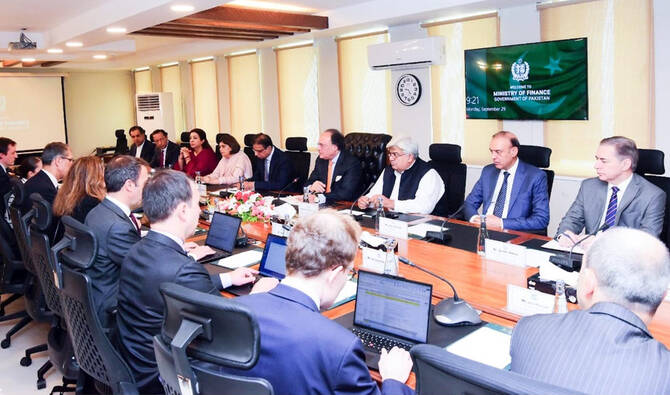
Pakistan’s Finance Minister Muhammad Aurangzeb (fourth in right row) holds a meeting with the visiting IMF delegation in Islamabad, Pakistan, on September 29, 2025. (PID/File)
Short Url
Updated 26 November 2025
Follow

IMF board to review Pakistan program on Dec. 8, paving way for $1.2 billion disbursement

  • IMF review covers Pakistan’s $7 billion EFF and $1.4 billion RSF programs, bringing total disbursements to about $3.3 billion so far
  • Economists say improved inflation, reserves and current account stability now depend on deeper fiscal and energy-sector reforms

KARACHI: The IMF Executive Board will meet on Dec. 8, according to an official calendar, to consider and approve a $1.2 billion disbursement for Pakistan, a move economists say will further stabilize the cash-strapped country’s economy.

The upcoming board meeting comes nearly two months after the Fund reached a Staff-Level Agreement (SLA) with Pakistan for the second review of its $7 billion Extended Fund Facility (EFF) and the first review of its $1.4 billion Resilience and Sustainability Facility (RSF). The SLA followed a mission led by IMF chief Iva Petrova, who held discussions with Pakistani authorities during a Sept. 24–Oct. 8 visit to Karachi, Islamabad and Washington, DC.

Board approval would unlock about $1 billion under the EFF and $200 million under the RSF, bringing total disbursements under both arrangements to approximately $3.3 billion.

“It [board meeting] is scheduled early December, yes,” an IMF official privy to the matter told Arab News from Washington as he shared the board’s calendar. 

Pakistan has relied heavily on financing from bilateral partners such as Saudi Arabia, China and the United Arab Emirates, as well as multilateral lenders including the IMF, World Bank, Asian Development Bank and Islamic Development Bank, to support its recovery.

“The IMF Board’s expected approval of the $1.2 billion tranche on Dec. 8 will further stabilize Pakistan’s near-term external position and unlock additional official inflows,” Khaqan Najeeb, Pakistan’s former finance adviser, told Arab News.

“Continued engagement also reinforces macro stability, as reflected in recent improvements in inflation, the current account, and reserve buffers.”

Pakistan came close to sovereign default in mid-2023, when foreign exchange reserves fell below three weeks of import cover, inflation surged to a record 38 percent in May, and the country struggled to secure external financing after delays in its IMF program. Fuel shortages, import restrictions, and a rapidly depreciating rupee added to the pressure, while ratings agencies downgraded Pakistan’s debt and warned of heightened default risk. 

The crisis eased only after Pakistan reached a last-minute Stand-By Arrangement with the IMF in June 2023, unlocking emergency support and preventing an immediate default.

Since then, Pakistan has attempted to regain stability by sharply reducing inflation to 0.3 percent in April this year, while narrowing its current account deficit. The State Bank of Pakistan now holds $14 billion in foreign exchange reserves, equivalent to roughly two months of import cover.

Still, Najeeb noted that deeper structural reforms will be essential to sustain the stabilization effort.

“The real impact hinges on sustained fiscal discipline, deeper tax reforms, and decisive corrections in the energy sector,” he said.

“Markets have gotten a boost, with prevalent stability, yet structural follow-through is necessary to ensure pressure on reserves, inflation, and the exchange rate does not return.”



Pakistan spin out Australia in second T20I to take series

Updated 31 January 2026
Follow

Pakistan spin out Australia in second T20I to take series

  • Salman Agha’s 76 and Usman Khan’s 53 lift Pakistan to 198-5, their highest T20I total against Australia
  • Pakistan’s spinners take all 10 wickets as Australia are bowled out for 108, sealing an unbeatable 2-0 series lead

LAHORE: Skipper Salman Agha hit his highest score in the shortest format before Pakistan’s spinners routed Australia by 90 runs in the second Twenty20 international in Lahore on Saturday.

Agha hit a 40-ball 76 and Usman Khan smashed a 36-ball 53 as Pakistan made 198-5, their highest-ever T20I total against Australia.

This was enough for Pakistan’s spin quintet who shared all ten wickets between them with Abrar Ahmed returning the best figures of 3-14 and Shadab Khan finishing with 3-26.

Australia were routed for 108 in 15.4 overs, giving Pakistan their biggest T20I victory over Australia eclipsing the 66-run win in Abu Dhabi in 2018.

“It has to be a perfect game,” said Agha. “We batted well and then were outstanding with the ball. Fielding was outstanding.”

The victory gives Pakistan an unbeatable 2-0 lead after they won the first match by 22 runs, also in Lahore, on Friday.

“We want to play in the same way, forget the 2-0 scoreline and come again with the same intensity and go to the World Cup with the same energy,” said Agha of the event starting in India and Sri Lanka from February 7.

This is Pakistan’s first T20I series win over Australia since 2018. The final match is on Sunday, also in Lahore.

Despite skipper Mitchell Marsh coming back after resting on Friday, the visiting batters had little answer to Pakistan’s spin assault.

Ahmed dismissed Marsh for 18, Josh Inglis for five and Matthew Short for 27.

Cameroon Green top scored with a 20-ball 35 before spinner Usman Tariq dismissed him on his way to figures of 2-16.

Marsh admitted Pakistan were better.

“Pakistan outplayed us,” said Marsh. “Hopefully, we can improve and come back tomorrow. They put us under great pressure in batting; it was probably a 160-170 wicket so they scored a big total.”

Earlier, Agha and Usman led Pakistan to a fighting total after they won the toss and batted.

Agha built the innings with Saim Ayub (11-ball 23) during a second wicket stand of 55 as Pakistan scored 72 runs in the power-paly.

Agha’s previous highest in all T20 cricket was 68 not out.

After Babar Azam failed with a five-ball two, Usman helped Agha add another quickfire 49 for the fourth wicket before Sean Abbott broke the stand.

Agha smashed four sixes and eight fours in his sixth Twenty20 half century.

Pakistan added a good 61 runs in the last five overs with Usman knocking two sixes and four fours in his second T20I half century while Shadab’s knock had two sixes and a four.

The Usman-Shadab fifth-wicket stand yielded 63 runs off just 39 balls.

Shadab finished with an unbeaten 20-ball 28.

Pacer Xavier Bartlett and spinner Matthew Kuhnemann were expensive, conceding 92 runs between them in their eight overs.