

Pope’s visit is a blessing for Lebanon’s forgotten psychiatric patients

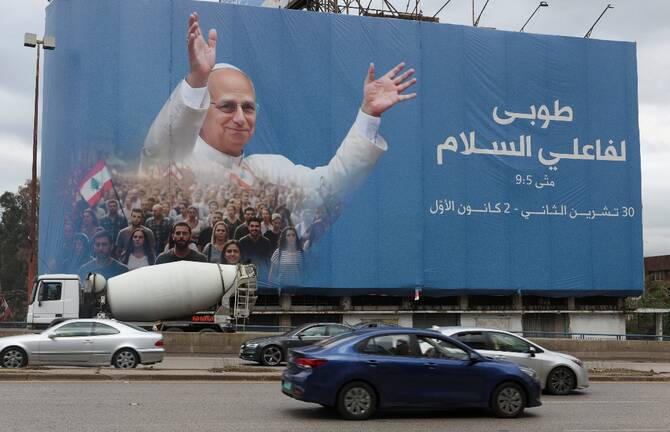
Cars drive past a billboard depicting Pope Leo XIV, ahead of his planned visit to Lebanon, in Beirut, Lebanon. (Reuters)
Short Url
Updated 26 November 2025
Follow

Pope’s visit is a blessing for Lebanon’s forgotten psychiatric patients

  • Established in 1952, the church-run hospital is one of only a few mental health facilities in Lebanon, a country where people diagnosed with psychiatric illnesses can experience social stigma and where state hospitals are severely underfunded

JAL EL DIB: Staff at Lebanon’s De La Croix Psychiatric Hospital are delighted that Pope Leo’s visit will give its carers and residents, often abandoned by their families, recognition at last.
Established in 1952, the church-run hospital is one of only a few mental health facilities in Lebanon, a country where people diagnosed with psychiatric illnesses can experience social stigma and where state hospitals are severely underfunded.
De La Croix is run by nuns from the Franciscan order, who care for around 800 patients. Leo will visit the hospital in Jal el-Dib, north of the capital Beirut, on December 2, the last day of his first trip abroad.
The building is being freshly painted and about 50 patients are practicing for a choir recital in his honor.
“His Holiness the Pope, just by visiting De La Croix Hospital, that’s proof that he cares,” said Sister Rose Hanna.
“There are many families who don’t visit, or people who don’t care about this marginalized group,” she said.

LIVING BY A MIRACLE
The hospital has survived decades of instability in Lebanon but the last six years have been particularly challenging.
Lebanon’s financial collapse emptied state coffers, the COVID-19 pandemic brought extra risks and the last two years of war left De La Croix dependent on what Hanna called “divine providence.”
The Lebanese state gives the hospital $15 per day per patient, but Hanna said it costs $75 daily to fully care for each resident.
“How are we managing to live? I don’t know. We’re living by a miracle,” she said.
Patients painted together in shared rooms, sat quietly in hallways and helped each other climb onto seats. Nurses and nuns laughed with female residents in the corridor.
“It’s a message from the patients that they exist, they are still here, they can be seen and heard,” says Chantal Sarkis, a doctor and vice-coordinator of the visit.
Mother Marie Makhlouf said the Franciscan Sisters were ready to welcome the Pope “with total simplicity.”
“This grace that’s coming to us is going to embrace us, change us, and make us feel that we are not abandoned at a time when we were really struggling,” Makhlouf told Reuters.
“The Pope comes and visits us to tell us — ‘what you are doing is sacred’.”


Lebanon urges UNSC delegation to press Israel to respect ceasefire

Updated 57 min 56 sec ago
Follow

Lebanon urges UNSC delegation to press Israel to respect ceasefire

  • Israel has kept up strikes on Lebanon and has also maintained troops in five south Lebanon areas it deems strategic

BEIRUT: Lebanese President Joseph Aoun urged a United Nations Security Council delegation on Friday to pressure Israel to respect a year-old ceasefire and to support his army’s efforts to disarm Hezbollah.
Despite a November 2024 ceasefire that was supposed to end more than a year of hostilities between Israel and the Iran-backed militant group, Israel has kept up strikes on Lebanon and has also maintained troops in five south Lebanon areas it deems strategic.
Aoun “stressed the need to pressure the Israeli side to implement the ceasefire and withdraw, and expressed his hope for pressure from the delegation,” according to a statement from the presidency.
He also noted “Lebanon’s commitment to implementing international resolutions” and asked the envoys to support the Lebanese army’s efforts to disarm non-government groups.
The Lebanese government ordered its military to fully disarm Hezbollah in August, and the army expects to complete the first phase of its plan by the end of the year.
The UN delegation visited Damascus on Thursday and after its meeting with Aoun was due to inspect the border area in southern Lebanon on Saturday, accompanied by US envoy Morgan Ortagus.
The visit comes as Lebanese and Israeli civilian representatives held their first direct talks in decades.
On Thursday, Information Minister Paul Morcos quoted Aoun calling the initial negotiations “positive” and stressing “the need for the language of negotiation — not the language of war — to prevail.”
That same day, Israel struck four southern Lebanese towns, saying it was targeting Hezbollah infrastructure including weapons depots to stop the group from rearming.
UN peacekeepers called the strikes “clear violations of Security Council resolution 1701,” which ended the 2006 war between Hezbollah and Israel.
The peacekeepers also said their vehicles were fired on by six men on three mopeds near Bint Jbeil on Thursday. There were no injuries in the incident.
“Attacks on peacekeepers are unacceptable and serious violations of resolution 1701,” the international force added.
Hezbollah refuses to disarm but has not responded to Israeli attacks since the ceasefire. It has, however, promised a response to the killing of its military chief in a strike on Beirut’s southern suburbs last month.