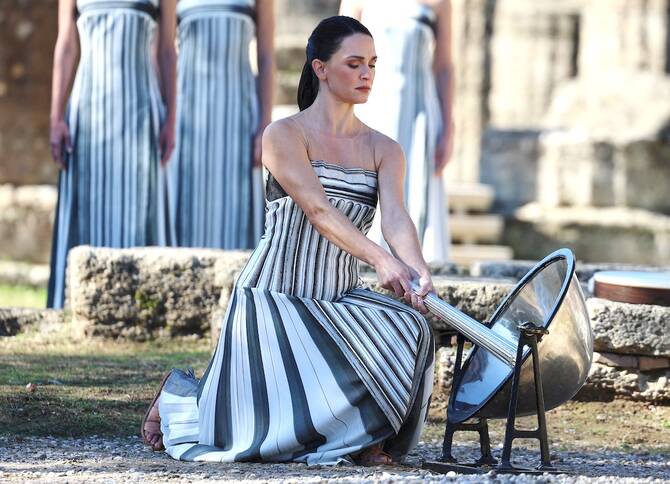
ANCIENT OLYMPIA, Greece: At a temple in Ancient Olympia, a flame is drawn from the sun to begin its journey to the Winter Games. The choreographed ceremony inspired by ancient Greece is designed to link the original games to today’s global competition.
On Wednesday, the flame will be kindled once more for the Milan Cortina 2026 Winter Olympics. From Olympia — birthplace of the ancient games — to Milan’s San Siro Stadium on Feb. 6, the torch will cross Italy’s cities, and cultural landmarks, carried by thousands of relay runners.
Here’s a look at how the ceremony unfolds, the challenges it faces, and where both the Olympic and Paralympic flames will travel in the months ahead.
It’s all about the weather
The first modern Olympic Games were held in Athens in 1896 but the flame was introduced later and only standardized in the 1930s using a method that hasn’t changed since. A concave mirror concentrates sunlight onto the tip of a torch, producing a flame that represents purity and continuity with the Games’ ancient roots.
The main challenge is the weather: No direct sunlight, no flame. Cloudy skies have forced organizers in the past to rely on a backup, a pre-lit flame produced during rehearsals. Copies of the flame are kept handy in a lantern throughout its journey so torches that occasionally go out mid-relay can be discreetly relit.
Protests staged by activists have disrupted past relays, notably ahead of the Beijing Olympics, prompting tighter security. Torch relays after the 2008 Games were limited to Greece and the host country.
A high priestesses and help from Apollo
Central to the lighting ceremony is a meticulously choreographed performance led by the actors and dancers playing the role of a high priestess and her ensemble of priestesses and male kouroi.
The selection of the performers, their costumes and choreography are all inspired by the ancient aesthetic. Practicing for weeks, performers learn to coordinate precise gestures, sculptural poses, and synchronized movements across Ancient Olympia’s uneven ground.
At the culmination of the ceremony, the high priestess calls for a moment of “sacred silence” before the torch is lit. In Greek, she recites an invocation to the ancient gods: “Apollo, god of sun and the idea of light, send your rays and light the sacred torch for the hospitable cities of Milan and Cortina. And you Zeus give peace to all peoples on earth and wreath the winners of the sacred race.”
10,000 torchbearers ready for Italian tour
The flame is carried by a torch relay to the host city, occasionally making a spectacular detour: It’s been taken undersea, beamed into space, and guided to the summit of Mount Everest.
The time, it will tour Greece for a week and spend the night at the Acropolis in Athens before a handover ceremony to Winter Games organizers on Dec. 4 and embarking on an Italian adventure.
Starting in Rome, the 63-day Italian relay will stretch across 12,000 kilometers, pass through 60 cities, cross all 110 provinces, and put a spotlight on dozens of world heritage sites.
Approximately 10,000 torchbearers will participate, leading up to the opening ceremony of the Feb. 6-22 games at San Siro stadium in Milan.
Every Olympics gets its own torch for the relay. The sleek “Essenziale” was crafted in Italy to promote sustainability. Powered by renewable gas, it is built using recycled aluminum and features a bio-based polymer handle.
Wait. There’s another flame?
Parallel to the Olympic journey, the Paralympic flame will begin its own on Feb. 24, 2026 for the March 6-15 Winter Paralympics.
It will be lit at Stoke Mandeville Hospital in England — birthplace of the Paralympic movement. That’s where the first wheelchair athletes’ competition was organized after World War II, an event that inspired the first Paralympic Games held in Rome in 1960.
Over 11 days, the Paralympic flame will cover 2,000 kilometers and will eventually be united with fire produced as Flame Festivals planned in several Italian cities before the opening ceremony at Verona Arena on March 6.


![]()

Praying for the sun: What to know about the flame-lighting ceremony for the Winter Olympics
Short Url
https://arab.news/n3kfg
Praying for the sun: What to know about the flame-lighting ceremony for the Winter Olympics
- On Wednesday, the flame will be kindled once more for the Milan Cortina 2026 Winter Olympics
- From Olympia — birthplace of the ancient games — to Milan’s San Siro Stadium on Feb. 6


Latest updates


Recommended


© 2026 SAUDI RESEARCH & PUBLISHING COMPANY, All Rights Reserved And subject to Terms of Use Agreement.