

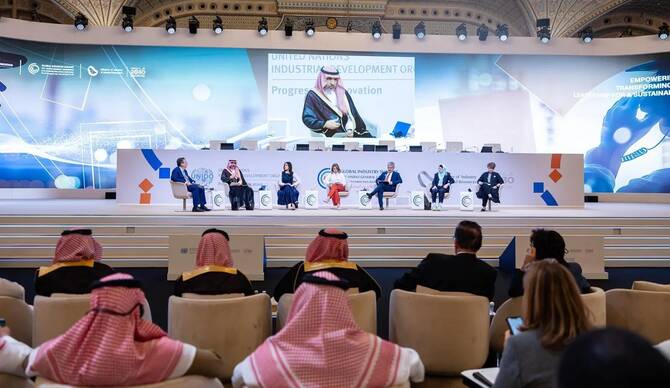

RIYADH: The 21st session of the General Conference of the UN Industrial Development Organization concluded its third day of work in Riyadh, focusing on women’s empowerment and the importance of their role in global industrial transformation, as well as addressing the challenges that limit their participation in various industrial sectors.
In a keynote address delivered by Abdullah Ali Al-Ahmari, assistant minister of industry and mineral resources for planning and development, during a dialogue session entitled “Women’s Empowerment and Industrial Transformation: Leadership for a Sustainable Future,” he emphasized the Kingdom’s commitment to expanding women’s presence in various industrial sectors and enhancing their leadership roles in driving innovation and achieving sustainable industrial development.
Al-Ahmari explained that the Kingdom is working to build a more inclusive and future-oriented industrial environment that empowers women and enhances their participation.
He noted that there are currently more than 100,000 women working in the Saudi industrial sector across more than 12,000 licensed factories.
He added that current efforts focus on rehabilitating and expanding factory capacities, developing industrial infrastructure to accommodate additional female labor, and coordinating with partners in the public and private sectors to rehabilitate and upgrade these facilities.
This includes collaborating with local and international partners committed to supporting women’s empowerment and skills development.
The third day of the Global Manufacturing and Industrialisation Summit commenced with a session titled “Introduction to Women’s Empowerment,” which established a general framework for the role of inclusive industrial policies in creating more equitable working environments for women, particularly in the technology and heavy industrial sectors.
This was followed by a session titled “Ambition and Impact: Women Shaping the Future of Industry,” which explored practical strategies for increasing women’s participation across industrial value chains, alongside discussions focused on promoting resilient industrial development in developing countries.
The conference also featured three concurrent sessions that focused on women’s empowerment at both the national and global levels.
The session titled “Bridging the Gap: Global Challenges and Solutions for Women in Industry” addressed ways to overcome obstacles hindering women’s participation in industry.
The session “Enhancing Women’s Role in Industry: Regional Perspectives with Global Impact – The Saudi and GCC Experiences” explored the Gulf experience as a model for expanding women’s presence in industrial value chains.
The session “From Cotton to Fashion: Promoting Equality Globally Across Value Chains” examined the role of creative industries and supply chains in fostering greater equality across the global economy.
These discussions highlighted the importance of reforming industrial policies, building inclusive leadership pathways, investing in scientific and technical skills, and designing industrial policies that consider the needs of social diversity.
The Saudi experience was also showcased as a replicable model for the region, through a review of national programs that expand women’s participation in the manufacturing, mining, logistics, and advanced technology sectors, in line with the objectives of the Kingdom’s Vision 2030.
The third day of the Global Manufacturing and Industrialisation Summit also featured a session on “Mentoring, Networking, and the Future of Women’s Leadership in Industry.” This session focused on mentoring as a tool to accelerate women’s advancement in industrial career paths and on building cross-border networks that enhance women’s participation in high-growth sectors.
Participants developed practical strategies calling for the expansion of structured mentoring programs, the development of industrial policy frameworks that address women’s needs and strengthen their leadership pathways, and ensuring their representation in industrial decision-making systems at both the national and international levels. This aims to transform gender equality commitments into measurable and implementable programs.
In the closing session, a highlight of the third day, senior officials discussed ways to “mobilize recognition of women’s role in industry” and move from rhetorical pledges to practical mechanisms, including developing performance indicators and documenting replicable success stories in both developing and developed countries.
The third day concluded with the “Orange Hour” event, led by the assistant minister of industry and mineral resources for planning and development. This coincided with the UNIDO Women’s Empowerment Day and the International Day for the Elimination of Violence against Women. Representatives from over 170 countries reaffirmed their commitment to promoting women’s safety, ensuring their equality, and expanding their empowerment across various economic and social sectors.


