

Nigeria announces renewed US security partnership

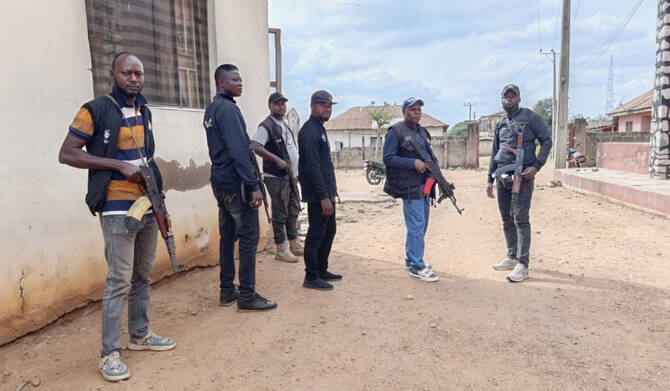
Police officers providing security hold weapons outside the Christ Apostolic Church during a Sunday service held for those killed and kidnapped in an attack by gunmen on November 18, in the town of Eruku, Kwara state, Nigeria, November 23, 2025. (REUTERS)
Short Url
Updated 24 November 2025
Follow

Nigeria announces renewed US security partnership

  • Nigeria has faced militancy in the northeast that has killed more than 40,000 people and displaced around 2 million since it broke out in 2009

LAGOS: Nigerian authorities announced Monday the country had strengthened its “security partnership” with the US, while again rejecting accusations of targeted persecution against Christians in the West African country.
The announcement follows US President Donald Trump’s threats of military intervention in early November over allegations that militants were “killing the Christians and killing them in very large numbers” in Nigeria.
A Nigerian delegation, including the National Security Adviser, Nuhu Ribadu, visited Washington last week to meet with senior US officials to discuss their concerns, according to a statement from Nigeria on Monday.

FASTFACTS

• A Nigerian delegation visited Washington last week to meet with senior US officials to discuss their concerns, according to a statement from Nigeria on Monday.

• While meeting with US officials, Nigerian authorities said they ‘refuted allegations of genocide’ against Christians, ‘emphasising that violent attacks affect families and communities across religious and ethnic lines.’

“Following these engagements, the US government affirmed its readiness to deepen security cooperation with Nigeria,” said the statement from Bayo Onanuga, special adviser to the Nigerian President Bola Tinubu.
He specified that the cooperation includes enhanced intelligence support, expedited processing of defense equipment requests and the “potential provision of excess defense articles.”
While meeting with US officials, Nigerian authorities said they “refuted allegations of genocide” against Christians, “emphasising that violent attacks affect families and communities across religious and ethnic lines,” according to the statement.
“The delegation strongly rejected wrongful framing of the situation, saying such would only divide Nigerians and distort the realities on the ground,” it added.
On Friday, the US Department of Defense said the two parties discussed ways to end violence against Christians and strengthen the fight against militants that has plagued much of the region.
Nigeria has faced militancy in the northeast that has killed more than 40,000 people and displaced around 2 million since it broke out in 2009.
The violence has spilt over into neighboring Niger, Chad and Cameroon, prompting the creation of a regional military force to fight the militants.
Nigeria has also faced violence led by “bandit” gangs in the northwest that commit kidnappings, village raids and killings.
Separately, Nigeria’s president on Sunday reassigned VIPs’ police bodyguards to core policing duties and ordered tens of thousands of new officers to be recruited due to a security crisis, his office said.
Tinubu “has ordered the withdrawal of police officers currently providing security for Very Important Persons,” said a statement from his office, adding that “many parts of Nigeria” are not adequately policed.
It said Tinubu also approved the recruitment of 30,000 additional police officers.
“In view of the current security challenges facing the country, President Tinubu is desirous of boosting police presence in all communities.”
A report published last month by the European Union Agency for Asylum said more than 100,000 of the estimated 371,000-strong force, were “assigned to the protection of politicians and VIPs, rather than to tasks serving the general population.”
“This shortage in manpower, as well as corruption and insufficient resources have resulted in delayed responses to crimes and numerous communities being left without protection,” said the report.


Foreign truckers ‘in God’s hands’ in militant-hit Mali

Updated 3 sec ago
Follow

Foreign truckers ‘in God’s hands’ in militant-hit Mali

KIDIRA: Amath Mboup, a young Senegalese, is haunted by the charred and decomposing bodies of fellow truckers killed by jihadists lying along the highway to the Malian city of Kayes.
Since September, fighters from the Al-Qaeda-linked Group for the Support of Islam and Muslims, known by its Arabic acronym JNIM, have sought to cripple landlocked Mali’s economy and undermine its junta.
They have been blocking and sometimes attacking fuel tankers entering Mali and placing total blockades on certain strategic routes leading to the capital Bamako.
Hundreds of tankers from Abidjan, Ivory Coast’s economic capital, and the Senegalese capital Dakar have been set ablaze.
Dozens of drivers have been killed or kidnapped, particularly on the Kayes-Bamako road in the west of the country, near the border with Senegal.
After waiting two days for routine checks in the Senegalese border town of Kidira, one of the main crossing points between Senegal and Mali, Mboup — who is in his thirties — was preparing to travel onwards to Bamako, his truck loaded with goods.
Alone in the truck, where amulets hang to ward off bad luck, Mboup was apprehensive as he is every time he takes this route.

- ‘Everyone is afraid’ -

“Everyone is afraid to take this road because it’s too risky: You know you’re leaving, but you don’t know if you’ll come back alive,” he told AFP, his face dusty and pale with fatigue.
Malick Bodian, another Senegalese driver, told AFP he is always putting his life “in God’s hands.”
“Your mind is never at peace when you travel this road. You think you could be attacked at any moment,” he said.
Many of the truckers interviewed by AFP said there was no question of quitting their jobs.
“We don’t have a choice. It’s the only job I know how to do to feed my family,” said Mboup, a married father of two.
Behind him, dozens of trucks, engines rumbling, were lined up for several kilometers waiting to leave Senegal for the bumpy Malian roads and all their potential dangers.
Fuel tankers were not among the trucks, however. Last November, JNIM claimed in a propaganda video that all tanker drivers would henceforth be considered “military targets.”
The drivers in line were Senegalese, Malian, Ivorian and Burkinabe and many said they had encountered militants on their journeys.
“They often appear out of nowhere in the forest on motorcycles and are usually wearing turbans and heavily armed,” Malian driver Moussa Traore said.
“When you see them, you’re the one who slows down. Sometimes they stop you to ask for your documents, other times not,” he said.

- Obstacle course -

Mali imports most of its requirements, including fuel, fish, fruit and vegetables, by road from Senegal, Mauritania or Ivory Coast. More than 70 percent of its imports transit through Dakar port.
JNIM is waging a form of “economic jihad” in western Mali, aiming to destabilize the region by “targeting vital logistics routes,” according to a 2025 report by the Timbuktu Institute think tank.
Traveling on certain roads in Mali such as the one to Kayes has become an obstacle course.
“The flow of trucks that used to pass through Kidira is no longer the same,” said Modou Kayere, an official with the West African Truck Drivers Union, which represents some 15 countries.
In late November, Senegalese authorities reported that nearly 2,500 shipping containers filled with goods destined for Mali were blocked at Dakar port due to the security situation.
According to most of the drivers interviewed by AFP, vehicles carrying goods are rarely attacked by militants, unlike fuel tankers.
But the risk is real and the drivers are trying to adapt.
They have decided to stop driving at night and some have even set up alert networks on WhatsApp to warn their peers of danger on the road.