Nigerian defense minister to lead search for kidnapped schoolgirls

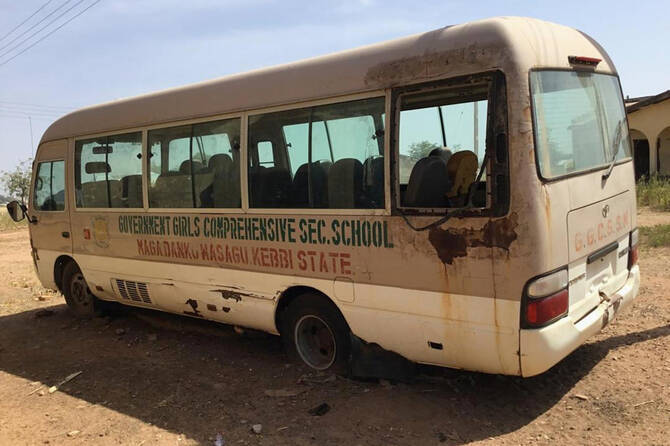
Nigeria’s President Bola Tinubu on Thursday ordered his minister of state for defense to go to western Kebbi state, where two dozen girls kidnapped from their boarding school earlier this week are still missing. (AP/File)
Short Url
Updated 21 November 2025
Follow

Nigerian defense minister to lead search for kidnapped schoolgirls

  • A presidency statement said Matawalle had “experience in dealing with banditry and mass kidnapping“
  • He secured the release of 279 students who had been kidnapped in 2021 in Zamfara state

LAGOS: Nigeria’s President Bola Tinubu on Thursday ordered his minister of state for defense to go to western Kebbi state, where two dozen girls kidnapped from their boarding school earlier this week are still missing.
The order for minister AlHajji Bello Matawalle to “relocate to Kebbi State over the abduction of 24 schoolgirls” came as pressure mounted on the government after US President Donald Trump this month threatened military action over what he described as the killing of Nigeria’s Christians, a narrative rejected by the Nigerian authorities.
A presidency statement said Matawalle had “experience in dealing with banditry and mass kidnapping,” after he secured the release of 279 students aged between 10 and 17 who had been kidnapped from a government secondary school in 2021 in western Zamfara state.
Another state, Kwara, in the east of the country, has ordered some schools shut following a deadly raid on a church on Tuesday, a government official told AFP.
Gunmen stormed a church service in the state on Tuesday, killing at least two people.
Michael Agbabiaka, an elder of the church, told AFP that the attackers fired shots, beat up worshippers and ransacked bags, taking cash and mobile phones.
Speaking by phone, he said 35 people had been abducted by the attackers.
Following the attack, Kwara state government directed the closure of schools in four areas as part of steps to “address recent security breaches,” state government spokesman Ibraheem Abdullateef told AFP.
“This decision was taken to checkmate kidnappers who may want to use schoolchildren as soft targets and human shields amidst a renewed crackdown on their hideouts by the security operatives,” he said.
Nigerian security forces have been placed on high alert, the information minister said this week, as the country faces an uncomfortable spotlight on its security situation.
Tinubu has “postponed” a trip to South Africa for a G20 summit and to Angola for an Africa-EU meeting to receive “security briefings” on the kidnapped schoolgirls and the church attack, his office said.


US allows oil majors to broadly operate in Venezuela, new energy investments

Updated 3 sec ago
Follow

US allows oil majors to broadly operate in Venezuela, new energy investments

  • Treasury Department issues general license allowing Chevron, BP, Eni, Shell and Repsol to operate oil and gas operations in Venezuela
  • Move is the most significant relaxation of sanctions on Venezuela since US forces captured and removed President Nicolas Maduro
WASHINGTON: The US ​eased sanctions on Venezuela’s energy sector on Friday, issuing two general licenses that allow global energy companies to operate oil and gas projects in the OPEC member and for other companies to negotiate contracts to bring in fresh investments. The move was the most significant relaxation of sanctions on Venezuela since US forces captured and removed President Nicolas Maduro last month.
The Treasury Department’s Office of Foreign Assets Control issued a general license allowing Chevron, BP, Eni, Shell and Repsol to operate oil and gas operations in Venezuela. Those companies still have offices in the country and stakes in projects, and are among the main partners of state-run ‌company PDVSA.
The authorization ‌for the oil majors’ operations requires payments for royalties and Venezuelan ​taxes ‌to ⁠go through ​the US-controlled ⁠Foreign Government Deposit Fund.
The other license allows companies around the world to enter contracts with PDVSA for new investments in Venezuelan oil and gas. The contracts are contingent on separate permits from OFAC.
The authorization does not allow transactions with companies in Russia, Iran, or China or entities owned or controlled by joint ventures with people in those countries.
The licenses “invite American and other aligned companies to play a constructive role in supporting economic recovery and responsible investment, ” the US State Department said in a release. Additional authorizations may be issued “as necessary,” it said.
A spokesperson for Chevron, ⁠the only US oil firm currently operating in Venezuela, said the company welcomed ‌the new licenses.
“The new General Licenses, coupled with recent changes ‌in Venezuela’s Hydrocarbons Law, are important steps toward enabling the further development ​of Venezuela’s resources for its people and for advancing ‌regional energy security,” the spokesperson said in a statement.
Eni said it is assessing the opportunities in ‌Venezuela that the authorization opens up.

Oil law reform

The US licenses follow a sweeping reform of Venezuela’s main oil law approved last month, which grants autonomy for foreign oil and gas producers to operate, export and cash sale proceeds under existing joint ventures with PDVSA or through a new production-sharing contract model.
The US has had sanctions on Venezuela since ‌2019 when President Donald Trump imposed them during his first administration. Trump is now seeking $100 billion in investments by energy companies in Venezuela’s oil and gas sector. ⁠US Energy Secretary Chris Wright ⁠said on Thursday, during his second day of a trip to Venezuela, that oil sales from the country since Maduro’s capture have hit $1 billion and would hit another $5 billion in months.
Wright said the US will control the proceeds from the sales until Venezuela stands up a “representative government.” Since last month, the Treasury issued several other general licenses to facilitate oil exports, storage, imports and sales from Venezuela. It also authorized the provision of US goods, technology, software or services for the exploration, development or production of oil and gas in Venezuela.
The Venezuelan government expropriated assets of Exxon Mobil and ConocoPhillips in 2007 under then-President Hugo Chavez. The Trump administration is trying to get those companies to invest in Venezuela as well. At a meeting at the White House with Trump last month, Exxon Mobil CEO Darren Woods said Venezuela was “uninvestable” at ​the moment.
Wright said on Thursday that Exxon, ​which no longer has an office in Venezuela, is in talks with the government there and gathering data about the oil sector. Exxon did not immediately comment.