

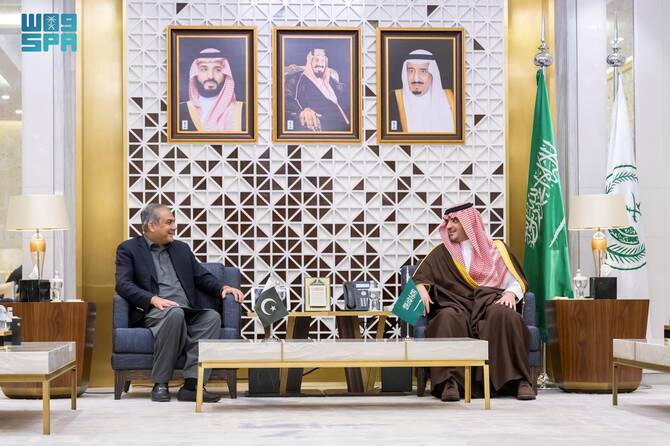
Saudi and Pakistani interior ministers discuss cooperation to combat drug smuggling

1 / 3
Saudi Interior Minister Prince Abdulaziz bin Saud bin Nayef bin Abdulaziz receives Pakistan’s Minister of Interior and Narcotics Control Mohsin Raza Naqvi in Riyadh on Monday. (SPA)
2 / 3
Saudi Interior Minister Prince Abdulaziz bin Saud bin Nayef bin Abdulaziz receives Pakistan’s Minister of Interior and Narcotics Control Mohsin Raza Naqvi in Riyadh on Monday. (SPA)
3 / 3
Saudi Interior Minister Prince Abdulaziz bin Saud bin Nayef bin Abdulaziz receives Pakistan’s Minister of Interior and Narcotics Control Mohsin Raza Naqvi in Riyadh on Monday. (SPA)
Short Url
Updated 24 November 2025
Follow

Saudi and Pakistani interior ministers discuss cooperation to combat drug smuggling

  • Prince Abdulaziz and Naqvi discussed ways to enhance security cooperation between their countries, especially with regard to combating drug smuggling

RIYADH: Saudi Arabia’s Interior Minister Prince Abdulaziz bin Saud bin Nayef bin Abdulaziz received Pakistan’s Minister of Interior and Narcotics Control Mohsin Naqvi in Riyadh on Monday, the Saudi Press Agency reported.

Prince Abdulaziz and Naqvi discussed ways to enhance security cooperation between their countries, especially with regard to combating drug smuggling.

A number of topics of common interest were also discussed, SPA said.


US firm plans world’s first commercial space station

Updated 11 sec ago
Follow

US firm plans world’s first commercial space station

  • Project developed by VAST Space company for 2027
  • Plan for short missions and research in microgravity

RIYADH: A US firm plans to launch the world’s first commercial space station for astronauts in 2027, the company’s CEO said at a Riyadh conference.

VAST Space’s CEO Max Haot outlined the company’s plans for the Haven-1 station at the Space Debris Conference 2026, the Saudi Press Agency reported on Wednesday.

Haot explained that Haven-1 represents the first phase of a long-term vision to develop commercial space stations, which will support a sustainable human presence in low Earth orbit.

This is in line with the global transition toward commercial operating models as the International Space Station approaches the end of its operational life, expected at the end of 2030.

The ISS, a partnership between NASA and the Russian, European, Japanese and Canadian space agencies, was first launched into orbit in 1998.

Haven-1 is designed to host a crew of four astronauts on short-duration missions, while supporting scientific research, technology demonstrations and commercial applications in a microgravity environment.

Haot added that the station’s design places strong emphasis on safety and sustainability, including the integration of debris protection systems, as well as dedicated processes for safe deorbiting.

The company aims to achieve operational revenues through four crewed missions, supported by scientific and commercial payloads and strategic partnerships, from 2027 to 2030.

Haot expressed confidence in his company’s progress and testing during 2025.