

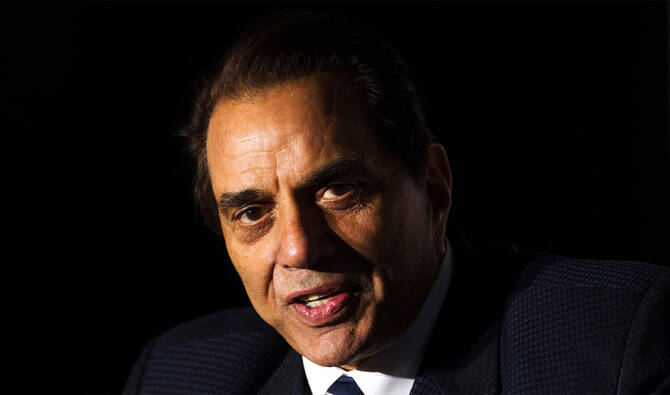

NEW DELHI: Dharmendra, one of Indian cinema’s most popular stars whose versatile performances made him a defining screen presence of 1970s and 1980s Bollywood films, died Monday. He was 89.
The actor, who would have turned 90 on Dec. 8, had been in and out of a hospital in the financial capital, Mumbai, over the past few weeks.
A senior police official who had spoken to Dharmendra’s doctor confirmed the death on condition of anonymity. Prime Minister Narendra Modi offered his condolences, saying the actor’s death marks the end of an era in Indian cinema.
“He was an iconic film personality, a phenomenal actor who brought charm and depth to every role he played. The manner in which he played diverse roles struck a chord with countless people,” Modi said on social media platform X.
Often called Bollywood’s “He-Man,” Dharmendra combined the old-school heroism of an action star with the tenderness of a romantic lead, making him one of India’s most iconic actors. Though most of his fame came from roles in which he embodied the archetype of a larger-than-life hero — upright, patriotic and fearless — his charming performances in romantic hits equally made him popular with the masses.
Dharmendra’s performance in “Sholay” (1975) — Bollywood’s take on the Spaghetti Western and regarded as one of India’s greatest films — earned him enduring popularity. His roles in other Hindi-language hits, from the romantic comedy “Chupke Chupke” (1975) to the action drama “Mera Gaon Mera Desh” (1971), made him one of the most recognizable film faces from that era.
His role in Bollywood classic “Sholay,” where he played an affable character alongside Amitabh Bachchan, his co-actor in the film, cemented his status as a superstar. The duo’s on-screen partnership also became one of Bollywood’s most iconic pairings.
His on-screen chemistry with actress Hema Malini, whom he later married, became one of Bollywood’s most popular collaborations, as the pair acted together in more than two dozen films. But their union was rooted in scandal. Dharmendra had married Prakash Kaur before his film debut, and went on to have four children with her, including two who would follow in his acting footsteps — Sunny Deol and Bobby Deol.
Despite his marriage to Malini in 1980, he reportedly never divorced Kaur and continued to live with her. According to local media reports, he briefly converted to Islam before marrying Malini as Indian law disallows Hindus to marry twice, especially if their spouse is alive.
Dharmendra and Malini had two daughters, including Bollywood actor Esha Deol. His nephew, Abhay Deol, also joined the industry.
Later in his career, Dharmendra moved to more character-driven roles, frequently portraying paternal figures in the 1990s and 2000s in a career that continued through 2025. He was last seen in war biopic film “Ikkis.”
“I never thought I would come this far,” he said in a 2021 interview with Indian news website Rediff.
Born Dharmendra Kewal Krishan Deol in India’s northern state of Punjab in 1935, he grew up in a farming family and moved to Mumbai in the late 1950s, making his Bollywood debut in 1960. Over a career spanning six decades, he acted in more than 300 films.
In 2012, Dharmendra was awarded the Padma Bhushan, India’s third-highest civilian honor, in recognition of his contribution to Indian cinema. He also briefly turned to politics, serving as a Bharatiya Janata Party lawmaker in Parliament from 2004 to 2009, though his political stint was short-lived.
Dharmendra is survived by his wives, children and grandchildren.


