


PESHAWAR: STEMvese, a Pakistani educational institution teaching robotics and Science, Technology, Engineering and Mathematics (STEM) education to children, hopes to promote inclusive and non-traditional learning across classrooms in the Middle East region with the help of Palestinian company Mufakker, the institution’s founder said this week.
Headquartered in the northwestern city of Peshawar, STEMverse says it has trained more than 2,500 students in robotics and STEM education. The institution says it has partnered with over ten schools in Pakistan so far to promote STEM education in the country.
Mufakker, meanwhile, is a Palestinian company that specializes in the design and production of educational tools tailored to the abilities and needs of children with autism, Down syndrome and learning difficulties.
STEMverse founder and CEO Mashaal Jawad met Mufakker founder Maali Diab at the GITEX Global 2025 event held in Dubai last month. Both companies inked a memorandum of understanding to exchange expertise in robotics and STEM education to promote non-traditional learning in classrooms.
“The hope is for both companies to expand into these regions,” Jawad told Arab News on Friday, “If their (Muffaker’s) expertise is in the language department, I’d be more than happy to have their games being used here to teach us things like Urdu or English, even regional languages like Pashto, Sindhi and Punjabi.”
STEMverse, on the other hand, hopes to expand into these regions and help people who have autism, Down syndrome and other learning difficulties get access to STEM education, Jawad said.
Jawad pointed out that Mufakker specializes in creating educational games for people with learning disabilities because “the traditional classroom is not well equipped for them.”
“I’m partnering with them to actually bring that sort of technology and that sort of input into our classrooms here,” the STEMverse CEO added.
The collaboration will blend Muffaker’s language-based learning tools with STEMverse’s technical and engineering content, Jawad said.
“We’re working on making content that can be transformed into games that will benefit them from learning STEM and technical education all through games as well,” she pointed out.
Jawad said she generated several leads at GITEX Global 2025, helping her promote STEM education in the Middle East region.
“I’m now in talks with multiple schools in Dubai and Saudi Arabia who are particularly interested in having our content run in their schools,” she said.
‘COMPLETELY NEW THING’
STEMverse works through three models. In the first model, it partners with schools and teaches STEM as a formal subject like other curriculums.
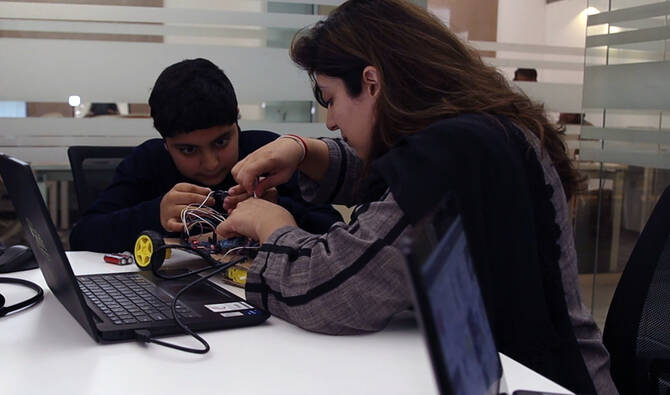
“What we have is a year-long curriculum that our trainers and my engineers go into schools and they teach all of this through hands-on robotic kits, virtual tools and 3D printers,” she explained.
The second model brings children to STEMverse campuses for after school programs that focus on hands-on innovation. Besides Peshawar, the institute has a campus in Islamabad.
She said children at these campuses, some of them as old as eight, are building products for people to buy. One student is currently building an automatic beverage machine that combines tea and coffee, Jawad said.
The third model aims to reach underserved areas by developing a gamified mobile app that teaches robotics, AI, 3D modelling and more.
“It’s harder for us to reach these underserved areas but most people have smartphones,” Jawad said. “So what we’ve done is we’ve gamified STEM.”
Maheen Arshad, who has graduated in Industrial Engineering, works with STEMverse as a science communicator. According to her, STEM education is popular among children.
“The children are obviously really excited because it’s a completely new thing to them and parents also love it,” she said.
“It takes a bit of time for them to adjust to this new concept of STEM education, but once they see the results and the projects that the children made themselves, they’re quite ecstatic about it.”
Musa Mustafa, 11, is a student of the Edex School in Peshawar and has been enrolled in one of the STEMverse’s programs, called ‘Maker’s Club.’ He has been building a robot for the past three months that will help carry food, water or any other object.
Once finished, users will be able to control the robot via an application on their laptops or phones, Mustafa said.
“I wanted to help my grandparents since they can’t move that much,” Mustafa said. “So I made this robot.”


