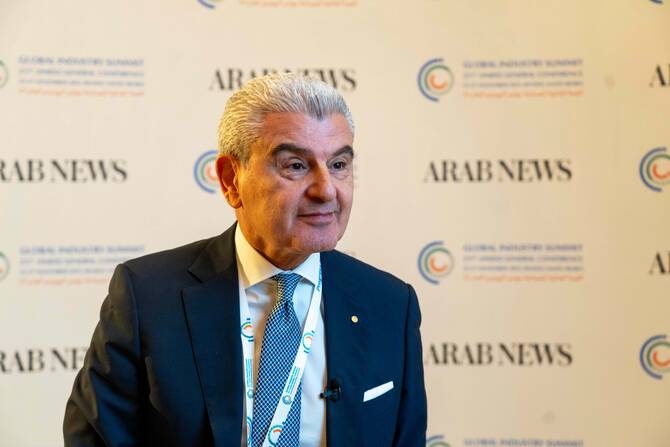

RIYADH: Lebanon’s Minister of Industry Joe Issa El-Khoury outlined his new strategy for industrial growth at an event in Riyadh on Sunday.
Speaking to Arab News at the 21st General Conference of the UN Industrial Development Organization, El-Khoury explained that in the next five to 10 years, his strategy focuses on three pillars: tracking global trends in industry; taking account of the competitive advantages of Lebanon; and looking into liabilities.
One notable sector is the agricultural industry, which the minister described as “quite strong” in Lebanon.
“Lebanese food and cuisine … represent close to 40 percent of our exports.”
Lebanon is also home to many machinery companies, the minister said, including companies that develop and sell factory machinery to multinational companies such as L’Oreal and Nestle.
One example is Multilane, a leading company in Lebanon in high-speed data center solutions, which has been designing, manufacturing and selling equipment to companies in the US such as Nvidia, Cisco, Apple, MIT, Facebook and more.
El-Khoury also mentioned two young founders in their late 20s who design and manufacture robots for BMW and Volkswagen in Lebanon.
The next generation of innovators, El-Khoury said, are possibly the country’s greatest asset.
“I would say industrial technology is also one major focus for us because despite all the crises that Lebanon has been going through and the wars … one thing that was, thank God, not hit, was the level of education.
“We have so many young girls and young boys who are extremely well educated.
“So instead of shipping them away to develop their ideas, we’re now trying to keep them home so that they would do their startups back home,” he said.
The minister also emphasized plans and policies to be put in place to protect the country’s other resources, namely water and electricity.
“We don’t have water scarcity. We have a lot of water, but in Lebanon we’ve been misusing the water,” he said.
The ministry of energy and water is implementing the National Water Sector Strategy 2024-35, a plan that aims to enhance water security, improve public services, create sustainable utilities and promote good governance.
Additionally, Lebanon’s average cost of electricity production is about $0.25 per kilowatt hour, “which is humongous” compared to neighboring countries.
“Industrialists in Lebanon do not compete only with industrialists in Lebanon, they compete with industrialists in Turkiye, Saudi, Egypt or Europe.”
The cost of electricity from private generators for Lebanese industrialists is approximately 30 cents per kilowatt hour, about five times the numbers in Turkiye, Saudi Arabia and Egypt.
“So we need to reduce the cost of production so that Lebanese products can become very competitive.”
Another objective of El-Khoury’s national industrial strategy is to reduce the trade deficit, which historically stands at an average of minus $15 billion per year.
Reducing that number will require boosting exports on one hand and developing import-substitute products in Lebanon on the other.
“I always say, God blessed us with a beautiful country. We have mountains, we have a lot of land, we have water.
“We have sea and sun and you name it. And we’ve been ruining it.
“Now it’s time to take care of our environment.”
One of the ways to do that, he said, is by moving from waste treatment to the industrialization of waste: 60 percent to 65 percent of waste in Lebanon is organic — waste that can be extracted, recycled, and composted to organic material that can be used for agriculture and gas.
Of other waste, 30 percent to 35 percent is cardboard, plastic, or glass materials that can be recycled; and only the remaining 5 percent to 10 percent is dumped.
Developing recycling practices is where UNIDO comes in, El-Khoury said.
“We’re putting in place all these policies in order to encourage that development. And we're doing a lot with UNIDO to actually engage in the recycling of these materials.
“We think that green energy, the green economy, is key for everybody. So, we need to clean the planet.”