

Individuals could be ‘wrongly’ criminalized after Palestine Action ban, UK Home Office official warns

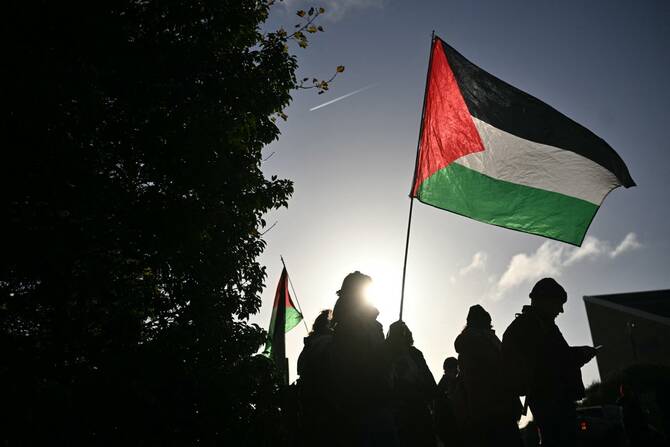
Supporters of alleged Palestine Action activists accused of breaking into Israeli-based defence firm Elbit Systems’ site in Bristol in August 2024, hold placards and wave Palestinian flags outside Woolwich Crown Court in south east London, where the activists are due to stand trial, Nov. 17, 2025. (AFP)
Short Url
Updated 23 November 2025
Follow

Individuals could be ‘wrongly’ criminalized after Palestine Action ban, UK Home Office official warns

  • Co-founder of Palestine Action Huda Ammori is suing former Home Secretary Yvette Cooper this week for her decision to designate the group under anti-terror laws in July
  • Individuals supporting Palestine advocacy, but not Palestine Action, are wrongly labeled as extremists, and supporters of Palestine Action are referred to Prevent despite posing no threat, an official says

LONDON: The ban on Palestine Action has led to people in the UK being wrongly labeled as extremists, and the anti-terrorism Prevent program risks being overwhelmed, a member of the Home Office’s homeland security group has warned.

Prevent duty, established in 2015, mandates certain British authorities, such as education and health, to report concerns about individuals who are vulnerable to radicalization.

The official, who works closely with Prevent, told The Guardian that the proscription of Palestine Action has confused counterterrorism police, officials, schools, and hospitals. They expressed concern that individuals supporting Palestine advocacy, but not Palestine Action, are wrongly labeled as extremists, and that supporters of Palestine Action are referred to Prevent despite posing no threat.

Co-founder of Palestine Action Huda Ammori is suing former Home Secretary Yvette Cooper this week for her decision to designate the group under anti-terror laws in July.

“I’m concerned about a surge in referrals to the Prevent system that might have a link to Palestine advocacy in light of the fact that this very high-profile group is now proscribed, and the confusion there might be on the frontline in schools and healthcare settings and all the other places that are expected to make Prevent referrals.

“I’ve heard senior counterterrorism police people say that they are already seeing on the frontline concerns about this come up and I’m aware of testimonies from Prevent leads at local authorities where they are also concerned about the impact of this on their area and confusion about whether certain cases should be referred to Prevent or not.”

Referrals to the anti-terrorism program rose by 27 percent in the year to March 2025, marking the highest number since records began. The official also expressed concerns that Prevent could be “overwhelmed” by referrals related to Palestine Action.

“We have already seen police officers, let alone frontline Prevent practitioners, mistakenly arrest or interfere with people for supporting Palestine, not supporting Palestine Action.

“There is a risk that what’s now the crime of support for Palestine Action might lead to the Prevent system becoming an unwitting sort of gateway for people to mistakenly be criminalized, especially young people who don’t know the law and they don’t know the consequences of expressing what might sound like — or may actually be — support for a group that, overnight, has become proscribed.”

The official who spoke to The Guardian expressed concern that the ban had undermined the credibility of essential counterterrorism efforts.

“The proscription has damaged trust in the government more widely and Prevent specifically — so potentially eroding Prevent’s effectiveness to tackle the real issues even further,” they said.

A spokesperson for the Home Office said: “We do not comment on anonymous briefings.

“Supporting Palestine is not the same as supporting a proscribed terrorist organization. There are many lawful ways to express support for Palestinian rights and sovereignty without being a member of, or associated with, this harmful group.”

Palestine Action was banned after an alleged attack on two planes at RAF Brize Norton in June, causing £7 million ($9.3 million) in damage, for which five members face vandalism charges. Moreover, 24 individuals face charges over a break-in at the UK site of the Israel-based defense firm Elbit Systems in Bristol that occurred in August.

Supporting Palestine Action is now a criminal offense in the UK, punishable by up to 14 years in prison.


Ukraine businesses struggle to cope as Russian attacks bring power cuts and uncertainty

Updated 2 sec ago
Follow

Ukraine businesses struggle to cope as Russian attacks bring power cuts and uncertainty

KYIV: It is pre-dawn in the historic Podil district of the Ukraine capital, Kyiv, and warm light from the Spelta bakery-bistro’s window pierces the darkness outside. On a wooden surface dusted with flour, the baker Oleksandr Kutsenko skilfully divides and shapes soft, damp pieces of dough. As he shoves the first loaves into the oven, a sweet, delicate aroma of fresh bread fills the space.
Seconds later the lights go out, the ovens switch off and darkness envelops the room. Kutsenko, 31, steps outside into the freezing night, switches on a large rectangular generator and the power kicks back in. It’s a pattern that will be repeated many times as the business struggles to keep working through the power outages caused by Russia’s bombing campaign on Ukraine’s energy grid.
“It’s now more than impossible to imagine a Ukrainian business operating without a generator,” said Olha Hrynchuk, the co-founder and head baker of Spelta.
The cost of purchasing and operating generators to overcome power outages is just one of many challenges facing Ukrainian businesses after nearly four years of war. Acute labor shortages due to mobilization and war-related migration, security risks, declining purchasing power and complicated logistics add to the pressure, officials say.
Hrynchuk, 28, opened the bakery 10 months after Russia launched its full-scale invasion in 2022. That winter was the first year Russia targeted Ukraine’s energy system. Hrynchuk says they barely know what it is to work under “normal” conditions, but have never faced the challenges they do now.
Production is entirely dependent on electricity and the generator burns about 700 hryvnias ($16) worth of fuel per hour.
“We run on a generator for 10 to 12 hours a day. You have no fixed schedule — you have to adapt and refuel it at the same time,” Hrynchuk said.
‘Operate at a loss’
Olha Nasonova, 52, who is head of the Restaurants of Ukraine analytical center, says the industry is experiencing its most difficult period of the past 20 years.
While businesses were prepared for electricity cuts, no one expected such a cold winter and it’s been especially tough for small cafés and family-run establishments, because they have the least financial resources.
The “Best Way to Cup” project, which has two venues and roasts and grinds its own coffee, is on the brink of permanent closure. Co-founder Yana Bilym, 33, who opened the cafe in May, said a Russian attack shattered all its windows and glass doors in August. Bilym said the cost of renovation was 150,000 hryvnias (about $3,400), half of which she financed with a bank loan that she only recently finished repaying.
Last month, after several consecutive large-scale Russian attacks on the energy sector, her entire building lost its water supply, and soon after the sewer system stopped working.
“We were forced to close. We believe it’s temporary. Businesses in December and January, unfortunately, operate at a loss,” Bilym said.
Now she has to regularly check the coffee machine and the specialty refrigerators, which she fears may not withstand the cold. Bilym hopes the closure is short-term. Her husband volunteered to serve in the military on the front line and she wants him to have somewhere to come back to when he returns to civilian life.
Generators are expensive to run
Many businesses have become a lifeline for communities struggling with plunging temperatures. Ukraine’s government has allowed some firms to operate during curfew hours in the energy emergency as “Points of Invincibility,” allowing access to free electricity to charge phones and power banks, drink tea and have some respite from the cold.
Tetiana Abramova, 61, is a founder of the Rito Group, a clothing company that has been producing designer knitwear for men and women since 1991, the year Ukraine became independent.
It participates in Ukraine Fashion Week, the country’s biggest fashion show, and exports garments to the United States. Abramova took out a loan in 2022 to purchase a powerful 35-kilowatt generator costing 500,000 hryvnias ($11,500) to keep the business running during blackouts and a wood-fired boiler for heating.
“At work we have heat, we have water, we have light — and we have each other,” she said.
But it’s not easy. Operating on generators is 15 percent–20 percent more expensive than using regular electricity. As a result, production costs are currently about 15 percent higher than normal. Added to that, customer numbers have dropped by about 40 percent as many people have left the country, so the focus is now on attracting new clients through online sales.
“Profitability has fallen by around 50 percent, partly due to power outages,” she said. “This affects both the volume and efficiency of our work. We simply cannot operate as much as we used to.”
‘Main goal is to survive’
A macroeconomic forecast by the Kyiv School of Economics for the first quarter of 2026 says strikes on the energy system are currently the most acute short-term risk to the country’s GDP. The analysis says if business manages to adapt, output losses could be limited to around 1 percent or 2 percent of GDP. But if the energy system failures are prolonged it could lead to larger losses, of as much as 2 percent or 3 percent of GDP.
Abramova, an entrepreneur with more than 30 years of experience, says she spent nearly 100,000 hryvnias ($2,300) over two months on generator servicing to maintain production. But she cannot pass all those costs on to retailers.
“For us now, the main goal is not to be the most efficient, but to survive,” Abramova said.