

Smaller EU nations push for greater Africa role

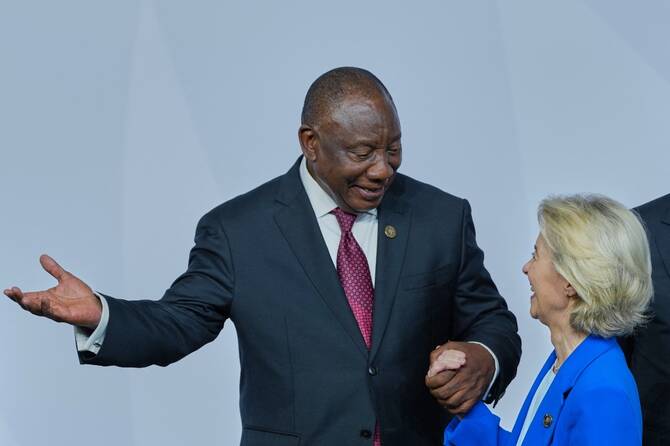
South African President Cyril Ramaphosa speaks with EU Commission President Ursula Von der Leyen at the G20 Summit in Johannesburg, South Africa. (AFP)
Short Url
Updated 23 November 2025
Follow

Smaller EU nations push for greater Africa role

  • Africa has emerged as a renewed diplomatic battleground in recent years, with China, the United States and Russia competing for its minerals, energy potential and political support

JOHANNESBURG: From Finland opening diplomatic outposts in Senegal to Czech instructors training Mauritanian security forces, a group of smaller European nations has joined a global scramble for influence in Africa.
Estonia, Romania and Malta are among European Union countries that have sought to boost their presence on the continent over the past five years, revamping diplomatic and trade links.
“There is a wave of second-generation Africa policy refreshes completed and... underway,” said Alex Vines of the European Council on Foreign Relations.
“It shows the growing importance of Africa across the EU including for its smaller member states.”
Africa has emerged as a renewed diplomatic battleground in recent years, with China, the United States and Russia competing for its minerals, energy potential and political support.
The EU styles itself as the continent’s “leading partner” in areas ranging from trade to security, a role it will try to reinforce at a summit with the African Union in Angola on Monday and Tuesday.
Yet it has suffered setbacks at times, fueled by resentment at the West’s colonial past, with China securing strategic resources in some countries and Russia taking over as preferred security partner in others.
Burkina Faso, Niger and Mali have, for example, turned to the Kremlin for support after cutting ties with France following a string of military coups.

- ‘Back in the game’ -

This has led to a strategic rethink in many corners of the 27-nation EU.
“We needed to somehow get back into the game,” a European diplomat told AFP.
Some EU nations with no former empires have sought to use their history — and in some cases their past domination by Russia — as an asset to establish relations seen as egalitarian, not top-down.
“We are not seen as the big oppressor from the past telling them to do this thing or the other,” said a second diplomat speaking on condition of anonymity.
Estonia’s painstaking transition from ex-Soviet republic to EU member has helped it find some common ground with African nations, said Daniel Schaer, the Baltic country’s ambassador to Kenya and South Africa.
“In the ‘90s, we had all of these advisers coming to tell us how we should do things. So I think our advice is in some ways fresh,” he said.
Similarly, Kaarina Airas, who is in charge of Africa policy at Finland’s foreign ministry, said her country’s struggle for independence has helped generate goodwill.
“Our African partners want trade, they want political relations with us and not only development aid,” she told AFP.
After a policy review in 2021, Finland opened a new embassy in Senegal, followed by Sweden and Denmark, and is aiming to double trade with Africa by 2030.
Estonia has deployed its tech expertise to digitalize private and public services from Namibia to Uganda, while Hungary has gained a foothold in Chad, opening a humanitarian aid center and a diplomatic mission in the capital, with plans to launch a military mission to train local forces.
Such efforts often pursue national political and business interests, from fighting Islamist militants to curbing migration and winning contracts for local firms.
But they have allowed the EU to diversify its offer at a time when African nations have no shortage of suitors.

- ‘A good path’ -

Whether that will pay dividends remains to be seen, said Geert Laporte of ECDPM, a European think-tank.
Some initiatives experienced teething problems as a few countries started their new engagements almost from scratch or with limited resources.
As Estonia still has only one embassy in Africa — in Egypt — Schaer said he spends about half his time traveling.
And Airas said it has taken some time for Finnish businesses to build knowledge and opportunities in Africa, as many — aside from telecoms group Nokia — had practically no experience there.
Trade figures show encouraging signs for the inroads made by smaller EU nations.
While still a small fraction of Europe’s total, Estonia’s trade in goods with the continent has almost doubled since 2019, while Hungary’s was up 35 percent over the same period, EU figures show.
The Czech Republic, Finland and Denmark, have also seen significant increases, albeit at a slower pace than the 25 percent recorded by the EU as a whole.
“We are on a good path,” said Airas.


Pakistani fighter jet crashes in Jalalabad, pilot captured: Afghan military, police

Updated 28 February 2026
Follow

Pakistani fighter jet crashes in Jalalabad, pilot captured: Afghan military, police

  • Fighting between Pakistan and Afghanistan’s Taliban military entered its third day on Saturday
  • Pakistan’s strikes on Friday hit Taliban military installations and posts, including in Kabul and Kandahar

JALALABAD: A Pakistani jet has crashed in Jalalabad city and the pilot captured alive, the Afghan military and police said Saturday, with residents telling AFP the man parachuted from the plane before being detained.
"A Pakistani fighter jet was shot down in the sixth district of Jalalabad city, and its pilot was captured alive," police spokesman Tayeb Hammad said.
Wahidullah Mohammadi, spokesman for the military in eastern Afghanistan, confirmed the Pakistani jet was downed by Afghan forces "and the pilot was captured alive".

The AFP journalist heard a jet overhead before blasts from the direction of the airport in Jalalabad, the capital of Nangarhar province, which sits on the road between Kabul and the Pakistani border.

Fighting between Pakistan and Afghanistan’s Taliban military entered its third day on Saturday, following overnight clashes as the international community expressed increasing concern about the conflict and called for urgent talks.

Pakistan’s strikes on Friday hit Taliban military installations and posts, including in Kabul and Kandahar, in one of the deepest Pakistani incursions into its western neighbor in years, officials said.

Islamabad accuses the Taliban of harboring Tehreek-e-Taliban Pakistan (TTP) militants, who it claims are waging an insurgency inside Pakistan, a charge the Taliban denies.

Pakistan described its actions as a response to cross-border assaults, while Kabul denounced them as a breach of its sovereignty, saying it remained open to dialogue but warned any wider conflict would result in serious consequences.

The fighting has raised ‌the risk ‌of a protracted conflict along the rugged 2,600-kilometer frontier.

Diplomatic efforts gathered ‌pace ⁠late on Friday ⁠as Afghanistan said its foreign minister, Amir Khan Muttaqi, spoke by telephone with Saudi Arabia’s Prince Faisal bin Farhan about reducing tensions and keeping diplomatic channels open.

The European Union called for both sides to de-escalate and engage in dialogue, while the United Nations urged an immediate end to hostilities.

Russia urged both sides to halt the clashes and return to talks, while China said it was deeply concerned and ready to help ease tensions.

The United States supports Pakistan’s right to defend itself against attacks by ⁠the Taliban, a State Department spokesperson said.

Border fighting continues

Exchanges of fire continued along ‌the border overnight.

Pakistani security sources said an operation dubbed “Ghazab Lil Haq” was ongoing and that Pakistani forces had destroyed multiple Taliban posts and camps in several sectors. Reuters could not independently verify the claims.

Both sides have reported heavy losses with conflicting tolls that Reuters could not verify. Pakistan said 12 of its ‌soldiers and 274 Taliban were killed while the Taliban said 13 of its fighters and 55 Pakistani soldiers died.

Taliban deputy spokesman Hamdullah Fitrat ⁠said 19 civilians were ⁠killed and 26 wounded in Khost and Paktika. Reuters could not verify the claim.

Pakistan’s Defense Minister Khawaja Muhammad Asif said “our cup of patience has overflowed” and described the fighting as “open war,” warning that Pakistan would respond to further attacks.

Taliban Interior Minister Sirajuddin Haqqani said in a speech in Khost province that the conflict “will be very costly,” and that Afghan forces had not deployed broadly beyond those already engaged.

He said the Taliban had defeated “the world, not through technology, but through unity and solidarity,” and through “great patience and perseverance,” rather than superior military power.

Pakistan’s military capabilities far exceed those of Afghanistan, with a standing army of hundreds of thousands and a modern air force.

In stark contrast, the Taliban lacks a conventional air force and relies largely on light weaponry and ground forces.

However, the Islamist group is battle-hardened after two decades of insurgency against US-led forces before returning to power in 2021.