Pakistan rout Sri Lanka by 7 wickets in tri-series game

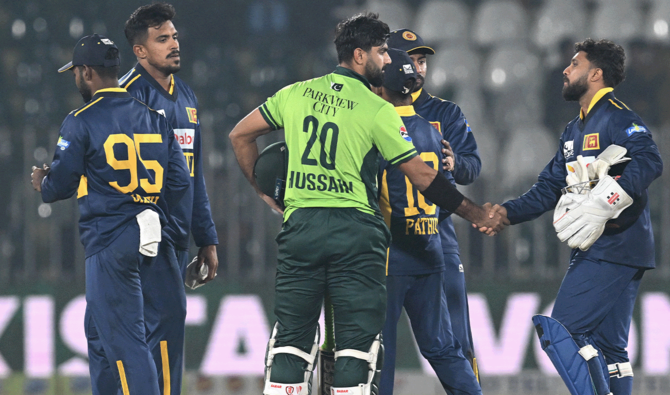
Pakistan's Hussain Talat (center) shakes hands with Sri Lanka's captain Kusal Mendis (right) at the end of the third one-day international (ODI) cricket match between Pakistan and Sri Lanka at the Rawalpindi Cricket Stadium, in Rawalpindi, on November 16, 2025. (AFP/File)
Short Url
Updated 22 November 2025
Follow

Pakistan rout Sri Lanka by 7 wickets in tri-series game

  • Sri Lanka got limited to 128-7 after captain Dasun Shanaka won the toss, elected to bat
  • Farhan’s blistering knock with five sixes, six boundaries sealed a second win for Pakistan

RAWALPINDI: Sahibzada Farhan bludgeoned a career-best unbeaten 80 off 45 balls as Pakistan routed struggling Sri Lanka by seven wickets in the T20 tri-series on Saturday.

Sri Lanka, which lost its opening game against Zimbabwe by 67 runs after getting bowled out for 95, got limited to 128-7 after captain Dasun Shanaka won the toss and elected to bat.

Farhan’s blistering knock that featured five sixes and six boundaries sealed a second successive win for Pakistan in just 15.3 overs as the home team cruised to 131-3.

Sri Lanka’s white-ball tour to Pakistan saw them losing the ODI series 3-0 against the hosts and their batters continued to struggle in the T20 format in the first two games of the tri-series.

“It was a complete game, we were very good with both bat and ball,” Pakistan captain Salman Ali Agha said. “We always wanted to start well, and he’s (Farhan) someone who if he bats for three to four overs, he can take the game away from any opposition.”

Kamil Mishara (22) got Sri Lanka going in the first three overs against the pace of Mohammad Wasim after Shaheen Shah Afridi was ruled out from Saturday’s game due to a foot injury.

But Sri Lanka lost its way inside the power play when Mishara was deceived by a slower ball from Faheem Ashraf and holed out at mid-on and Kusal Mendis was run-out while going for a needless second run.

Left-arm spinner Mohammad Nawaz (3-16) and leg-spinner Abrar Ahmed (1-28) then squeezed Sri Lanka in the middle overs and picked up wickets with regular intervals as they slipped to 80-5 in 12 overs.

Nawaz struck off successive deliveries when he clean bowled Kusal Perera with a sharp turning delivery that spun back into the left-hander and then Shanaka couldn’t read another turning ball as his leg stump was knocked back by the left-armer.

Wasim picked up a smart juggling catch of Kamindu Mendis on the edge of the boundary at mid-wicket in Nawaz’s final over and Sri Lanka tailenders struggled to accelerate in the death overs against the pace.

Wasim and Mirza bowled to tight lengths and allowed Sri Lanka to score only 37 runs off the final five overs with Janith Liyanage showing some resistance by scoring unbeaten 41 off 38 balls.

Farhan showed aggressive intent from the onset in the run chase and provided Pakistan a brisk start of 47 runs in five overs before Shanaka had Saim Ayub (20) stumped.

But Farhan didn’t hold back and dominated a 69-run stand off 52 balls with Babar Azam (16) by playing attractive shots on both sides of the wickets and raised his half century off 33 balls.

Fast bowler Dushmantha Chameera (2-29) got two late wickets when he uprooted the off stump of Babar and then had captain Salman Ali Agha trapped leg before wicket of a ball that caught the batter on the backfoot.

Farhan then finished off the game with a straight six of Malinga and also surpassed his previous best T20 score of 74.

“We aren’t a team that should perform like this, we’re better than this,” Shanaka said. “We feel very bad today ... since we arrived here we have struggled to find rhythm batting in these pitches. We need to work on that a bit, but I’m sure we’re a better team than this.”

Pakistan, which has won both its league games, next plays against Zimbabwe on Sunday.


Pakistan raises India's suspension of water-sharing treaty with UNGA president, seeks action

Updated 15 February 2026
Follow

Pakistan raises India's suspension of water-sharing treaty with UNGA president, seeks action

  • New Delhi said in April last year it was holding the treaty in abeyance after a gun attack in Indian-administered Kashmir
  • Official says such actions threaten lives of 240 million Pakistanis, particularly at a time of climate stress, water scarcity

ISLAMABAD: Pakistan has taken up India’s suspension of a decades-old water-sharing treaty with the president of the United Nations General Assembly (UNGA), urging action over the move that Islamabad said sets "dangerous precedents."

The Indus Waters Treaty (IWT) divides control of the Indus basin rivers between the two nuclear-armed neighbors. India said in April last year it would hold the treaty “in abeyance” after a gun attack in Indian-administered Kashmir killed more than 26 tourists. New Delhi blamed the assault on Pakistan, Islamabad denied it.

The attack led to a four-day military conflict between the neighbors last May that say them attack each other with fighter jets, missiles, drones and artillery before the United States-brokered a ceasefire. Tensions have remained high between the nuclear-armed neighbors.

During a meeting on the sidelines of the Inter-Parliamentary Union (IPU) annual hearing, Pakistan Senate Chairman Yusuf Raza Gilani told UNGA President Annalena Baerbock that India's unlawful action constituted a blatant violation of the treaty’s provisions and principles of customary international law.

"Such actions threaten the lives and livelihoods of over 240 million Pakistanis and set dangerous precedents, particularly at a time when climate stress and water scarcity demand cooperation and strict respect for international agreements," he was quoted as saying by the Pakistani information ministry.

The treaty, mediated by the World Bank, grants Pakistan rights to the Indus basin’s western rivers — Indus, Jhelum, and Chenab — for irrigation, drinking, and non-consumptive uses like hydropower, while India controls the eastern rivers — Ravi, Beas, and Sutlej — for unrestricted use but must not significantly alter their flow.

Highlighting the adverse impacts of climate change, Gilani said countries like Pakistan remain among the most severely affected and underscored the urgency of collective action, climate justice and strengthened international cooperation.

"The United Nations provides an indispensable platform for addressing these interconnected challenges," he said at the meeting.

Gilani, who was leading a six-member parliamentary delegation, this week delivered the national statement at the IPU annual hearing at the UN headquarters, calling for democratic, transparent, and accountable decision-making in order to enhance the UN’s credibility, according to the Senate of Pakistan.

“Parliaments are indispensable partners in ensuring national ownership of international commitments,” he was quoted as saying by the Senate. “Reform is essential. But it must be ‘Reform for All, Privilege for None’.”

The Senate chairman highlighted the continuing importance of the United Nations as the cornerstone of multilateral cooperation, stressing that the organization’s universal membership and Charter-based mandate remain central to promoting global peace and security.