India mourns pilot killed in fighter jet crash at Dubai Airshow

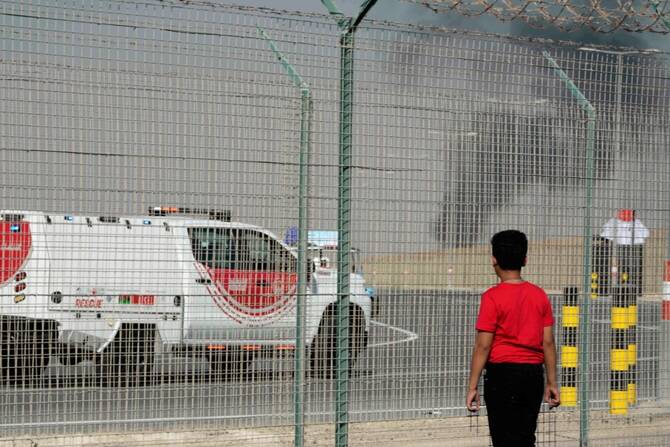
A bystander watches as an Indian HAL Tejas crashes during a demonstration at the Dubai Air Show in Dubai, UAE on Nov. 21, 2025. (AP)
Short Url
Updated 22 November 2025
Follow

India mourns pilot killed in fighter jet crash at Dubai Airshow

  • Wing Commander Namansh Syal was a 34-year-old fighter pilot from Himachal Pradesh
  • Indian defense minister among officials who expressed grief over Syal’s death

NEW DELHI: Indians are mourning the pilot of an Indian combat plane who was killed when the aircraft crashed at the Dubai Airshow.

The pilot, whom local media identified as 34-year-old Wing Commander Namansh Syal, was flying an Indian-made Tejas aircraft during a demonstration for a crowd of spectators at Dubai World Central when it crashed on Friday afternoon.

The plane had reportedly flown across the display site several times before it dived directly towards the ground. Multiple videos of the crash taken by spectators have since been circulated widely on social media.

“The pilot sustained fatal injuries in the accident. (The Indian Air Force) deeply regrets the loss of life and stands firmly with the bereaved family in this time of grief. A court of inquiry is being constituted to ascertain the cause of the accident,” the IAF said in a statement.

Indian Defense Minister Rajnath Singh said he was “deeply anguished” by Syal’s death, calling him a “brave and courageous” pilot.

“My heartfelt condolences to the bereaved family. The nation stands firmly with the family in this tragic hour,” he said on X.

Sukhvinder Singh Sukhu, chief minister of the northern Indian state of Himachal Pradesh, where Syal is from, also took to social media to write a tribute, calling it an “extremely heartbreaking” incident.

“The nation has lost a brave, dutiful and courageous pilot,” he said. “I pay heartfelt tribute to the indomitable bravery, dedication to duty and commitment to national service of brave son Namansh Syal.”

On Saturday, headlines across major Indian outlets were filled with stories of Syal and his journey to become a fighter pilot, while many other Indians took to social media to express their grief.

“Deeply saddened by the tragic loss of Wing Commander Namansh Syal, who gave his life while showcasing the pride of our Indian Air Force, the Tejas. A brave son of India taken far too soon,” Indian actor Kamal Haasan wrote on X.

The incident has also cast a spotlight on Tejas, India’s indigenous fighter aircraft built by state-run Hindustan Aeronautics Limited.

Friday’s crash is the second-known case involving a Tejas jet, after an incident was reported during an exercise in the western Indian state of Rajasthan last year, with the pilot ejecting safely in that instance.

It took place a day after India’s Press Information Bureau rejected some social media claims alleging that a Tejas aircraft had experienced an oil leak while on display at the air show.

In a statement on X, the PIB called the posts “false” and said they were attempts to undermine the “fighter's proven technical reliability with baseless propaganda.”

It was not immediately clear whether the aircraft in question was the one that crashed on Friday.

Mohon Guruswamy, a policy analyst specializing in economic and security issues, called it “an unfortunate accident,” adding that fighter jets in air shows are “very prone” to crashes.

“The demonstration program has all kinds of daring tricks. I don’t think there’s anything wrong with the aircraft … (But) it’s a loss of image for India. It is a blow that has to be borne,” he told Arab News.

“Even in the best of fighter planes, accidents keep happening … All test pilots are very good and brilliant. (Syal) was a test pilot, a high-quality test pilot, and it’s a loss … a valuable experience of the aircraft was lost.”

The incident will “undermine India’s self-reliance narrative,” said defense expert Ranjit Kumar, as Tejas manufacturer HAL has been eyeing various export prospects, including in Southeast Asia.

“Since the crash happened during an international air show in Dubai, it will grab international attention and cast a shadow on the combat performance of the aircraft,” he told Arab News. “Rival nations will find (grounds) to highlight its operational weaknesses.”


145 years on, Bangladesh’s Gen Z honors Begum Rokeya, author of first feminist utopia

Updated 7 sec ago
Follow

145 years on, Bangladesh’s Gen Z honors Begum Rokeya, author of first feminist utopia

  • Begum Rokeya was one of the earliest voices for women’s rights and education in South Asia
  • Her Sakhawat Memorial Girls’ School was one of the first schools for Muslim girls in Bengal

DHAKA: Bangladeshis marked Rokeya Day on Tuesday, remembering a 19th-century pioneer of women’s liberation and education in the Indian subcontinent and author of one of the world’s first feminist science-fiction utopias.

Begum Rokeya, also known as Begum Rokeya Sakhawat Hossain, was a writer and social reformer born on Dec. 9, 1880 in colonial India, in the Rangpur district of present-day Bangladesh.

Widely regarded as one of the earliest voices for women’s rights in South Asia, she is best known for her work promoting education.

“She went door to door to convince the guardians to send their girls to school. Nowadays, it seems very easy, but in the early 20th century, it was something beyond imagination,” said Afsana Rahman, a 21-year-old student at BRAC University.

She started reading Rokeya’s works at the age of 12, when the school authorities honored her as the best student with a set of books that included “Sultana’s Dream” — one of the world’s earliest works of feminist science fiction.

Rokeya wrote “Sultana’s Dream” in English in 1905, setting the story in Ladyland, a country ruled entirely by women.

In Ladyland, women managed administration, science, and education, while men lived in seclusion, reversing the traditional system. The country was peaceful, free of crime, and developed. Powered by solar energy, it used science for social development and innovation, rather than violence or warfare.

“I was amazed by her thoughts — how a woman could imagine a women-led society more than 100 years ago, when women were not allowed to go outside their homes,” Rahman told Arab News.

“Actually, her thoughts were far ahead of her time. Since then, Begum Rokeya has become my source of inspiration and has taught me to think beyond stereotypical ideas.”

Rokeya received no formal schooling and learned Bengali and English privately at home. She advocated that women could thrive when given freedom and education, which are essential not only for their personal growth but also for the progress of society as a whole.

Her main supporter was her husband, Khan Bahadur Sakhawat Hossain, whose role, too, is seen as part of Rokeya’s legacy, as her personal life “demonstrates that men can break the cycle of patriarchal oppression and work as equal partners in the struggle for women’s rights,” said Nayma Jannat, a 23-year-old who studies international relations at Dhaka University.

“Her legacy represents courage, vision and the hope for a more equal society … Rokeya’s works and thoughts remain relevant even after nearly 150 years because the fundamental structures she critiqued continue to shape our society today.”

In 1911, Rokeya founded the Sakhawat Memorial Girls’ School in Calcutta — one of the first schools founded specifically by and for Muslim girls in Bengal. Later moved to Dhaka, the school remains influential and is still active today.

By establishing schools, Rokeya “established women’s education as a center of real liberation,” and by challenging the patriarchal society and its cultural norms, strengthened the foundation for women’s self-identity, paving the way for “decolonized feminism,” said Rawank Jahan Rakamoni, 25, who is graduating in information science.

“Rokeya did not see women’s liberation as a personal outrage. She envisioned it as a structural social transformation … This integrated approach has established her as a pioneer of women’s liberation in the subcontinent.”

Bangladesh celebrates Rokeya on her birthday every Dec. 9. Her legacy remains influential among the younger generation of both men and women.

For Ashraful Alam Khan, 24-year-old anthropology student from Dhaka University, while Rokeya “inspired generations,” the work she started is still incomplete.

“Women in Bangladesh or South Asia in general are still deprived of many rights … I think that’s the main idea why she is still relevant because we still somehow face the same difficult realities,” he said.

Prokriti Shyamolima, who lives at Begum Rokeya Hall — one of the largest and most prominent women’s dormitories at Dhaka University — wants to see herself and other female students as Rokeya’s successors.

“Today, our women are working in every sphere, and women are delivering simultaneously at home and outside. Where did the women get this courage? It began with the initiatives of Begum Rokeya,” she said.

“The legacy of Begum Rokeya will continue as long as we survive.”