23 children die of malnutrition within a month in Sudan’s Kordofan region

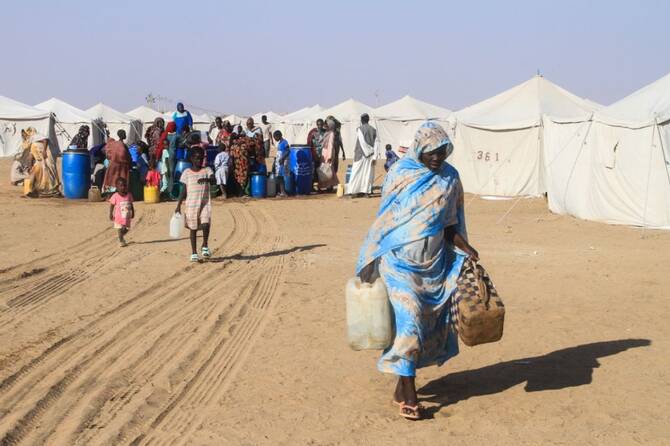
A Sudanese woman who fled El-Fasher in Darfur carries jerrycans of water at the Al-Afad camp for displaced people in the town of Al-Dabba, northern Sudan. (AFP)
Short Url
Updated 22 November 2025
Follow

23 children die of malnutrition within a month in Sudan’s Kordofan region

  • The devastating war has killed more than 40,000 people, according to UN figures, but aid groups say that is an undercount and the true number could be many times higher

CAIRO: Almost two dozen children died of malnutrition-related causes within a month in central Sudan where fierce fighting between the country’s military and a paramilitary group has centered, a medical group said.
The deaths of 23 children in the Kordofan region underscores the deteriorating humanitarian situation in the northeastern African country where famine is spreading after more than 30 months of devastating war.
Sudan plunged into chaos in April 2023 when a power struggle between the military and the powerful paramilitary Rapid Support Forces exploded into open fighting in the capital, Khartoum, and elsewhere in the country.
The devastating war has killed more than 40,000 people, according to UN figures, but aid groups say that is an undercount and the true number could be many times higher. It created the world’s largest humanitarian crisis, with over 14 million people forced to flee their homes, fueled disease outbreaks and pushed parts of the country into famine.
About 370,000 people had been pushed into famine in Kordofan and the western region of Darfur as of September, with another 3.6 million people one step from famine in the two regions, according to international hunger experts.
Children’s deaths blamed on severe malnutrition and supplies shortages
The children’s deaths were reported between Oct. 20 and Nov. 20 in the besieged city of Kadugli and the town of Dilling, said the Sudan Doctors Network, a body of professionals that tracks the conflict.
The group said late Friday that the deaths were a “result of severe acute malnutrition and shortages of essential supplies” in the two areas, where a blockade “prevents the entry of food and medicine and puts the lives of thousands of civilians at risk.”
Kadugli, the capital of South Kordofan province, is where famine was declared earlier this month by the Integrated Food Security Phase Classification. The RSF has besieged Kadugli town for months, with tens of thousands of people trapped as the group tries to seize more territory from the Sudanese military.
Dilling, also in South Kordofan, has reportedly experienced the same hunger conditions as Kadugli, but the IPC didn’t announce famine there because of a lack of data, it said.
Fighting for the control of Kordofan intensified earlier this year after the military forced the RSF out of Khartoum. The paramilitary group has since then focused its resources on Kordofan and the city of el-Fasher, which was the military’s last stronghold in the sprawling Darfur region.
The RSF drove the military out of el-Fasher earlier this month, and forced tens of thousands to flee to overcrowded camps to escape reported atrocities by the paramilitary force, according to aid groups and UN officials.
RSF fighters rampaged through the Saudi Hospital in the city, killing more than 450 people, according to the World Health Organization. The fighters also went house to house, killing civilians and committing sexual assaults, aid workers and displaced residents say.
Continued disposal of bodies in el-Fasher
New satellite images appear to show continued efforts by RSF to dispose of corpses at locations in el-Fasher, the Yale School of Public Health’s Humanitarian Research Lab said Friday.
The apparent disposal of bodies on the Saudi Hospital facility grounds and around a compound in Daraja Oula neighborhood are in locations where RSF reportedly carried out mass killings when they took over the city late last month, the HRS said.
“The combination of likely body disposal via immolation, lack of traditional burial activities and lack of market activity raises significant concerns about the presence of civilians and the sustainment of life for those who remain in el-Fasher,” the HRL said.
The lab said it’s highly likely that most civilians who were in the city before the RSF attack on Oct. 26 “have been killed, have died, are detained, are in hiding, have fled, or are otherwise unable to move freely.”


US raid allegedly killed Syrian undercover agent instead of Daesh group official

Updated 52 min 3 sec ago
Follow

US raid allegedly killed Syrian undercover agent instead of Daesh group official

  • Neither US nor Syrian government officials have commented on the death, an indication that neither side wants the incident to derail improving ties
  • Weeks after the raid, interim President Ahmad Al-Sharaa visited Washington and announced Syria would join the global coalition against Daesh

DUMAYR, Syria: A raid by US forces and a local Syrian group aiming to capture an Daesh (IS) group official instead killed a man who had been working undercover gathering intelligence on the extremists, family members and Syrian officials have told The Associated Press.
The killing in October underscores the complex political and security landscape as the United States begins working with interim Syrian President Ahmad Al-Sharaa in the fight against remnants of IS.
According to relatives, Khaled Al-Masoud had been spying on IS for years on behalf of the insurgents led by Al-Sharaa and then for Al-Sharaa’s interim government, established after the fall of former President Bashar Assad a year ago. Al-Sharaa’s insurgents were mainly Islamists, some connected to Al-Qaeda, but enemies of IS who often clashed with it over the past decade.
Neither US nor Syrian government officials have commented on Al-Masoud’s death, an indication that neither side wants the incident to derail improving ties. Weeks after the Oct. 19 raid, Al-Sharaa visited Washington and announced Syria would join the global coalition against IS.
Still, Al-Masoud’s death could be “quite a setback” for efforts to combat IS, said Wassim Nasr, a senior research fellow with the Soufan Center, a New York-based think tank focused on security issues.
Al-Masoud had been infiltrating IS in the southern deserts of Syria known as the Badiya, one of the places where remnants of the extremist group have remained active, Nasr said.
The raid targeting him was a result of “the lack of coordination between the coalition and Damascus,” Nasr said.
In the latest sign of the increasing cooperation, the US Central Command said Sunday that American troops and forces from Syria’s Interior Ministry had located and destroyed 15 IS weapons caches in the south.
Confusion around the raid
The raid occurred in Dumayr, a town east of Damascus on the edge of the desert. At around 3 a.m., residents woke to the sound of heavy vehicles and planes.
Residents said US troops conducted the raid alongside the Syrian Free Army, a US-trained opposition faction that had fought against Assad. The SFA now officially reports to the Syrian Defense Ministry.
Al-Masoud’s cousin, Abdel Kareem Masoud, said he opened his door and saw Humvees with US flags on them.
“There was someone on top of one of them who spoke broken Arabic, who pointed a machine gun at us and a green laser light and told us to go back inside,” he said.
Khaled Al-Masoud’s mother, Sabah Al-Sheikh Al-Kilani, said the forces then surrounded her son’s house next door, where he was with his wife and five daughters, and banged on the door.
Al-Masoud told them that he was with General Security, a force under Syria’s Interior Ministry, but they broke down the door and shot him, Al-Kilani said.
They took him away, wounded, Al-Kilani said. Later, government security officials told the family he had been released but was in the hospital. The family was then called to pick up his body. It was unclear when he had died.
“How did he die? We don’t know,” his mother said. “I want the people who took him from his children to be held accountable.”
Faulty intelligence
Al-Masoud’s family believes he was targeted based on faulty intelligence provided by members of the Syrian Free Army.
Representatives of the SFA did not respond to requests for comment.
Al-Masoud had worked with Al-Sharaa’s insurgent group, Hayat Tahrir Al-Sham, in its northwestern enclave of Idlib before Assad’s fall, his cousin said. Then he returned to Dumayr and worked with the security services of Al-Sharaa’s government.
Two Syrian security officials and one political official, who spoke on condition of anonymity because they were not authorized to comment publicly, confirmed that Al-Masoud had been working with Syria’s interim government in a security role. Two of the officials said he had worked on combating IS.
Initial media reports on the raid said it had captured an IS official. But US Central Command, which typically issues statements when a US operation kills or captures a member of the extremist group in Syria, made no announcement.
A US defense official, when asked for more information about the raid and its target and whether it had been coordinated with Syria’s government, said, “We are aware of these reports but do not have any information to provide.” The official spoke on condition of anonymity in accordance with regulations.
Representatives of Syria’s defense and interior ministries, and of US envoy to Syria Tom Barrack, declined to comment.
Increased coordination could prevent mistakes
At its peak in 2015, IS controlled a swath of territory across Iraq and Syria half the size of the United Kingdom. It was notorious for its brutality against religious minorities as well as Muslims not adhering to the group’s extreme interpretation of Islam.
After years of fighting, the US-led coalition broke the group’s last hold on territory in late 2019. Since then, US troops in Syria have been working to ensure IS does not regain a foothold. The US estimates IS still has about 2,500 members in Syria and Iraq. US Central Command last month said the number of IS attacks there had fallen to 375 for the year so far, compared to 1,038 last year.
Fewer than 1,000 US troops are believed to be operating in Syria, carrying out airstrikes and conducting raids against IS cells. They work mainly alongside the Kurdish-led Syrian Democratic Forces in the northeast and the Syrian Free Army in the south.
Now the US has another partner: the security forces of the new Syrian government.
Airwars, a London-based conflict monitor, has reported 52 incidents in which civilians were harmed or killed in coalition operations in Syria since 2020.
The group classified Al-Masoud as a civilian.
Airwars director Emily Tripp said the group has seen “multiple instances of what the US call ‘mistakes,’” including a 2023 case in which the US military announced it had killed an Al-Qaeda leader in a drone strike. The target later turned out to be a civilian farmer.
It was unclear if the Oct. 19 raid went wrong due to faulty intelligence or if someone deliberately fed the coalition false information. Nasr said that in the past, feuding groups have sometimes used the coalition to settle scores.
“That’s the whole point of having a hotline with Damascus, in order to see who’s who on the ground,” he said.