

Pakistan’s virtual assets’ chief joins WEF committee as crypto rules take shape

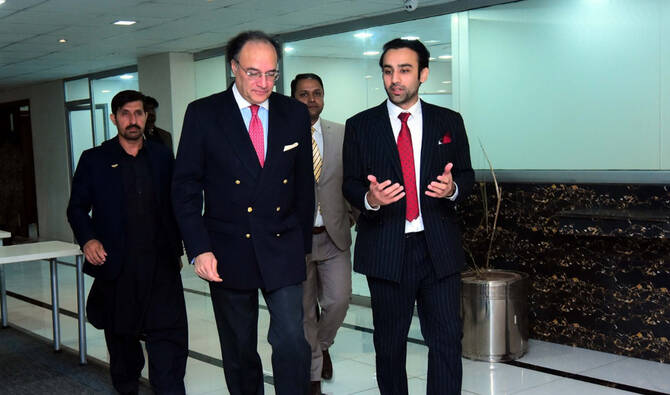
Pakistan Minister for Finance and Revenue, Muhammad Aurangzeb speaking with Bilal Bin Saqib, chairman of the Pakistan Virtual Asset Regulatory Authority upon the minister's visit to the authority in Islamabad, Pakistan, on November 20, 2025. (Finance Ministry)
Short Url
Updated 20 November 2025
Follow

Pakistan’s virtual assets’ chief joins WEF committee as crypto rules take shape

  • Pakistan moves toward first regulatory framework for virtual assets as government accelerates work on licensing, oversight, consumer safeguards
  • New bodies such as Crypto Council, virtual assets authority mark Islamabad’s shift from legal grey zone to structured regulation of digital assets

KARACHI: Pakistan has secured a seat in global rule-making on cryptocurrencies and blockchain governance after Bilal Bin Saqib, chairman of the Pakistan Virtual Asset Regulatory Authority (PVARA), joined the World Economic Forum’s Steering Committee on Digital Asset Regulations, the finance ministry said on Thursday.

The announcement comes as Pakistan works on its first regulatory framework for virtual assets, a sector the government says requires clear oversight to protect consumers, support financial stability and keep pace with international standards. 

Saqib’s inclusion in the WEF steering body signals Pakistan’s entry into high-level global discussions at a time when major economies are formalizing rules for cryptocurrencies and tokenized assets.

“A notable development for Pakistan’s global positioning in the virtual assets space is that the Chairman of PVARA is now part of the World Economic Forum’s Steering Committee on Digital Asset Regulations,” the finance ministry said.

“This participation strengthens Pakistan’s presence in international policy discussions and signals growing recognition of the country’s role in shaping the global conversation on digital asset governance.”

The statement followed Finance Minister Muhammad Aurangzeb’s first official visit to Pakistan’s virtual asset regulatory authority, where he received a briefing on ongoing consultations with domestic and international stakeholders and the development of phased regulatory guidelines. 

Officials said the framework aims to ensure transparency, consumer protection and alignment with global best practices.

“This is an important national mandate, and we are building it from the ground up with a Pakistan-first approach,” Saqib, 34, was quoted as saying in a finance ministry statement.

“The Authority is fully committed to responsible innovation, strong safeguards, and regulatory clarity. The Minister’s guidance and support will accelerate our work and help position Pakistan responsibly in the evolving digital economy.”

In March 2025, Pakistan established the Pakistan Crypto Council (PCC) under the Federal Finance Ministry to set policy and promote blockchain and digital assets. In July, the government formalized PVARA via the Virtual Assets Ordinance to license and regulate virtual-asset service providers. 

Saqib also unveiled the country’s first government-led strategic bitcoin reserve at Bitcoin Vegas 2025 this May.

Until now, Pakistan’s crypto space existed in a legal grey zone: while the State Bank of Pakistan has declared cryptocurrency transactions illegal, millions of citizens, including freelancers, are estimated to use trading platforms and peer-to-peer exchanges. The creation of the PCC and PVARA signals Islamabad is shifting toward regulation, balancing innovation with concerns about money-laundering and financial stability.


Pakistan military says 12 militants killed after coordinated attacks in Balochistan

Updated 10 sec ago
Follow

Pakistan military says 12 militants killed after coordinated attacks in Balochistan

  • ISPR says militants targeted a police station and two banks, taking away $12,000
  • Balochistan CM says one civilian was injured, warns militants of tougher response

ISLAMABAD: Pakistan’s military said on Friday security forces killed 12 militants during a clearance operation in the southwestern Balochistan district of Kharan after coordinated attacks on a police station and two banks a day earlier.

In a statement, the military’s media wing said 15 to 20 militants carried out multiple attacks in Kharan city on Thursday, targeting the City Police Station as well as branches of the National Bank of Pakistan and Habib Bank Limited, looting Rs3.4 million ($12,000).

“Security Forces effectively responded and engaged the terrorists, prompting them to retreat,” the Inter-Services Public Relations (ISPR) said. “During the ensuing clearance operation, twelve terrorists were sent to hell in three different engagements.”

The ISPR said the militants had attempted to create a hostage situation at the police station, which was thwarted, adding that “sanitization operations” were continuing in surrounding areas.

Earlier, Chief Minister Balochistan Sarfaraz Bugti said the attackers entered the area for a brief period of five to ten minutes and fled after the attacks, adding that one civilian, identified as Abdul Hakeem, was shot in the neck and evacuated to a military hospital for treatment.

“They came for five to ten minutes, tried to break into banks and ATMs and took around Rs3.4 million from the National Bank,” Bugti told a news conference, warning that future attacks would be met with force.

The military described the militants as members of “Fitna Al Hindustan,” a term Pakistan uses for Baloch separatist groups it accuses of operating with Indian backing, an allegation New Delhi denies.

Balochistan, Pakistan’s largest but least populated province, has long been plagued by separatist violence, with attacks frequently targeting security forces, infrastructure and civilians.