


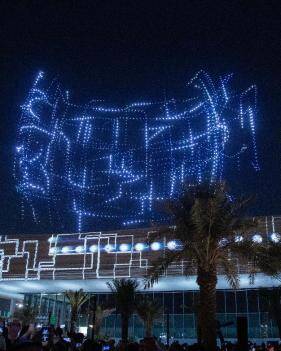



RIYADH: The fifth Noor Riyadh festival of light and art which began on Thursday is this year mapped out and integrated into the city’s metro system for easy viewing and accessibility.
The metro, which opened in December 2024, will allow passengers to pass by or stop at 60 light-based artworks by 59 artists from 24 countries until Dec. 6.
Nouf Al-Moneef, director of Noor Riyadh, told Arab News: “It’s connected by the past, the present and the future.
“What’s great about it is you can just hop in a station and then go to another station and check out the artworks … So that’s what’s making it easy for everyone to see and accessible for everyone.”
The artworks are spread across six locations: Qasr Al-Hokm District, King Abdulaziz Historical Center, stc Metro Station, KAFD Metro Station, Al-Faisaliah Tower, and the Riyadh Art Space at JAX District.
“All of the sites that are selected are along the metro line. And what’s interesting is that each one was built in a different era.
“Qasr Al-Hokm was built in the 1930s, King Abdulaziz (Historical Center) was built in the 80s, stc just opened right now, so it’s also a temporal move through the metro line.
“Through that, we really were engaging with different time scales in the city,” Riyadh-based curator Sara Al-Mutlaq told Arab News.
Al-Mutlaq was a member of the curatorial team alongside Beijing Art Lab’s Li Zhenhua, led by Mori Art Museum’s Mami Kataoka.
This year’s theme, “In the Blink of an Eye,” explores change and continuity, casting a constellation of light art across the city to bridge its rich cultural heritage with its energetic present.
“‘In the Blink of an Eye,’ normally attached to it is the fast changing of society’s development in all aspects in your life, speed in technology, in whatever our lifestyle,” Zhenhua told Arab News.
“I also have a different aspect, which means ‘In the Blink of an Eye’ is totally controlled by yourself.
“You can decide whether a millisecond, or a second, or 10 years of not opening your eyes.
“To think how you define how you react or how you participate in society. I think this is a beautiful moment of thinking.”
At the preview night on Wednesday, special guests convened at stc station where artworks by American-French artist Roman Hill, Saudi artist Saad Al-Howede, Dutch artist Marinix De Nijs and Japanese artist Ryoichi Kurokawa, were on display inside and just outside the station.
Al-Howede’s “Memory Melting,” which was one of the more captivating pieces, is a three-piece emoji installation made of melted discarded plastic toys gathered from children around the world.
Turning waste into nostalgia, each 3-meter sphere is a metaphor for memory’s transformation, the development of showing emotions, and remembrance through reinvention.
“They (the artists) have different kinds of approaches. Al-Howede, his approach is to understand what’s going on in social media and how these kinds of icons are dealing with that,” Zhenhua said.
“By bringing these kinds of fictional, virtual icons into reality, I find this is really beautiful … art can be a humorous kind of presentation for people to finally encounter (their) emoji in reality.”
De Nijs’ “New Dimensions: Riyadh Edition” is a large-scale interactive installation using images and sounds collected from cities around the world.
It investigates how bodies experience their city and how images of urban environments influence human behavior.
Spectators can physically control the installation through a sculptural device that enables human-machine interaction.
“‘In the Blink of an Eye’ is something that talks about transformation, this rapid movement into the future, maybe whether in Saudi Arabia or kind of in the world at large, so, coincidentally, a lot of the works that were selected really do embody technology in a variety of ways,” Al-Mutlaq said.
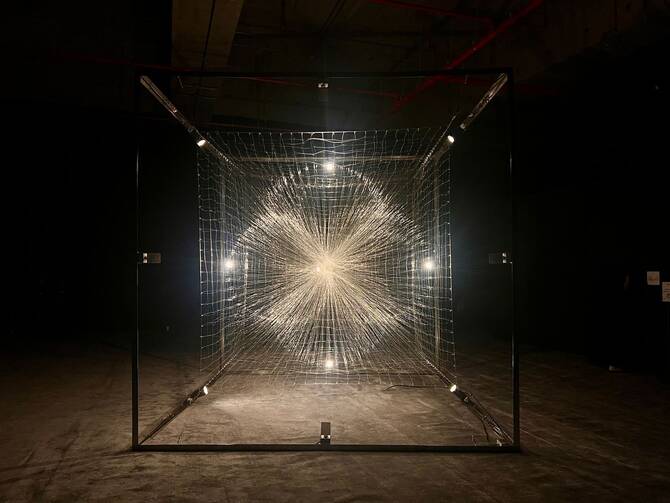
The site also features an indoor exhibition space with the works of Guillaume Cousin, Ivana Franke, Kurt Hentschlager, Saeed Gebaan, Shiro Takatani of the group Dumb Type, Shun Ito, Wu Chi-Tsung and Zheng Da.
“Local artists with international artists is a way to find common ground across generations and in some transtemporal manner. It’s the way it is, and in that way, I think Noor Riyadh is on an international standard,” Kataoka told Arab News.
The festival has become one of the capital’s cornerstone events, ushering in millions every year to preview its illuminated installations under starry skies and brisk weather.
Since 2021, Noor Riyadh has attracted more than 9.6 million visitors and spectators, presenting more than 550 works by 500 artists from around the world.
Alongside its citywide installations, the festival offers a public program of community activities, workshops, and panels. This mirrors Riyadh Art’s mission to enrich daily life through creativity and inspire dialogue across communities.


