

ADB approves $330 million loan to strengthen Pakistan’s power transmission network

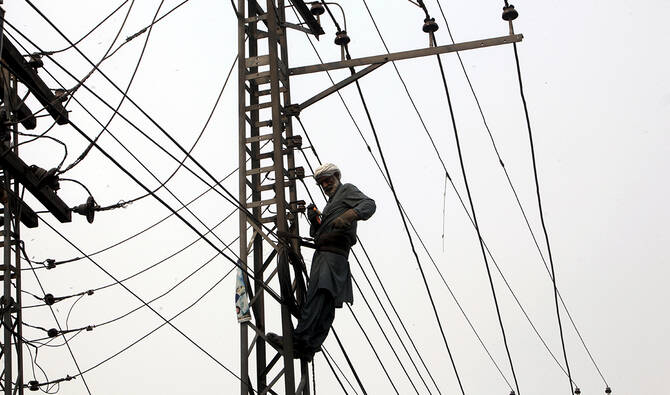
A power company employee works on power lines in Lahore, Pakistan, on November 6, 2015. (Reuters/File)
Short Url
Updated 20 November 2025
Follow

ADB approves $330 million loan to strengthen Pakistan’s power transmission network

  • Project involves construction of a new 290kilometer transmission line and grid infrastructure upgradation
  • ADB says loan will enable transfer of up to 3,200MWs to Islamabad, Faisalabad from hydropower plants in north

ISLAMABAD: The Asian Development Bank (ADB) on Thursday approved a $330 million loan for Pakistan to expand the national power transmission network under its Second Transmission Strengthening Project that aims to help Islamabad cut reliance on imported fuels and boost energy security, ADB said on Thursday.

The country of 250 million faces chronic power outages, soaring electricity costs and a ballooning circular debt in the power sector that has reached 1.7 trillion rupees ($5.9 billion), according to government data.

The ADB project entails the construction of a new 500-kilovolt, approximately 290-kilometer transmission line and upgrading grid infrastructure that serves Pakistan’s capital Islamabad and the city of Faisalabad.

It is expected to improve electricity reliability and could also benefit millions of households and industries while enhancing energy efficiency and supporting long-term economic growth in the South Asian nation.

“This project represents ADB’s strong partnership with Pakistan and our shared commitment to accelerate clean energy transition and integration, and to achieve a resilient and sustainable energy sector,” the bank quoted its Country Director for Pakistan Emma Fan as saying.

“By expanding transmission capacity and enabling the delivery of low-cost hydropower, the project aims to improve access to clean energy in the power mix, reduce system costs and support Pakistan’s long-term and sustainable economic development.”

ADB said the investments will enable the transfer of up to 3,200 megawatts of clean energy from hydropower plants in the north of Pakistan, highlighting that it will also help reduce reliance on imported fuels and support the country’s transition to a sustainable energy mix.

“ADB’s financing package comprises a $285 million loan from its ordinary capital resources and a $45 million concessional loan,” it added.

The loan will support state-owned enterprise reforms by “solidifying institutional, financial, operational and governance improvements” of the National Grid Company (NGC) of Pakistan Limited, ADB said.

Pakistan relies heavily on external borrowing and narrowly avoided default in 2023 after a political crisis compounded an economic downturn. A $7 billion International Monetary Fund (IMF) bailout helped unlock further loans from friendly nations, staving off collapse.

In Aug., ADB had approved a $410 million package to develop Pakistan’s Reko Diq copper and gold mine, which is one of the largest underdeveloped mines in the world. In late 2023, the bank had loaned Pakistan $250 million to expand its high-voltage transmission network in Punjab and Khyber Pakhtunkhwa provinces.


Pakistan says mosque data collection in Indian-administered Kashmir violates religious freedom

Updated 17 January 2026
Follow

Pakistan says mosque data collection in Indian-administered Kashmir violates religious freedom

  • Indian police distributed forms to collect details of mosques, including finances of institutions and personal details of imams
  • The exercise has triggered widespread concern in the territory, with a local leader calling it ‘infringement of the religious freedom’

ISLAMABAD: Pakistan on Saturday condemned reported profiling of mosques and their management committees in Indian-administered Kashmir, calling it “blatant intrusion into religious affairs.”

Police distributed forms to local officials to collect details of mosques, seminaries in Indian-administered Kashmir, including finances of the institutions, personal details of imams and members of management committees, Hindustan Times reported this week, citing residents.

The police referred to the busting of a “white collar terror module” last year, which included an imam, as the reason for the exercise that has triggered widespread concern in the territory, with National Conference leader Aga Ruhullah Mehdi calling it “infringement of the religious freedom.”

Pakistan’s foreign office said the forcible collection of personal details, photographs and sectarian affiliations of religious functionaries amounts to systematic harassment, aimed at “instilling fear among worshippers and obstructing the free exercise of their faith.”

“This blatant intrusion into religious affairs constitutes a grave violation of the fundamental right to freedom of religion and belief, and reflects yet another coercive attempt to intimidate and marginalize the Muslim population of the occupied territory,” the Pakistani foreign office said.

There was no immediate response from New Delhi to the statement.

Kashmir has been divided between Pakistan and India since their independence from Britain in 1947. Both countries have fought two of their four wars over the disputed region, which is ruled in part but claimed in its entirety by both India and Pakistan.

The Pakistani foreign office said the people of Indian-administered Kashmir possess an inalienable right to practice their religion “without fear, coercion or discrimination.”

“Pakistan will continue to stand in solidarity with them and will persist in raising its voice against all forms of religious persecution and intolerance targeting Kashmiris,” it added.