

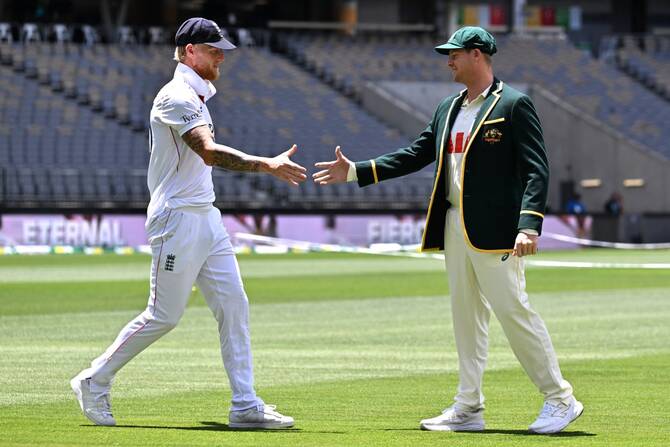

On Nov. 21, the first Test match of the 74th Ashes series between Australia and England will start at the Opta Stadium in Perth. Prior to this series, Australia has won 34 and England 32, with seven drawn, six of those leading to the retention of the Ashes by Australia as existing holders of the small urn.
Longtime readers will recall an earlier column that discussed the urn’s origins. After Australia’s first Test win on English soil in 1882, a satirical obituary was published in an English newspaper stating that English cricket had died, and that “the body will be cremated and the ashes taken to Australia.”
In the return three match series in 1882-83, England won 2-1, at the end of which a small urn was presented to the England captain, Ivo Bligh. The contents of the urn are reputed to be the ashes of a wooden bail, humorously described as “the ashes of Australian cricket.” Bligh’s wife subsequently said that her veil was used to create the ashes content. What started as good natured satire and humor has developed into raw, emotional and heated battles over the years, with undercurrents of colonialism and political intrigue.
Prior to the forthcoming series, 345 Ashes Tests have been played, Australia winning 142, England 110, with 93 draws. The balance in favor of Australia has widened since 2000. In 13 series since then, Australia has won 35 matches and England 19, with 11 drawn. This superiority is not reflected in terms of series wins. Australia has won six and England five, with two drawn. In the series won by Australia it has been dominant, winning 87 percent of the 30 matches. Five of these series were held in Australia. Only once since 2000, in 2010/11, has England won a series in Australia. The same can be said in reverse, Australia’s only series win in England being in 2001-02. However, Australia has run England closely in four of the five other series in England.
A month ago, Australia, holders of the Ashes since 2017, was rated the strong favorite to win the forthcoming series. This was based on home advantage, underpinned by a world-class trio of quick bowlers — Pat Cummins, Josh Hazlewood and Mitchell Starc — and 5-0, 4-0 and 4-0 drubbings of England in their past three visits to Australia.
Since then, injuries to the first two members of Australia’s trio have ruled them out of the first Test. England’s own quick bowers have had their injury issues over the years, but are all fit for selection. There is a sense among England’s media and supporters that there is an opportunity to lay down a marker in the first match and take advantage of Australia’s depleted quick bowling attack. Former England bowler, Stuart Broad, is on record as saying: “It’s probably the worst Australian team since 2010 when England last won, and it’s the best English team since 2010.”
Injuries are commonplace in sport and cricket is no exception. They can have a major impact on the outcome of a match. In the 2005 series between England and Australia in England, the home team was convincingly defeated in the first Test match at Lords where Glenn McGrath took nine wickets. During the warm-up prior to the second Test at Edgbaston, Birmingham, McGrath trod on a stray cricket ball during a game of touch rugby and sustained a freak injury to his ankle. This ruled him out of the match, which England won by two runs. It will never be known if the result would have been different had McGrath not been injured. Suffice to say that England scored an impressive 407 runs on the first day.
A less than fully fit McGrath was rushed back for the third Test, in which he claimed another five-wicket haul, as well as sharing a last-wicket partnership in the last hour of the match to save the match for Australia. An elbow injury caused him to miss the fourth Test, which England won by three wickets. There is a commonly held view that one player does not make a team, but it may be no coincidence that McGrath’s injury problems were a key factor in England regaining the Ashes, as their victories came in matches which he missed.
In the Centenary Test between Australia and England in 1977, there was no shortage of drama. Rick McCosker, one of Australia’s openers, suffered a broken jaw while batting in the first innings. Adding insult to injury, the ball bounced off his jaw onto his wicket. In Australia’s second innings, he chose to bat, walking out at number ten, his face bruised and bandaged, his jaw wired. He scored 25 from 68 balls in a ninth wicket stand of 54 runs. The margin of Australia’s ultimate victory was by 45 runs, the exact margin of the very first Test between the countries a century earlier. McCosker said that he was only doing his job, but his courage was a contributory factor to Australia’s triumph.
Outside of matches between Australia and England, there have been other notable examples of an injury impacting on the outcome of a match. In the 1984 Test match between England and the West Indies at Leeds, Malcolm Marshall fractured a thumb while attempting a catch. He was told to forget about playing cricket for ten days. Ignoring this advice, he batted at number 11 with his left hand in a cast, holding the bat in his right hand only, sharing a last wicket partnership of 13 runs. Any hopes which England harbored that the injury would prevent him from bowling were unrequited. Marshall claimed seven for 53 in England’s second innings of 159. The West Indies went on to win the match.
Another example of a major contribution to victory in the face of injury occurred in 2010 in Mohali, India. On a deteriorating pitch, India slumped to 124 for eight chasing a target of 216 against Australia. VVS Laxman was struggling with severe back spasms and barely able to move. In an innings full of deft touches, superb placement, immense will-power and superb temperament, his unbeaten 73 guided India to victory.
Such acts of stoicism do not always succeed. In the 2009 Test between Australia and South Africa in Sydney, the visitors were facing defeat. South Africa’s captain, Graeme Smith, had sustained a broken left hand and an injured right elbow during the match and had been ruled out of further participation. However, with nine wickets down and limited time left in the match, he chose to bat. Clearly in immense pain, he survived for 29 minutes, facing 17 deliveries before being bowled with only five minutes of the match remaining.
Most recently, in the final Test match between England and India at the Oval, London in August 2025, England’s Chris Woakes suffered a shoulder dislocation. On Day five, England required 27 runs to win with four wickets remaining. Soon, the equation was down to 17 with one wicket remaining. Woakes arrived at the wicket, his arm and shoulder heavily strapped, limply holding the bat in his right hand. He did not have to face a delivery, thankfully, as he watched the facing batter narrowly fail to secure victory.
Test cricket, with its potential to evolve patterns of drama over five days, sometimes creates opportunities for acts of bravery, some may say foolhardiness. There is always fierce anticipation and excitement leading up to an Ashes series. This one has been given an additional edge by the injuries to Australia’s quick bowlers. Over the course of the next six weeks, the implications of these injuries will be revealed, as will the destiny of the urn.


