


For more than two and a half centuries, from 1250 to 1517, the Mamluks ruled one of the most powerful empires in Islamic history. Once enslaved soldiers who rose to become sultans, their dynasty stretched from Egypt to Syria and controlled the Islamic world’s holiest sites. Under their rule, Cairo and Damascus became thriving centers of art, scholarship, and trade, producing works that still define Islamic craftsmanship today.
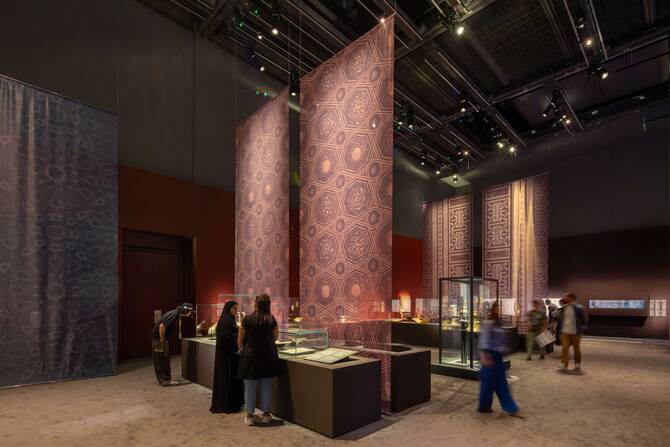
Louvre Abu Dhabi’s exhibition, “Mamluks: Legacy of an Empire,” brings this extraordinary era back to life. Running until Jan. 25, the show is the first of its kind in the Gulf region and one of the most comprehensive explorations of Mamluk art ever staged. It gathers over 270 masterpieces from 34 museums and cultural institutions in 13 countries, including treasures from the Musée du Louvre, the British Library, the Metropolitan Museum of Art in New York, and the Museum of Islamic Art in Doha.
The exhibition, presented in partnership with the Musée du Louvre and France Muséums, follows a celebrated run in Paris earlier this year. Now reimagined for Abu Dhabi, it expands on the original presentation with additional loans from regional collections and new pieces from Louvre Abu Dhabi’s own collection. The result is a panoramic portrait of a dynasty that shaped the political, cultural, and spiritual landscape of the Islamic world.
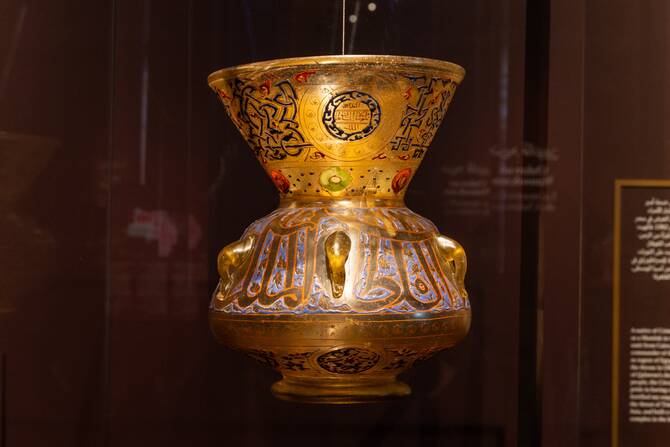
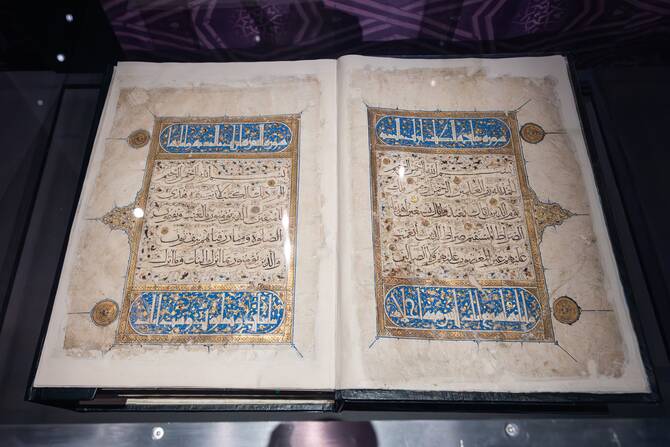
Among the highlights is the Baptistery of Saint Louis, one of the most famous examples of Islamic metalwork, made around 1330 for a Mamluk court and later used in the French royal household. Its intricate engravings of hunts and processions reveal the refinement of an empire whose influence reached across continents. Nearby, a brass key to the Kaaba bearing the name of Sultan Faraj and an ornate helmet of Sultan Barsbay trace the Mamluks’ dual identity as both warriors and guardians of the holy cities. A 15th-century Egyptian carpet, a Qur’an manuscript, and delicate glass mosque lamps testify to the dynasty’s mastery of material and meaning.
The exhibition curators, Dr. Souraya Noujaim and Dr. Carine Juvin from the Musée du Louvre’s Department of Islamic Art, with the support of Fakhera Alkindi, senior curatorial assistant at Louvre Abu Dhabi, present both the magnificence of Mamluk aesthetics and the social and cultural context behind them. The exhibition reveals how the Mamluks built an empire sustained by trade routes that linked Asia, Africa, and Europe. It also highlights lesser-known aspects of their society, including the roles of women and artisans, and their diplomatic relations with Venice and beyond.
Manuel Rabaté, director of Louvre Abu Dhabi, described the show as a milestone for the museum’s role in fostering cross-cultural understanding. The Mamluk period, he said, “reveals how interconnected the world was at that time” and resonates with Abu Dhabi’s vision as a meeting point between East and West.
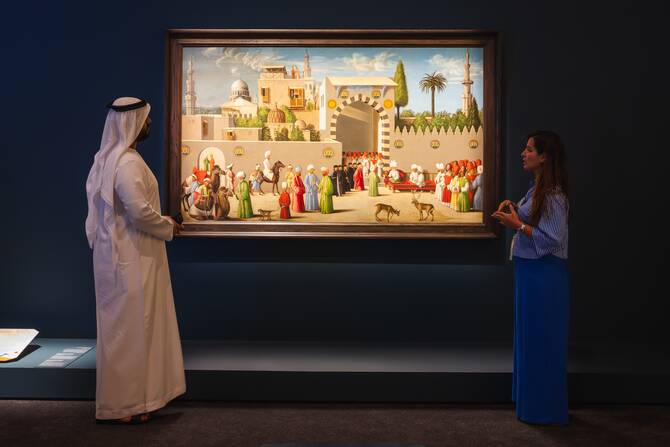
The exhibition unfolds across seven thematic sections that explore the structure and influence of the Mamluk dynasty. Paintings, such as “Venetian Diplomatic Mission Received by the Governor of Damascus,” are displayed alongside Mamluk metalwork to illustrate how East and West viewed each other during a period of vibrant cultural exchange. Six artworks from Louvre Abu Dhabi’s own collection are also on view, including a 13th-century Juz’ Amma, the 30th section of the Qur’an, and a 15th-century ceramic Albarello with coat of arms decoration. Each piece underscores the continuity of Islamic artistic tradition and its enduring influence on design across centuries.
Within the museum’s soft light, the brilliance of Mamluks again commands attention, speaking across centuries to a region still shaped by their legacy.
For more information and to book tickets, visit www.louvreabudhabi.ae or call Louvre Abu Dhabi at +971 600 56 55 66. Entrance to the exhibition is free with the museum’s general admission tickets.


