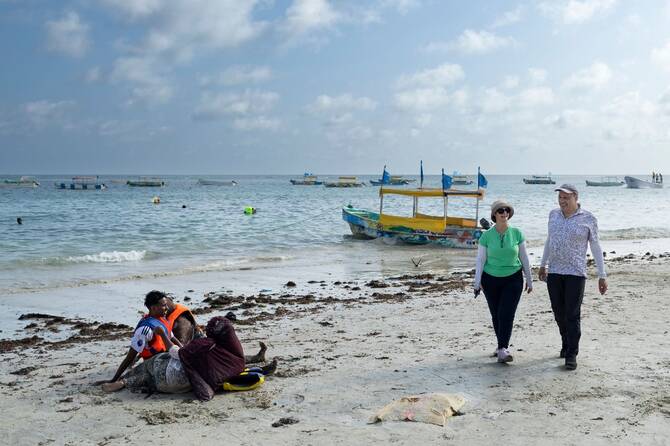

MOGADISHU: Children run in turquoise water, hawkers tout wares on white sands, and families laugh as tourists disembark from small boats — but it’s not some tropical island, it’s Somalia’s capital Mogadishu.
“I didn’t really tell my family where I was going,” said Sheryl, from the United States, after walking along Lido Beach in the city.
“But... from the moment we got off the aeroplane, I’ve been feeling totally comfortable,” she told AFP.
“It’s nothing like what you hear.”
To say that Somalia does not have a good reputation would be an understatement.
It has endured decades of conflict — first a brutal civil war in the 1990s, and now against the Al-Qaeda-linked insurgent group Al-Shabab — and its capital, Mogadishu, is a byword for bombs and armored cars.
But the east African country is trying to change that narrative, trumpeting an 86 percent reduction of attacks in the city since 2023 thanks to more surveillance cameras, roadblocks and plainclothes police. However, incidents do still occur, including a major assault on a prison last month by the militants.
And while Mogadishu is comparatively secure, the rest of the country is not — Al-Shabab’s major territorial gains earlier this year provoked warnings the capital itself could be at risk.
Still, despite the perils, tourism minister Daud Aweis Jama told AFP that roughly 10,000 people visited last year and the number for 2025 could be twice that — mostly from China, the US, and Turkiye.
As AFP accompanied Sheryl and her husband Richard — both in their fifties — around the city, accompanied by one armed soldier, they provoked only a passing curiosity.
“We’re freely walking around, and people are lovely, as people tend to be, and it’s a really interesting place to visit,” she said.
- Security improved -
Sheryl and Richard, who declined to give their surnames, are perhaps not typical travelers. Between them, they have visited Afghanistan, Iran, and North Korea, among others.
They explored Somalia’s capital — including the beach, Peace Gardens memorial park, and Tomb of the Unknown Soldier — with Visit Mogadishu Tours, one of its oldest travel agencies having started business with a solitary Chinese tourist in 2012.
Most foreigners are put off by “warnings they see in Western and European media outlets, which claim that Somalia is not safe to visit,” said the agency’s co-founder, Ali Hassan.
Britain warns against travel, cautioning there is a “high risk of kidnapping” and that Britons are seen as “legitimate targets.” The US is blunter, stating: “Do not travel to Somalia.”
But Hassan said that was in the past.
“Security has improved in many parts of the country, and tourists can interact with locals without any problems,” he said.
His firm charges roughly $500 per tourist per day, which includes the visa, accommodation, food — plus an armed vehicle escort.
The government is keen to promote tourism, which it says employs some 30,000 people.
It has fixed roads and introduced a new e-visa system — though it has already been hacked, prompting fresh warnings from Britain and the US.
“We believe tourism will change the image of Somalia,” said Jama, the tourism minister.
“Everywhere you go in the world, if there is tourism, that means there is stability.”
- ‘Terrifies people’ -
But negative realities remain.
“The name Somalia terrifies most people,” said Briton Anthony Middleton, 42, who was on a two-night trip that cost him around $1,500 for food, accommodation, and security.
Four of his bank cards were blocked after his bank “freaked out” over his location.
The scars of recent conflicts remain in Mogadishu, with many buildings still in ruins.
But Middleton said his initial nerves were quickly assuaged.
“A lot of people think of Somalia as dangerous, and to be honest, Somalia is, even though it’s getting better,” he told AFP.
“But... there’s a difference between dangerous and unfriendly,” he added.
The government has control over Mogadishu but Al-Shabab still has a powerful presence, controlling many parts of the economy, and the outlying territory.
Shopkeeper Abdi Malik, 21, told AFP he served a foreign tourist — an avid YouTuber — the day before, and enjoyed the interaction.
“Security is good in some areas,” said Malik, but others remain no-go, “especially [for] tourists.”