

Pakistan’s IT start-ups, freelancers struggle with payment barriers despite record exports

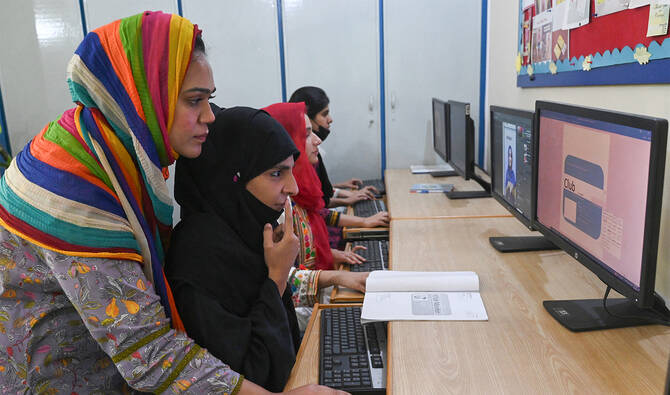
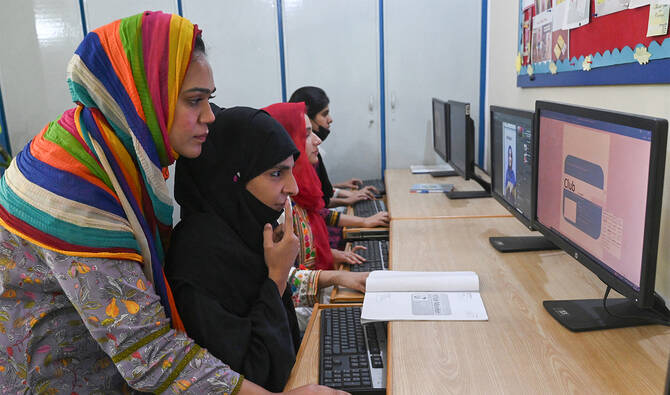
This photograph taken on May 6, 2024 shows hearing-impaired youths attending a computer class at a school run by the charity Deaf Reach, a non-profit organisation working to empower disadvantaged deaf children and youths, in Lahore. (AFP/File)
Short Url
Updated 20 November 2025
Follow

Pakistan’s IT start-ups, freelancers struggle with payment barriers despite record exports

  • Freelancers warn lack of PayPal, Stripe and reliable banking channels is costing millions in lost income
  • Government says negotiations with global payment gateways are underway as exports hit all-time high

ISLAMABAD:  Pakistan’s IT start-ups and freelancers said this week they continue to face crippling payment barriers and shrinking funding despite record export growth, warning that missing global payment platforms and complex banking processes are holding back one of the country’s fastest-growing sectors.

Pakistan’s IT exports hit a historic $3.8 billion in FY 2024–25, up from $3.2 billion the previous year, marking an 18 percent year-on-year increase, according to the Pakistan Software Export Board (PSEB). The government hopes to raise the figure to $15 billion by 2030, but industry leaders say the absence of trusted payment gateways like PayPal and Stripe is slowing progress.

Tufail Ahmad Khan, President of the Global Freelancers Union, said Pakistan now ranks fourth globally in freelance talent but workers face significant hurdles in repatriating their earnings.

“Earning money is not the real problem. The problem is bringing it back to Pakistan,” he told Arab News. “Without PayPal or any major international payment system, freelancers have to pay hefty cuts and margins. Their income is being eaten up simply due to the lack of proper channels.”

Start-up founders report similar challenges. 

Hasan Khan, the Chief Executive Officer of an IT start-up, said the issue affects both freelancers and young companies.

“We cannot receive payments from international clients through proper channels,” he told Arab News. “Sometimes our money gets stuck, sometimes the taxes are too heavy.”

“PayPal, Stripe, Checkout— these systems transformed other markets,” he added. “If they come to Pakistan, the IT business will boom.”

Hasan said even opening a basic bank account for a registered company could take weeks due to bureaucratic delays, limiting firms’ ability to scale quickly.

Sajjad Syed, Chairman of the Pakistan Software Houses Association (P@SHA), said payment difficulties were only one part of a wider challenge.

“Access to funding is limited,” he told Arab News on Tuesday. “Startups face regulatory uncertainty, weak IP protection, power outages, unreliable Internet and difficulty scaling due to limited understanding of global markets.”

Syed added that gender gaps, currency volatility, global competition and the absence of trusted payment gateways all made it harder for Pakistani start-ups to grow. “The potential is enormous, but the barriers are real.”

GOVERNMENT COURTING GLOBAL PAYMENT GATEWAY FIRMS

Pakistan’s start-up funding has fallen sharply. According to Invest2Innovate (i2i), total funding dropped 70 percent in 2024 to just $22.5 million, reflecting global investment trends but also exposing structural weaknesses in the domestic ecosystem.

A senior official from the Ministry of Information Technology, speaking on condition of anonymity, said the government was in talks with at least three major global payment gateway companies.

“Freelancers’ income has doubled in just two years from around $350 million to $710 million,” the official said. “The actual figure may be above $2 billion because many take payments as tax-free home remittances.”

“This growth makes Pakistan a strong business case for PayPal, Stripe and others,” he added.

He said the government’s new start-up policy and the Pakistan Startup Fund (PSF), which offers non-equity grants of up to 30 percent of an investment round to match foreign funding, were designed to improve investor confidence and ease regulatory bottlenecks.

The State Bank of Pakistan did not respond to questions. Previously, the central bank raised foreign currency retention limits for IT exporters from 35 percent to 50 percent, simplified payment procedures and allowed freelancers to open bank accounts digitally with minimal documentation.


UK announces ‘major reset’ of Pakistan development partnership with new trade, climate, education initiatives

Updated 10 December 2025
Follow

UK announces ‘major reset’ of Pakistan development partnership with new trade, climate, education initiatives

  • UK commits to increased investment-led cooperation in climate, business regulation and higher education
  • London shifts from aid donor to investment-focused partner as bilateral trade crosses $7.3 billion

ISLAMABAD: The United Kingdom on Wednesday unveiled what it called a “major reset” in its development partnership with Pakistan, announcing new investment-focused cooperation, education programs and a bilateral climate compact during a visit by UK Minister for Development Jennifer Chapman.

The trip marks the first federal-level development dialogue between the two governments in eight years and reflects London’s shift from a traditional aid-donor role toward investment-based partnerships. The British government said the new approach aims to use UK expertise to help partner economies build capacity and unlock domestic growth.

Pakistan-UK trade has also reached a record high, crossing £5.5 billion ($7.3 billion) for the first time, with more than 200 British firms now active in Pakistan, an increase London says signals growing two-way commercial confidence.

“Pakistan is a crucial partner for the UK. We work together to tackle the drivers behind organized crime and illegal migration, keeping both our countries safer,” Chapman was quoted as saying in a statement by the British High Commission in Islamabad. 

“Our strong bilateral trading relationship brings jobs and growth to us both. And we’re working together to tackle climate change, a global threat.”

The minister and Prime Minister Shehbaz Sharif on Tuesday jointly launched a package of business regulatory reforms aimed at improving Pakistan’s investment climate and making it easier for UK firms to operate. Officials said the initiative supports Pakistan’s economic recovery agenda and creates new commercial avenues for British companies.

A second key announcement was the next phase of the Pak-UK Education Gateway, developed with the British Council and Pakistan’s Higher Education Commission. The expanded program will enable joint research between universities in both countries, support climate- and technology-focused academic collaboration, and introduce a startup fund to help commercialize research. The Gateway will also promote UK university courses delivered inside Pakistan, giving students access to British degrees without traveling abroad.

Accompanied by Pakistan’s Minister for Climate Change Dr. Musadik Malik, Chapman also launched a Green Compact, a framework for climate cooperation, green investment, environmental protection and joint work at global climate forums.

The UK emphasized it remains one of Pakistan’s largest development partners, citing ongoing work in education, health, climate resilience and anti-trafficking capacity building. 

During the visit to Pakistan, Chapman will meet communities benefiting from UK-supported climate programs, which London says helped 2.5 million Pakistanis adapt to climate impacts in the past year, and observe training of airport officers working to prevent human trafficking.

“We remain firm friends of Pakistan, including in times of crisis, as shown through our floods response,” Chapman said. “And we know to accelerate growth in both our countries, we must work together in partnership to tackle the problems we face.”