BELEM, Brazil: Two global power players pushed negotiators on Wednesday to find compromises at United Nations climate talks in Brazil’s Belem, where a self-imposed deadline is rushing up fast.
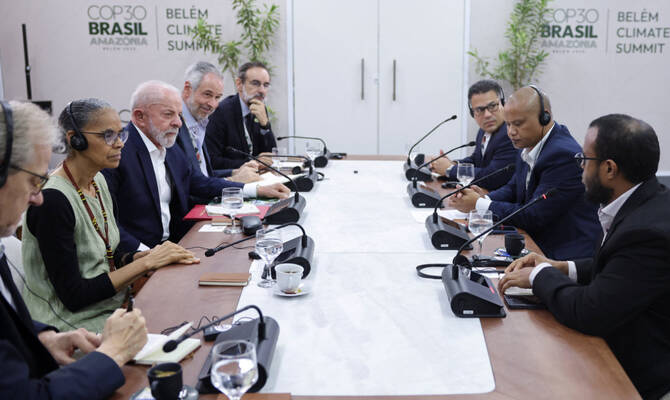
UN Secretary-General António Guterres and Brazilian President Luiz Inácio Lula da Silva arrived at the COP30 talks to take a hand, in what some attendees hoped could signal progress by day’s end. Lula’s tentative schedule included meetings with negotiators for the European Union, emerging nations in Latin America, the Middle East and Asia, and hard-hit small island nations and African countries.
Raising the possibility of a historic outcome, Greenpeace Brazil Executive Director Carolina Pasquali said: “The COP is nearing the endgame and the joint arrival of both Lula and Guterres gives a clear political signal that they mean business.”
Still, it’s routine for negotiators at these talks to miss deadlines.
Excluded issues expected to be discussed
Even though the talks are scheduled to go until at least Friday, COP30 President André Corrêa do Lago gave negotiators a Wednesday deadline for a decision on four interconnected issues that were initially excluded from the official agenda: whether countries should be told to toughen their new climate plans; details on handing out $300 billion in pledged climate aid; dealing with trade barriers over climate and improving reporting on transparency and climate progress.
Scores of countries, rich and poor, are also pushing for a detailed road map on how to phase out fossil fuels. And that’s key to toughening new climate plans for a shot at limiting future warming to 1.5 degrees Celsius (2.7 degrees Fahrenheit), the global goal set in 2015’s Paris Agreement.
In 2023, after days of contentious debate, climate talks agreed to language calling for a transition away from fossil fuels — coal, oil and natural gas. But little has been done since to clarify or amplify on that one sentence. Protesters inside and outside the conference venue kept pushing for a phaseout.
A group of scientists Wednesday criticized current proposals for a fossil fuel phaseout road map as inadequate, particularly to reach the goal of zero fossil fuel emissions by 2045 at the latest.
“A road map is not a workshop or a ministerial meeting. A road map is a real workplan that needs to show us the way from where we are to where we need to be, and how to get there,” said a letter from seven prominent scientists, including some who are advising the COP30 presidency.
Lula and fossil fuels
Lula, in talking to leaders earlier in Belem, boosted the efforts of clarifying how to wean the world from the fuels that emit heat-trapping gases, the chief cause of climate change.
The Brazilian president has also been pushing for more participation in a new multibillion international fund financed by interest-bearing debt instead of donations, called the Tropical Forests Forever Facility. It seeks to make it more lucrative for governments to keep their trees rather than cut them down.
Iskander Erzini Vernoit, director of the IMAL Initiative for Climate and Development, an independent think-tank based in Morocco, said it won’t be easy for Guterres and Lula to find common ground among negotiators.
“Various apparent impasses still remain, and chief among these from an African point of view is the unwillingness of the EU and other rich countries to engage on their obligation to provide climate finance,” Erzini Vernoit said.
Implementation is key to cut global warming
Going into this two-week conference, Brazilian leaders emphasized the importance of focusing on implementation, starting action on agreements, targets and pledges already made, over new deals.
If nations met the goals set at past climate talks of tripling renewables, doubling energy efficiency and cutting methane by 2030, the rate of global warming could be cut by a third within a decade and a half by 2040, according to a new report by Climate Analytics.
Neil Grant, a climate policy analysis expert and lead author of the report, said this could rescue the goal set a decade ago in the Paris Agreement.
While climate leaders have conceded that the world is on track to overshoot this climate goal, Grant said: “We have the tools to transition away from fossil fuels. Although the hour is dark, we still have agency.”
Lots of action plans
High-level climate liaisons met Wednesday to celebrate the creation or acceleration of more than 110 climate action plans on agreements and goals from past conferences.
These may not get the big headlines, but it’s what makes all these efforts work in the real world, said Dan Ioschpe, the COP30 climate champion, who acts as a liaison between governments and civil society at the talks.
“We need to make sure that we reach the targets of the agreement, of the Paris Agreement. And for that we need to implement technologies, solutions, processes,” Ioschpe told The Associated Press, mentioning aviation, maritime and agriculture as key industries to target.
Among the new efforts launched at COP30 is to get an agreement by businesses and governments to spend $1 trillion to improve the world’s electricity grid and renewable energy storage and quadruple biofuels, Ioschpe said.


![]()

Guterres and Lula push negotiators at COP30 as deadline looms
Short Url
https://arab.news/jxnkm
Guterres and Lula push negotiators at COP30 as deadline looms
- Brazilian leaders emphasized the importance of focusing on implementation, starting action on agreements, targets and pledges already made, over new deals


Latest updates





© 2026 SAUDI RESEARCH & PUBLISHING COMPANY, All Rights Reserved And subject to Terms of Use Agreement.