

Jordanian foreign minister calls for renewed global support of UN’s agency for Palestinians

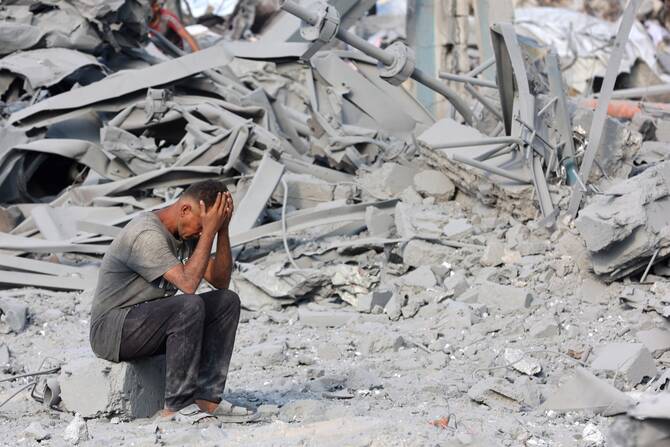
A Palestinian man reacts to the destruction after an overnight strike on the Sheikh Radwan Health Centre run by the UN Relief and Works Agency for Palestine Refugees (UNRWA) in the north of Gaza City, Aug. 6, 2025. (AFP)
Short Url
Updated 19 November 2025
Follow

Jordanian foreign minister calls for renewed global support of UN’s agency for Palestinians

  • Ayman Safadi highlights crucial work UNRWA does in delivering essential services to Palestinian refugees, especially in the Gaza Strip
  • No one else ‘can take UNRWA’s role to face the humanitarian catastrophe in Gaza,’ he says

LONDON: Jordan’s foreign minister, Ayman Safadi, on Wednesday stressed the need for international political and financial support so that the UN Relief and Works Agency for Palestine Refugees can continue to perform its “indispensable and irreplaceable” role.

He highlighted the crucial work of the agency in delivering essential services to Palestinian refugees, especially in the Gaza Strip, which is in the grip of a humanitarian crisis as a result of Israeli military aggression.

Safadi was speaking at a UNRWA Advisory Commission meeting that included the agency’s commissioner general, Philippe Lazzarini, as well as representatives of the commission’s 29 member states, and four observers: Palestine, the EU, the Arab League, and the Organization of Islamic Cooperation.

“No one can take UNRWA’s role to face the humanitarian catastrophe in Gaza,” Safadi said as he reiterated Jordan’s rejection of Israeli legislation banning the agency, which came into effect early this year, describing it “a blatant violation of international law and a denial of essential rights and vital services recognized by the international community.”

In January, Israeli authorities ordered UNRWA to vacate all of its offices in occupied East Jerusalem and cease its operations there after accusing the agency of employing “military operatives” from Hamas and other armed groups. Despite the ban, UNRWA operations continue in Gaza and the West Bank, as well as Jordan, Lebanon and Syria.

Safadi warned that the ongoing Israeli actions targeting UNRWA were part of a larger effort by the nation to “liquidate” the refugee issue, which began with the 1948 conflict that resulted in the founding of the State of Israel and a mass exodus of the Palestinians who lived there at the time.

The UNRWA Advisory Commission meets twice a year to address issues relevant to the agency’s mandate, and advises the commissioner general. Member states take turns chairing the commission for a 12-month term, with Brazil currently filling the role.


Hezbollah says targeted Israeli bases, tanks after strikes on Lebanon

Updated 2 sec ago
Follow

Hezbollah says targeted Israeli bases, tanks after strikes on Lebanon

BEIRUT: Lebanese militant group Hezbollah said Tuesday it targeted several Israeli military bases and tanks in response to Israeli strikes on the group’s strongholds in Lebanon, including the south Beirut suburbs.
Israel continues to carry out successive air raids, particularly on Beirut’s southern suburbs and the south of the country, after issuing evacuation warnings to residents, while Lebanese authorities on Monday recorded the displacement of more than 58,000 people from areas hit by the strikes.
Israel announced Tuesday morning it had begun a new round of “simultaneous strikes in Tehran and Beirut.”
It announced later that day that it hit “approximately 60” targets “belonging to the Hezbollah and Hamas terrorist organizations.”
The Israeli military also said it had deployed troops to several locations in southern Lebanon in what it described as a “forward defense” measure along the border.
Defense Minister Israel Katz said he “authorized the Israel Defense Forces (IDF) to advance and take control of additional strategic positions in Lebanon in order to prevent attacks on Israeli border communities.”
Lebanon was drawn into the regional war on Monday after an initial attack on Israel by Hezbollah, which said it wanted to “avenge” the killing of Iranian supreme leader Ayatollah Ali Khamenei during the US-Israeli strikes.
Israel promptly launched large-scale strikes on Lebanon, where the government on Monday declared an immediate ban on Hezbollah’s military activities.
In separate statements, Hezbollah on Tuesday claimed responsibility for 11 attacks on Israel, saying it targeted at least five Israeli tanks, three of them in Lebanese territory using guided missiles and “appropriate weapons.”
The group also said it used attack drones and rocket salvos to target several bases in northern Israel and the Golan Heights, occupied by Israel since 1967.
Additionally, it claimed to have downed an Israeli drone over the southern city of Nabatiyeh.
These attacks came “in response to the criminal Israeli aggression on dozens of Lebanese cities and towns,” Hezbollah said.
Since the early morning hours, Beirut’s southern suburbs have been subjected to a series of air strikes targeting several buildings after evacuation warnings.
AFP photographers saw huge plumes of smoke rising into the air and obscuring the sky.
Hezbollah’s Al-Manar TV broadcaster said its Beirut headquarters had been targeted overnight and announced Tuesday morning that Israel targeted the offices of Hezbollah’s Al-Nour radio broadcaster as well.
In a statement, Hezbollah condemned the strikes on “two civilian media outlets” saying they were aimed at “silencing the voice and image of the resistance.”
The southern city of Sidon, largely spared during the last Hezbollah-Israel war, was struck twice on Tuesday.
One strike hit a headquarters belonging to Jamaa Islamiya, an Islamist group allied with Hamas and Hezbollah, and the other came after an evacuation warning elsewhere in the city.
The surroundings of Tyre, further south, were also struck after evacuation warnings.