


NEW YORK: UN member states, including many that temporarily cut funding for the UN Relief and Works Agency over Israeli claims last year, have rallied support for it as an essential force for Palestinians.
The UNRWA ministerial meeting was held on Thursday during the UN General Assembly, with an appearance from UN Secretary-General Antonio Guterres, who condemned Israel’s killing of the agency’s staff in Gaza.
It came as UNRWA sought urgent funding to address a significant financial shortfall of more than $200 million.
Jordanian Foreign Minister Ayman Safadi, who hosted the meeting, said: “I don’t have to make the case for UNRWA. The starving children of Gaza so painfully make that case. The mothers who are watching their infants fade before their eyes make the case for UNRWA.
“The 600,000 or more students in Gaza who haven’t gone to school for two years make the case for UNRWA.
“Hundreds of thousands who depend on UNRWA for the little food that they get, for the little subsidies on which they survive, make the case for UNRWA. People of the West Bank, children who have no hope, make the case for UNRWA.”
But the agency is “collapsing” due to a “political assassination campaign … launched long before Oct. 7,” Safadi added, referring to the Hamas attack on Israel in 2023.
“By the end of this month, if UNRWA doesn’t get the funds it needs to feed Palestinian children, to rebuild the schools that have been destroyed, UNRWA won’t be able to continue to operate.”
The “genocide is continuing in Gaza,” he said, and it is “incomprehensible” that “one member state of the UN continues to violate its laws and Charter … and the world does nothing.”
When the war ends, “we need UNRWA” because the agency “has been (in Gaza) when others weren’t,” and because it “knows every alley, street, home, school, clinic and family that needs support,” Safadi said, adding that support for the agency among UN member states must be translated into practical action.
“Let’s continue with UNRWA’s noble work. Let’s bridge the financial gap that UNRWA is suffering from.
“We have to save UNRWA because by saving UNRWA, we’re saving a little bit of what’s left of the credibility of our multilateral system and our commitment to international law and international humanitarian law.”
Guterres, speaking at the meeting, said: “Generations of Palestine refugees have counted on UNRWA for education, health care and other essential services.”
But beyond the agency’s humanitarian effects, its “full impact goes far deeper,” he added, describing UNRWA as a “force for stability in the most unstable region of the world.”
Guterres said: “UNRWA’s operational presence contributes to the Palestinian Authority’s governance in the West Bank, to Lebanon’s efforts to fulfill requirements for a ceasefire in refugee camps, to Syria’s efforts to navigate the path to lasting peace, and to Jordan’s role in building regional stability.”
Its work is integral to many of the actions supported by the New York Declaration for the two-state solution, spearheaded by Saudi Arabia and France, and endorsed by the UNGA this month, he added.
Yet the agency is being forced “to operate under extreme and rising pressure,” he said. “In Gaza, our staff are being killed and our premises destroyed, and everywhere UNRWA faces budget shortfalls and a firehose of disinformation.”
He called on member states to take immediate action in response to a UN report commissioned earlier this year that found the status quo of the agency is untenable.
Countries must “stand in solidarity with UNRWA, by providing political support and by countering the distortions that threaten one of the only lifelines many Palestine refugees have left,” Guterres said.
The agency must also be given the resources to carry out its mandate, and funded “urgently, fully and predictably,” he added.
Guterres honored the agency’s staff who have been killed during Israel’s war on Gaza. “I can’t begin to express the depths of my admiration, respect and gratitude (for the staff). More than 370 of our dear colleagues have been killed. Every single one has endured unimaginable loss,” he said.
Guterres added that UNRWA, if provided with the necessary funding and political support, would “help build peace and stability for Palestinians, for Israel and for the region.”
UNGA President Annalena Baerbock said: “For 76 years, UNRWA has been a lifeline for millions. But as we also know, while the entire UN system is under strain, few agencies have been scrutinized as intensively as UNRWA.”
She cited the agency’s work across the Middle East, including its operation of 183 schools in Gaza before the war, its provision of services to more than 912,000 refugees in the West Bank, the agency’s 25 health centers in Jordan providing 1.6 million consultations annually, and its service as the sole basic services provider across 12 refugee camps in Lebanon, among others.
But the agency is facing “massive financial, political and operational pressure,” said Baerbock, who hit back at Israeli claims that UNRWA has deep-rooted ties to Palestinian militant groups by highlighting the 2024 Colonna review that confirmed its neutrality. “It’s a strength of an organization to reflect on critics and scrutinize their own work,” she added.
The report, which provided recommendations that are under implementation, highlights “why this institution isn’t only needed more than ever, but also that it’s capable of doing the reform the whole UN is doing,” Baerbock said.
“The Israeli-Palestinian conflict can’t be resolved by endless war and permanent occupation and recurrent terror,” she added.
“It will only end when both Israelis and Palestinians are able to live side by side in peace, security, dignity, and their own sovereign and independent states.
“A Palestinian state would mean also that UNRWA wouldn’t be needed any longer, but until that day, we should never stop working for the two-state solution and never stop supporting UNRWA.”
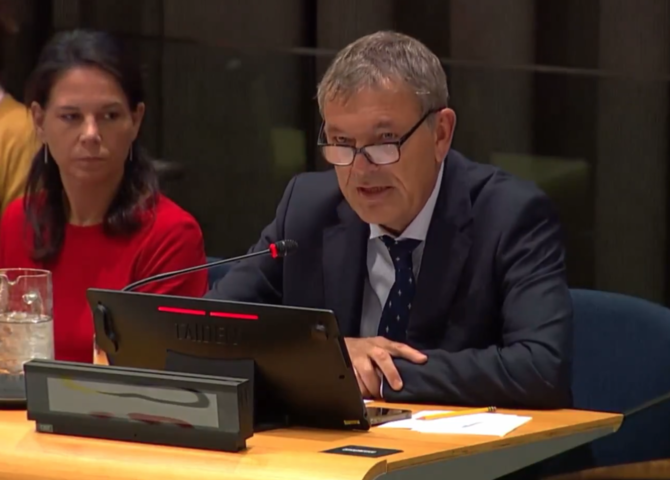
The agency’s head, Philippe Lazzarini, accused Israel of seeking to justify the assassination of Palestinian journalists and deny the reality of famine in Gaza by undermining UNRWA’s reputation.
“For nearly two years, we’ve witnessed an appalling disregard for life and international law in the Occupied Palestinian Territories,” he said.
“History will forever ask our predecessors why they failed to prevent the genocides perpetrated under their watch.”
Lazzarini said UNRWA “continues to stand by Palestinians … against overwhelming odds,” and it is “enabling Palestinians … to build the best possible lives under a brutal occupation.”
Israeli attacks on the agency — both in Gaza and through rhetoric — seek to “dismantle” it, end the refugee status of Palestinians and undermine prospects for a two-state solution, he added.
“UNRWA has been the subject of a fierce and well-funded disinformation campaign spearheaded by the government of Israel. The campaign has targeted lawmakers in donor countries to tarnish the agency’s reputation, and to strangle both political support and funding for its vital work,” he added.
“Similar campaigns are now being deployed to silence other UN entities, international NGOs and public officials to justify assassinating journalists and to deny the reality of famine and other international crimes.”
The agency’s financial shortfall exceeds $200 million, Lazzarini warned, adding that projected income in the first quarter of next year is “far too low to absorb any deficit.”
The war in Gaza is “reshaping the multilateral system in profound ways,” he said, urging UN member states to “push back against the weaponization of humanitarian assistance” and insist on UNRWA’s presence in the Occupied Territories.
The meeting included remarks from an array of Arab foreign ministers and ambassadors to the UN, including Palestinian envoy Riyad Mansour.
“UNRWA is indispensable. UNRWA is the brilliant, most successful story of multilateralism … It’s our obligation to help it in every possible way, politically and financially,” he said.
The agency is “intertwined with the question of Palestine, and it will continue to exist until we have a just, comprehensive solution to the Palestine question,” he added.
Egypt’s Foreign Minister Badr Abdelatty told the meeting that UNRWA is “indispensable in safeguarding the rights and dignity of the Palestinian refugees.”
He added: “Any attempt to undermine UNRWA’s mandate would inflict grave damage on the just cause of Palestine.”
Egypt is continuing “intensive efforts” with US and Qatari mediators to secure a ceasefire in Gaza, Abdelatty said.
“Once a ceasefire is achieved, Egypt will host the international conference for Gaza reconstruction and early recovery to implement the Arab-Islamic Plan for Reconstruction,” he added.
The plan, which lays out a five-year roadmap for Gaza’s reconstruction, was adopted by Arab states earlier this year.
Lebanon’s Foreign Minister Youssef Rajji said his country “expresses its deep concern over the ongoing campaign targeting UNRWA, a campaign that has persisted for over two years.”
UNRWA plays a “central role in safeguarding the rights of Palestinian refugees … and there’s no alternative to the agency,” he added.
UK Foreign Secretary Yvette Cooper paid tribute to the UNRWA staff who “have given their lives while doing their jobs.”
She said: “We must work together to protect this vital mandate, including by supporting necessary reforms to the agency.
“We welcome progress on implementing the recommendations of the Colonna report, and urge UNRWA to continue this effort. UK support for UNRWA remains steadfast.”
Cooper announced an additional $10 million to support the agency, bringing the UK’s total contribution to $37 million this financial year.


