

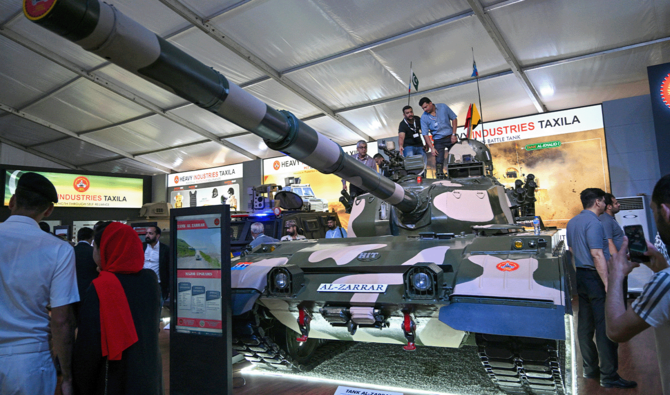

ISLAMABAD: China used this year’s four-day military confrontation between India and Pakistan to test and advertise its advanced weapons systems while deepening defense ties with Islamabad, according to a new report by a US congressional commission released this month.
The US-China Economic and Security Review Commission (USCC), a bipartisan body that reports annually to Congress, says Beijing’s role in the May 7–10 conflict highlighted how Chinese arms and intelligence support for Pakistan is reshaping South Asia’s security balance and complicating Washington’s efforts to manage tensions between two nuclear-armed rivals.
The clash followed an Apr. 22 militant attack near the resort town of Pahalgam in Indian-administered Jammu and Kashmir, where gunmen killed 26 civilians, mostly tourists. India blamed Pakistan-based militants and responded with missile and air strikes on targets in Pakistan and Azad Kashmir, which Pakistan administers, prompting retaliatory Pakistani attacks involving drones, missiles and artillery. Analysts described the fighting, which left dozens dead on both sides, as the most intense India–Pakistan exchange in half a century, before a ceasefire brokered with US help took hold on May 10.
The report situates the conflict in the context of a long-running dispute over Kashmir that has sparked multiple wars and crises since 1947, noting that both governments brought forces to high alert and briefly closed airspace to each other’s commercial flights. The commission says India alleged China provided Pakistan with “live inputs” on about 109 Indian military positions during the crisis, while Beijing and Islamabad rejected those claims as groundless – underscoring how China’s growing role has become a central concern for New Delhi.
“Beijing opportunistically leveraged the conflict to test and advertise the sophistication of its weapons,” the commission said, arguing that the war served as a showcase for Chinese systems in real-world combat.
According to the report, the four-day clash marked the first combat use of several modern Chinese platforms in Pakistan’s inventory, including the HQ-9 air defense system, PL-15 air-to-air missiles and J-10 fighter aircraft. The commission says Pakistan’s “military success” in the confrontation was closely tied to this Chinese hardware, and that Chinese embassies later highlighted those battlefield performances in outreach aimed at boosting global arms sales.
The panel notes that China supplied about 82 percent of Pakistan’s arms imports between 2019 and 2023, citing data from the Stockholm International Peace Research Institute, and says Beijing followed the May war by reportedly offering Islamabad 40 J-35 fifth-generation fighters, KJ-500 airborne early-warning aircraft and new ballistic-missile defense systems. Pakistan, it adds, announced a 20 percent jump in its 2025–26 defense budget to around $9 billion despite broader fiscal pressures.
The report also points to expanding Chinese–Pakistani military cooperation beyond the crisis itself, including Warrior-VIII counterterrorism exercises in late 2024 and China’s participation in Pakistan’s AMAN naval drills in early 2025, which Indian commentators viewed as a direct security challenge.
At the same time, the commission says Beijing waged an online disinformation campaign after the May fighting that sought to undermine India’s French-built Rafale jets and promote China’s own J-35 fighter to foreign buyers, using fabricated battlefield claims and coordinated social-media activity.
Indian officials have publicly accused China of tilting the military balance in Pakistan’s favor. A senior Indian army officer alleged in July that Beijing had provided “live inputs” during the fighting, while Indian media and analysts warned of a growing “China–Pakistan axis.”
Pakistan’s army chief and Chinese diplomats have denied any direct Chinese operational role, insisting the war remained a bilateral India–Pakistan confrontation.
The USCC concludes that, whether or not Beijing directly guided Pakistani operations, the May war illustrated how future India–Pakistan crises are likely to unfold under the shadow of China’s expanding defense industry, data-gathering capabilities and regional ambitions, raising the stakes for crisis management by Washington and other outside powers.


