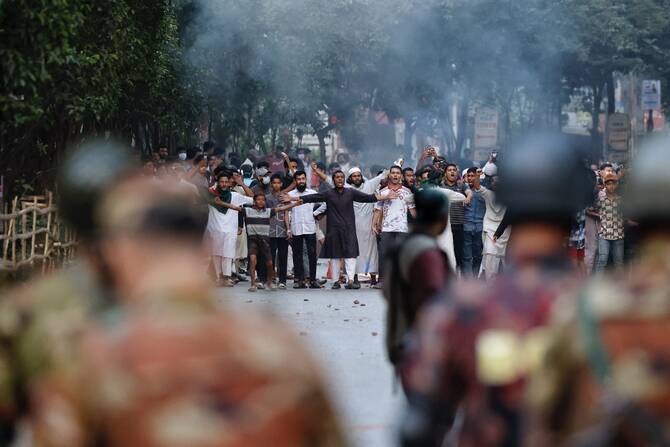
DHAKA: This week’s sentencing to death of Bangladesh’s former Prime Minister Sheikh Hasina on charges of crimes against humanity is seen by her opponents as a chance to move forward for a nation traumatized by the scale of the violent uprising that drove her from power into exile.
Hasina has been in India since Aug. 5 last year, when her 15-year rule ended during the violence that left hundreds of people dead and thousands injured. She has rejected Monday’s verdict, calling it “biased and politically motivated.”
Challenges are enormous for Bangladesh’s interim government led by Nobel Peace Prize Laureate Muhammad Yunus, under pressure to hold a credible election in February after decades of rule by either Hasina or her longtime rival.
Here’s what to know.
A tense election ahead
Bangladesh’s new leaders are determined to move the South Asian nation back to democracy through the upcoming election, one they have made sure won’t include Hasina and her Awami League party. But emotions remain high.
“The interim government has fully suppressed the Awami League … So the level of polarization is at a fever pitch,” said analyst Michael Kugelman, a senior fellow with the Asia Pacific Foundation of Canada.
The biggest concern is violence involving the election, he said.
“Awami League spoilers may try to disrupt the election with unrest. And with Bangladesh’s police force dealing with serious morale issues, there would be concerns about the state’s capacity to manage the violence,” Kugelman said. Police in Bangladesh were on the frontlines of the deadly crackdown in 2024 and some in their ranks were killed after protesters attacked police stations.
Hasina’s son has warned that the party could try to block the election if the ban on its political activities is not lifted and that only an inclusive election could stabilize the country.
A ‘long game’ for Hasina
India is unlikely to extradite Hasina, despite Bangladesh’s renewed call for that following Monday’s verdict.
“Hasina will likely bide her time, continue to manage her party’s affairs from India and play a long game with the hope of a return to politics if circumstances change in the coming years,” Kugelman said. “In the region, dynastic leaders and their parties may take hits, but they never go away.”
Analyst Sabir Mustafa, former head of BBC’s Bengali Service, said that the Awami League could be seriously demoralized without Hasina’s leadership, but that the party needs to reform if it wants to move forward.
“So, Hasina needs to start the party’s reforms herself,” he said, indicating that she has to look to the future if she wants to eventually get back to politics.
Mustafa said the trial was “seriously flawed” and that a death sentence was unjust for a case held in absentia. Despite that, he said it would be a challenge to get her supporters and others out into the streets to protest anytime soon.
Mustafa said that without party reforms and new leadership under the guidance of Hasina, it would be difficult for the Awami League to make a comeback.
“That’s the kind of bullet they have to bite,” he said.
New leader under pressure
Human rights groups and the UN’s High Commissioner for Human Rights have expressed mixed reactions to the verdict and trial process.
Human Rights Watch and Amnesty International raised questions of fairness in the trial process, while the UN rights body said the verdict was “an important moment” for victims of last year’s crackdown that killed hundreds, although it remains opposed to the death penalty in all cases.
Given that, the Yunus-led administration will need to convince the international community about the credibility of the trial process.
For Kugelman, Yunus’ first priority — and his biggest challenge — is ensuring a safe and peaceful environment for the election.
These are high stakes polls: It’s the first election in nearly 20 years in Bangladesh in which there are strong expectations that the vote will be free and fair. The January 2024 election, which swept Hasina to power for a fourth consecutive term, was boycotted by opposition parties and marked by violent protests and international scrutiny.
Mustafa said Yunus has already failed his legacy as a Nobel Peace Price laureate by presiding over many violations, including blatant mob justice, custodial deaths, blanket arrests and jailing of people, some without any specific and credible charges, especially among Hasina supporters.
But he thinks the international community will continue to support the interim leader.
“The challenge before him between now and February is to ensure that things run smoothly and the elections do happen in February in a peaceful and credible manner,” Mustafa said.
He said that, given the electoral ban of the Awami League, Yunus should ensure the election is not rigged by the Bangladesh Nationalist Party, headed by former Prime Minister Khaleda Zia, or the country’s largest Islamist party, Jamaat-e-Islami.
“Thus he can revive his legacy as a Nobel Peace Prize laureate.”


![]()

What former leader Sheikh Hasina’s death sentence means for Bangladesh
Short Url
https://arab.news/mtzzv
What former leader Sheikh Hasina’s death sentence means for Bangladesh
- Bangladesh’s new leaders are determined to move the South Asian nation back to democracy through the upcoming election, one they have made sure won’t include Hasina and her Awami League party


Latest updates



Recommended


© 2026 SAUDI RESEARCH & PUBLISHING COMPANY, All Rights Reserved And subject to Terms of Use Agreement.