

Israeli airstrike on a Palestinian refugee camp in Lebanon kills 13 people, Lebanese ministry says

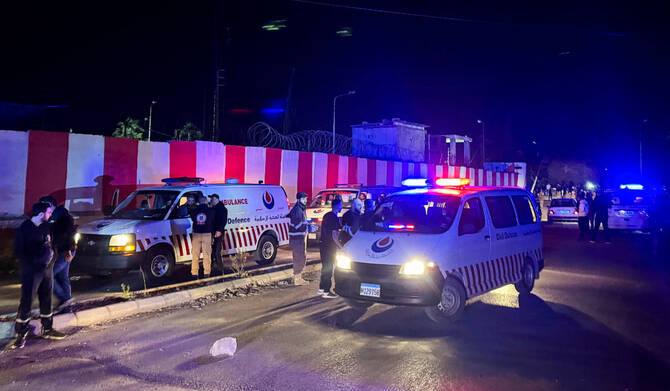
Civil defence vehicles park at the entrance of Ain al-Hilweh Palestinian refugee camp, following an Israeli strike that killed several people, according to the Lebanese Health Ministry, in the southern city of Sidon, Lebanon November 18, 2025. (REUTERS)
Short Url
Updated 19 November 2025
Follow

Israeli airstrike on a Palestinian refugee camp in Lebanon kills 13 people, Lebanese ministry says

  • Hamas condemned the attack in a statement saying the strike hit a sports playground and denying that it was a training compound
  • Lebanon’s Health Ministry has reported more than 270 people killed and around 850 wounded by Israeli military actions since the ceasefire

SIDON, Lebanon: An Israeli airstrike on a Palestinian refugee camp in southern Lebanon on Tuesday killed 13 people and wounded several others, state media and government officials said. It was the deadliest strike on Lebanon since a ceasefire in the Israel-Hezbollah war a year ago.
The drone strike hit a car in the parking lot of a mosque in the Ein el-Hilweh refugee camp on the outskirts of the coastal city of Sidon, the state-run National News Agency said. The Lebanese Health Ministry said 13 people were killed and several others wounded in the airstrike, without giving further details.
Hamas fighters in the area prevented journalists from reaching the scene, as ambulances rushed to evacuate the wounded and the dead.
The Israeli military said it struck a Hamas training compound that was being used to prepare an attack against Israel and its army. It added that the Israeli army would continue to act against Hamas wherever the group operates.
Hamas condemned the attack in a statement saying the strike hit a sports playground and denying that it was a training compound.
Over the past two years, Israeli airstrikes on Lebanon have killed scores of officials from the militant Hezbollah group as well as Palestinian factions such as Hamas.
Saleh Arouri, the deputy political head of Hamas and a founder of the group’s military wing, was killed in a drone strike on a southern suburb of Beirut on Jan. 2, 2024. Several other Hamas officials have been killed in strikes since then.
Hamas led the Oct. 7, 2023 attack on southern Israel that killed about 1,200 people. That sparked Israel’s offensive on the Gaza Strip that killed tens of thousands of Palestinians, according to the Gaza Health Ministry.
A day after the Israel-Hamas war started, Hezbollah began firing rockets toward Israeli posts along the border. Israel responded with shelling and airstrikes in Lebanon, and the two sides became locked in an escalating conflict that became a full-blown war in late September 2024.
That war, the most recent of several conflicts involving Hezbollah over the past four decades, killed more than 4,000 people in Lebanon, including hundreds of civilians, and caused an estimated $11 billion worth of destruction, according to the World Bank. In Israel, 127 people died, including 80 soldiers.
The war ended in late November 2024 with a US-brokered ceasefire. Since then, Israel has carried out scores of airstrikes in Lebanon, saying that Hezbollah is trying to rebuild its capabilities.
Lebanon’s Health Ministry has reported more than 270 people killed and around 850 wounded by Israeli military actions since the ceasefire.


Syria’s growth accelerates as sanctions ease, refugees return

Updated 06 December 2025
Follow

Syria’s growth accelerates as sanctions ease, refugees return

  • Economy grows much faster than World Bank’s 1% estimate, fueling plans for currency’s relaunch

NEW YORK: Syria’s economy is growing much faster than the World Bank’s 1 percent estimate for 2025 as refugees flow back after the end of a 14-year civil war, fueling plans for the relaunch of the country’s currency and efforts to build a new Middle East financial hub, central bank Governor AbdulKader Husrieh has said.

Speaking via video link at a conference in New York, Husrieh also said he welcomed a deal with Visa to establish digital payment systems and added that the country is working with the International Monetary Fund to develop methods to accurately measure economic data to reflect the resurgence. 

The Syrian central bank chief, who is helping guide the war-torn country’s reintegration into the global economy after the fall of Bashar Assad’s regime about a year ago, described the repeal of many US sanctions against Syria as “a miracle.”

The US Treasury on Nov. 10 announced a 180-day extension of the suspension of the so-called Caesar sanctions against Syria; lifting them entirely requires approval by the US Congress. 

Husrieh said that based on discussions with US lawmakers, he expects the sanctions to be repealed by the end of 2025, ending “the last episode of the sanctions.”

“Once this happens, this will give comfort to our potential correspondent banks about dealing with Syria,” he said.

Husrieh also said that Syria was working to revamp regulations aimed at combating money laundering and the financing of terrorism, which he said would provide further assurances to international lenders. 

Syria’s central bank has recently organized workshops with banks from the US, Turkiye, Jordan and Australia to discuss due diligence in reviewing transactions, he added.

Husrieh said that Syria is preparing to launch a new currency in eight note denominations and confirmed plans to remove two zeroes from them in a bid to restore confidence in the battered pound.

“The new currency will be a signal and symbol for this financial liberation,” Husrieh said. “We are glad that we are working with Visa and Mastercard,” Husrieh said.