UN approves US plan authorizing an international stabilization force in Gaza

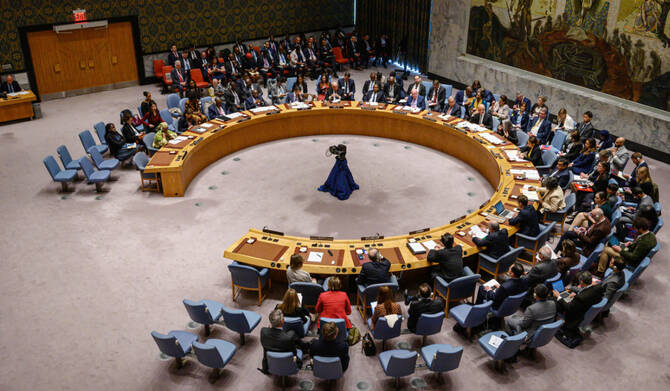
A general view shows a United Nations security council meeting on the protection of civilians in armed conflict, at the UN headquarters in New York. (AFP)
Short Url
Updated 18 November 2025
Follow

UN approves US plan authorizing an international stabilization force in Gaza

  • Russia, which had circulated a rival resolution, abstained along with China on the 13-0 vote
  • During nearly two weeks of negotiations on the US resolution, Arab nations and the Palestinians had pressed the United States to strengthen the original weak language about Palestinian self-determination
  • Hamas says resistance against Israel by all means is legitimate, rejects to disarm

UNITED NATIONS: The UN Security Council on Monday approved a US plan for Gaza that authorizes an international stabilization force to provide security in the devastated territory and envisions a possible future path to an independent Palestinian state.
Russia, which had circulated a rival resolution, abstained along with China on the 13-0 vote. The US and other countries had hoped Moscow would not use its veto power on the United Nations’ most powerful body to block the resolution’s adoption.
The vote was a crucial next step for the fragile ceasefire and efforts to outline Gaza’s future following two years of war between Israel and Hamas. Arab and other Muslim countries that expressed interest in providing troops for an international force had signaled that Security Council authorization was essential for their participation.
The US resolution endorses President Donald Trump’s 20-point ceasefire plan, which calls for a yet-to-be-established Board of Peace as a transitional authority that Trump would head. It also authorizes the stabilization force and gives it a wide mandate, including overseeing the borders, providing security and demilitarizing the territory. Authorization for the board and force expire at the end of 2027.
US Ambassador Mike Waltz called the resolution “historic and constructive,” saying it starts a new course in the Middle East.
“Today’s resolution represents another significant step toward a stable Gaza that will be able to prosper and an environment that will allow Israel to live in security,” he said. He stressed that the resolution “is just the beginning.”

The Palestinian Foreign Ministry welcomed on Tuesday the UN vote on Gaza and urged its immediate implementation.

Indonesia also welcomed the UN Security Council’s adoption of a US drafted resolution endorsing President Donald Trump’s plan to end the war in Gaza, the foreign ministry said.

German Foreign Minister Johann Wadephul said on Tuesday the adoption of a resolution to end the war in Gaza by the United Nations Security Council was “good news.”
After meeting his Serbian counterpart in Belgrade, Wadephul said Germany remained ready to “play a constructive role in reconstruction of Gaza.” 
Stronger language on Palestinian state helps get the US plan over the finish line
During nearly two weeks of negotiations on the US resolution, Arab nations and the Palestinians had pressed the United States to strengthen the original weak language about Palestinian self-determination.
The US revised it to say that after the Palestinian Authority — which now governs parts of the West Bank — makes reforms and after redevelopment of the devastated Gaza Strip advances, “the conditions may finally be in place for a credible pathway to Palestinian self-determination and statehood.”
“The United States will establish a dialogue between Israel and the Palestinians to agree on a political horizon for peaceful and prosperous coexistence,” it adds.
That language angered Israeli Prime Minister Benjamin Netanyahu, who had vowed to oppose any attempt to establish a Palestinian state. He has long asserted that creating a Palestinian state would reward Hamas and eventually lead to an even larger Hamas-run state on Israel’s borders.
A key to the resolution’s adoption was support from Arab and Muslim nations pushing for a ceasefire and potentially contributing to the international force. The US mission to the United Nations distributed a joint statement Friday with Qatar, Egypt, United Arab Emirates, Saudi Arabia, Indonesia, Pakistan, Jordan and Turkiye calling for “swift adoption” of the US proposal.
Russia had floated its own plan
The vote took place amid hopes that Gaza’s fragile ceasefire would be maintained after a war set off by Hamas’ surprise attack on southern Israel on Oct. 7, 2023, which killed about 1,200 people. Israel’s more than two-year offensive has killed over 69,000 Palestinians, according to the Gaza health ministry, which doesn’t distinguish between civilians and combatants but says the majority are women and children.
Russia last week suddenly circulated a rival proposal with stronger language supporting a Palestinian state alongside Israel and stressed that the West Bank and Gaza must be joined as a state under the Palestinian Authority.
It also stripped out references to the transitional board and asked UN Secretary-General Antonio Guterres to provide options for an international force to provide security in Gaza and for implementing the ceasefire plan, stressing the importance of a Security Council role.
What else the US proposal says
The US resolution calls for the stabilization force to ensure “the process of demilitarizing the Gaza Strip” and “the permanent decommissioning of weapons from non-state armed groups.” A big question is how to disarm Hamas, which has not fully accepted that step.
It authorize the force “to use all necessary measures to carry out its mandate” in compliance with international law, which is UN language for the use of military force.
The resolution says the stabilization troops will help secure border areas, along with a Palestinian police force that they have trained and vetted, and they will coordinate with other countries to secure the flow of humanitarian assistance. It says the force should closely consult and cooperate with neighboring Egypt and Israel.
As the international force establishes control and brings stability, the resolution says Israeli forces will withdraw from Gaza “based on standards, milestones, and timeframes linked to demilitarization.” These must be agreed to by the stabilization force, Israeli forces, the US and the guarantors of the ceasefire, it says.


Netanyahu says Israel and Hamas will enter ceasefire’s second phase soon

Updated 08 December 2025
Follow

Netanyahu says Israel and Hamas will enter ceasefire’s second phase soon

  • Says the second phase addresses the disarming of Hamas and withdrawal of Israeli troops from Gaza
  • Second stage also includes the deployment of an international force to secure Gaza and forming a temporary Palestinian government

TEL AVIV, Israel: Israeli Prime Minister Benjamin Netanyahu said Sunday that Israel and Hamas are “very shortly expected to move into the second phase of the ceasefire,” after Hamas returns the remains of the last hostage held in Gaza.
Netanyahu spoke during a news conference with visiting German Chancellor Friedrich Merz and stressed that the second phase, which addresses the disarming of Hamas and the withdrawal of Israeli troops from Gaza, could begin as soon as the end of the month.
Hamas has yet to hand over the remains of Ran Gvili, a 24-year-old police officer who was killed in the Hamas-led Oct. 7, 2023, attack that sparked the war. His body was taken to Gaza.
The ceasefire’s second stage also includes the deployment of an international force to secure Gaza and forming a temporary Palestinian government to run day-to-day affairs under the supervision of an international board led by US President Donald Trump.
A senior Hamas official on Sunday told The Associated Press the group is ready to discuss “freezing or storing or laying down” its weapons as part of the ceasefire in a possible approach to one of the most difficult issues ahead.

Netanyahu says second phase will be challenging
Netanyahu said few people believed the ceasefire’s first stage could be achieved, and the second phase is just as challenging.
“As I mentioned to the chancellor, there’s a third phase, and that is to deradicalize Gaza, something that also people believed was impossible. But it was done in Germany, it was done in Japan, it was done in the Gulf States. It can be done in Gaza, too, but of course Hamas has to be dismantled,” he said.
The return of Gvili’s remains — and Israel’s return of 15 bodies of Palestinians in exchange — would complete the first phase of Trump’s 20-point ceasefire plan.
Hamas says it has not been able to reach all remains because they are buried under rubble left by Israel’s two-year offensive in Gaza. Israel has accused the militants of stalling and threatened to resume military operations or withhold humanitarian aid if all remains are not returned.
A group of families of hostages said in a statement that “we cannot advance to the next phase before Ran Gvili returns home.”
Meanwhile, Israeli military Chief of Staff Lt. Gen. Eyal Zamir on Sunday called the so-called Yellow Line that divides the Israeli-controlled majority of Gaza from the rest of the territory a “new border.”
“We have operational control over extensive parts of the Gaza Strip and we will remain on those defense lines,” Zamir said. “The Yellow Line is a new border line, serving as a forward defensive line for our communities and a line of operational activity.”
Germany says support for Israel is unchanged
Merz said Germany, one of Israel’s closest allies, is assisting with the implementation of the second phase by sending officers and diplomats to a US-led civilian and military coordination center in southern Israel, and by sending humanitarian aid to Gaza.
The chancellor also said Germany still believes that a two-state-solution is the best possible option but that “the German federal government remains of the opinion that recognition of a Palestinian state can only come at the end of such a process, not at the beginning.”
The US-drafted plan for Gaza leaves the door open to Palestinian independence. Netanyahu has long asserted that creating a Palestinian state would reward Hamas and eventually lead to an even larger Hamas-run state on Israel’s borders.
Netanyahu also said that while he would like to visit Germany, he hasn’t planned a diplomatic trip because he is concerned about an arrest warrant issued by the International Criminal Court, the UN’s top war crimes court, last year in connection with the war in Gaza.
Merz said there are currently no plans for a visit but he may invite Netanyahu in the future. He added that he is not aware of future sanctions against Israel from the European Union nor any plans to renew German bans on military exports to Israel.
Germany had a temporary ban on exporting military equipment to Israel, which was lifted after the ceasefire began on Oct. 10.
Israel kills militant in Gaza
The Israeli military said it killed a militant who approached its troops across the Yellow Line.
Gaza’s Health Ministry says Israeli forces have killed more than 370 Palestinians since the start of the ceasefire, and that the bodies of six people killed in attacks had been brought to local hospitals over the past 24 hours.
In the original Hamas-led attack in 2023, the militants killed around 1,200 people and took more than 250 others hostage. Almost all the hostages or their remains have been returned in ceasefires or other deals.
Israel’s offensive in Gaza has killed at least 70,360 Palestinians, according to Gaza’s Health Ministry, which operates under the Hamas-run government. The ministry does not differentiate between civilians and combatants, but says that nearly half the dead have been women and children. The ministry is part of Gaza’s Hamas government and its numbers are considered reliable by the UN and other international bodies.