

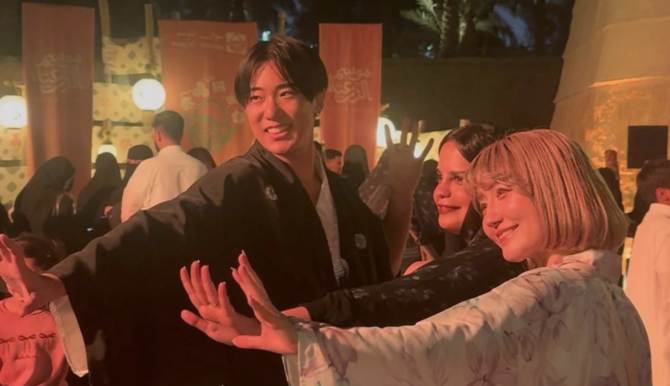

RIYADH: In the heart of Saudi Arabia’s Diriyah’s historic district, a special event at Souq Al-Mawsim marked the 70th anniversary of diplomatic relations between the Kingdom and Japan.
The celebration brought together Najdi and Japanese heritage, highlighting the longstanding ties between the two nations, according to Al-Eqtisadiah.
These relations, however, did not begin only 70 years ago; their roots stretch back over a century, when the Japanese pilgrim Yamaoka Kotaro, made his first visit to perform Hajj, inspiring others through the accounts he recorded in his books.
Although Kotaro’s journey was religious in nature, it laid the foundation for communication between the two countries, long before formal diplomatic relations were established.
Over the years, the relationship between Saudi Arabia and Japan has expanded to encompass broader economic ties through a long trajectory of cooperation. In the first four months of 2024, bilateral trade reached approximately $9.3 billion.
A broad area of economic cooperation
Japan stands out as a major trade partner for Saudi Arabia and its primary energy supplier. Last year, the Kingdom exported 988,000 barrels of oil per day to Japan, accounting for 41.3 percent of Japan’s crude imports in June alone.
At the same time, Japanese direct investments in Saudi Arabia have surpassed $6.3 billion, with the launch of the joint strategic investment platform last September to support new projects under the Saudi-Japan 2030 Vision.
The platform, a collaboration between the Saudi Ministry of Investment and the Japan Business Association, aims to direct investments toward targeted sectors outlined in the vision, further supporting the diversification of the Kingdom’s economy.
A shared cultural heritage expressed differently
Culturally, the scene at Souq Al-Mawsim was even more tangible, as the Najdi mahffah, which mean palm-leaf fan in English and the Japanese folding fan were displayed side by side, symbolizing a shared appreciation for traditional craftsmanship and heritage in both countries.
While Saudis crafted the mahaffah from palm fronds at the handicraft corner, Japanese artisans demonstrated their traditional skills through beautifully crafted paper fans.
In the games area, Saudi and Japanese children exchanged traditional toys, revealing remarkable similarities despite differences in the tools and forms of expression.


