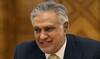
Deputy PM Dar in Moscow to lead Pakistan delegation at SCO summit

Pakistan's Deputy Prime Minister Ishaq Dar (second left) is seen at Nur Khan Airbase in Rawalpindi, Pakistan, on November 17, 2025, leaving for Moscow to attend the SCO summit. (Pakistan Government)
Short Url
Updated 17 November 2025
Follow

Deputy PM Dar in Moscow to lead Pakistan delegation at SCO summit

  • Two-day summit features senior officials from China, Iran, India, Central Asian states, Russia
  • Deputy PM Ishaq Dar will share Pakistan’s perspective on regional, global issues at the forum

ISLAMABAD: Deputy Prime Minister Ishaq Dar on Monday arrived in Moscow to lead Pakistan’s delegation at the two-day Shanghai Cooperation Organization’s (SCO) Council of Heads of Government (CHG) summit, the Pakistani foreign ministry said.

The SCO is an intergovernmental organization that strives to strengthen cooperation between member states in politics, trade, economy, science and technology, culture, education, energy, transport, tourism, environmental sectors.

The CHG is the second highest SCO forum that deals with economic, trade, social, cultural and humanitarian issues, as well as budgetary matters related to the organization. Dar will present the country’s stance on regional and global issues at the summit.

Upon arrival at the airport, Dar was received by Russian Deputy Foreign Minister Mikhail Galuzin along with other Russian and Pakistani diplomatic officials, according to the Pakistani foreign ministry.

“In his address to the SCO CHG, the Deputy Prime Minister will share Pakistan’s perspective on important regional and global issues as well as ways to strengthen the Organization for the benefit of the SCO region,” state broadcaster Radio Pakistan reported.

The CHG summit on Nov. 17-18 will be attended by the heads of government from Belarus, China, Kazakhstan, Kyrgyzstan, Russia, Tajikistan and Uzbekistan and the vice president of Iran as well as the foreign minister of India, according to the Pakistani foreign ministry.

In addition to SCO member States, the heads of the governments of Mongolia, Bahrain, Egypt, Qatar, Kuwait, Turkmenistan and heads of international organizations including Commonwealth of Independent States (CIS), Euro Asian Economic Union (EAEU), Collective Security Treaty Organization (CSTO) and Democratic Socialists of America (DSA) will also be attending the meeting.

The foreign ministry in Islamabad said Dar, who also serves as Pakistan’s foreign minister, will hold bilateral meetings with the leaders of other SCO countries on the sidelines of the summit.

This will be the second time this year that Pakistan and India will be attending a SCO summit after their brief four-day military confrontation in May that left more than 70 people dead on both sides before Washington brokered a ceasefire on May 10.

Pakistani PM Shehbaz Sharif and his Indian counterpart Narendra Modi had participated in a SCO summit hosted by China in August this year.


Pakistani PM seeks faster reform implementation in talks with World Bank chief 

Updated 8 sec ago
Follow

Pakistani PM seeks faster reform implementation in talks with World Bank chief 

  • 10-year World Bank framework announced last year will focus $20 billion in lending to Pakistan over the coming decade on development issues 
  • Ajay Banga is on his first official visit to Pakistan as head of World Bank Group and as Islamabad works to advance multi-year reform agenda 

ISLAMABAD: Pakistani Prime Minister Shehbaz Sharif and World Bank Group President Ajay Banga agreed on Monday on the need to accelerate implementation and strengthen oversight of development priorities, as Islamabad seeks to deliver reforms “at speed and scale” under the World Bank’s Country Partnership Framework (CPF), Sharif’s office said.

Banga is on his first official visit to Pakistan as head of the World Bank Group and as the country works to advance a multi-year reform agenda supported by international financial institutions, including the World Bank and the International Monetary Fund.

According to a statement issued by the Prime Minister’s Office, Sharif welcomed Banga and acknowledged the World Bank Group’s long-standing partnership with Pakistan, particularly its support through the 10-year CPF announced last year. The one-of-a-kind plan will focus $20 billion in lending to the cash-strapped nation over the coming decade on development issues like the impact of climate change as well as boosting private-sector growth.

The prime minister said Pakistan was pursuing a comprehensive, domestically driven reform program aimed at achieving sustainable economic stability, the statement said, adding that the government was working across multiple sectors, including energy, agribusiness, digital development, fiscal reforms and job creation.

“Prime Minister and Mr.Banga reiterated the need to fast-track implementation and ensure strong oversight to deliver impact at speed and scale on CPF-aligned priorities,” a statement from Sharif’s office said.

“These measures would duly assist Prime Minister’s initiative to address and resolve Implementation bottlenecks in development projects.”

Sharif also reaffirmed the government’s commitment to structural reforms aimed at unlocking job-rich growth and strengthening investor confidence, according to the statement.

According to the statement, Banga welcomed Pakistan’s ongoing reform efforts and reaffirmed the World Bank Group’s commitment to deepening cooperation through what he described as a “One World Bank Group” approach, the statement said. 

“Greater leverage of private resources, in addition to strong coordination with development partners, is necessary to meet the ambition of the government’s reform agenda,” the statement quoted Banga as saying.

Pakistan has relied heavily on multilateral financing and development support in recent years as it navigates balance-of-payments pressures, high inflation and the need for deep-seated structural reforms to boost growth and resilience.

The South Asian nation is currently under a $7 billion International Monetary Fund bailout program, which requires the country to boost government revenues and shore up external sources of financing, much of which comes from loans from China and Gulf nations.

Announcing the CPF last January, Sharif said in a post on social media platform X that the new plan would focus the global institution’s pledge of $20 billion in areas including clean energy and climate resilience in the ten years from 2026.

The World Bank said in a statement at the time that policy and institutional reforms to boost private sector growth and expand fiscal space for government investment in crucial areas would also be key to the CPF.

“We are focused on prioritising investment and advisory interventions that will help crowd-in much needed private investment in sectors critical for Pakistan’s sustainable growth and job creation, including energy and water, agriculture, access to finance, manufacturing and digital infrastructure,” said Zeeshan Sheikh, the World Bank’s International Finance Corporation Country Manager for Pakistan and Afghanistan in a statement.

The World Bank has currently committed about $17 billion to Pakistan for 106 projects.