

Lahore’s toxic smog takes toll on fruit vendors struggling to ‘make ends meet’ 

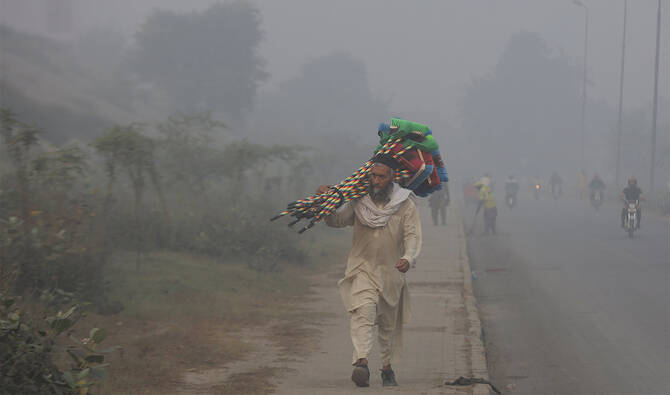
A man walks carrying a bunch of cleaning brushes on his shoulder while selling them along a road amid smog and air pollution in the morning, in Lahore, Pakistan, on October 30, 2025. (REUTERS/File)
Short Url
Updated 17 November 2025
Follow

Lahore’s toxic smog takes toll on fruit vendors struggling to ‘make ends meet’ 

  • Swiss monitoring agency IQAir frequently ranks Lahore among world’s most polluted cities 
  • Air pollutants, vehicle emissions, agricultural fires worsen Lahore’s smog every year in winter

LAHORE: Dense toxic smog blanketed Pakistan’s second biggest city Lahore on Saturday (November 15), with air quality hitting “hazardous” levels and posing a health threat to the city’s millions, particularly those working outdoors and exposed, data from the Swiss group IQAir showed.

Lahore recorded an Air Quality Index (AQI) of 344 at 8 am local time (0300 GMT), making it world’s second most polluted city after the Indian capital Delhi among the list of polluted major cities.

Fruit vendors, who ply their trade outdoors by buying fruits at wholesale markets and then selling them on carts and roadside stalls, say they are especially vulnerable to health problems caused by the smog, and struggle to make ends meet if they can’t work due to sickness.

“I went to the (wholesale) fruit market as early as 7 in the morning to buy fruit. Yes, smog is affecting throats, causes cold, cough and irritation to eyes. I fell ill two, three times and stayed home. But it is necessary to come here to run the business to make ends meet, even if one is sick,” said one fruit vendor, Mohammad Amir.

Khalid Mehmood, an elderly fruit vendor, told Reuters, “at times we fall ill and we are unable to make ends meet. It brings poverty to our families.”

Each winter, plain areas of Punjab province — of which Lahore is the capital — are gripped by thick smog as cold, heavy air traps pollutants from construction dust, vehicle emissions, and agricultural fires. While the provincial government has previously deployed measures such as anti-smog guns, these offer only temporary relief, leaving vulnerable populations exposed.


Pakistan telecom authority approves PTCL’s $400 million deal to acquire Telenor

Updated 6 sec ago
Follow

Pakistan telecom authority approves PTCL’s $400 million deal to acquire Telenor

  • Deal will see PTCL’s mobile arm Ufone merge with Telenor Pakistan to create second-largest mobile operator
  • Regulator says will closely monitor transaction, urges both companies to ensure continuity, quality of services 

ISLAMABAD: The Pakistan Telecommunication Authority (PTA) announced this week it has granted a no objection certificate to the Pakistan Telecommunication Company Limited (PTCL) to push ahead with its $400 million deal to acquire Telenor Pakistan. 

The major acquisition, which was announced earlier this year, will merge PTCL’s mobile arm Ufone with Telenor Pakistan to create the country’s second-largest mobile operator.

The development takes place as Pakistan’s telecom industry faces rising costs and regulatory pressures.

 “PTA evaluated the transaction’s impact on market competition and consumer interests, and consulted relevant government bodies to ensure full compliance with statutory requirements,” the authority said in a statement issued late Saturday. 

The PTA said both companies must ensure continuity and quality of services to consumers, urging them to uphold all license obligations during the transaction. 

“PTA will closely monitor the process to safeguard consumer rights and maintain a competitive and forward-looking telecom sector,” it added. 

PTCL had earlier said the acquisition will improve customer experience, enhance network quality and coverage, while enabling the whole sector to achieve greater efficiency, build resilient infrastructure and create a more competitive landscape. 

The deal is expected to reshape Pakistan’s telecom landscape, which has four major operators but remains under pressure from thin margins, high spectrum fees and heavy capital expenditure needs.