


BEIRUT: The UN peacekeeping force in Lebanon has reiterated its appeal to the Israeli army to stop any acts of aggression or attacks on or near its soldiers.
These forces are working to support efforts to restore stability, a goal that Israel and Lebanon claim to be pursuing, it said.
The appeal came after Israeli forces fired upon UNIFIL soldiers near an Israeli-occupied position in Lebanese territory on Sunday.
The incident was described by UNIFIL as a “serious violation of UN Security Council Resolution 1701.”
FASTFACT
The Lebanese military said in a statement that Israeli violations of its sovereignty caused instability within the country and hindered its own forces from deploying in the south
UNIFIL confirmed in a statement that an Israeli army Merkava tank “fired heavy machine gun rounds at UNIFIL peacekeepers who were approximately 5 meters away from an Israeli-established position inside Lebanese territory. The soldiers were on foot and had to take cover in the area.”
UNIFIL reported that “through its communication channels, the peacekeepers requested the Israeli army to cease fire. They were able to leave safely after 30 minutes, when the Merkava tank withdrew to a position held by the Israeli army. Fortunately, no one was injured.”
Israeli army spokesman Avichai Adraee said in a post on his X account that two suspicious individuals were observed near Hamamis in southern Lebanon.
He said that Israeli forces fired warning shots to deter them, and the individuals left the area without any injuries.
After examining the incident, Adraee said it became clear that the two individuals were UNIFIL soldiers conducting a patrol in the area.
They were identified as suspects because of the adverse weather conditions. The incident is currently under investigation, Israel said.
Adraee also claimed that there was no intentional firing at UNIFIL soldiers, and the issue was being addressed through official military coordination channels.
The incident involving Israelis shooting at peacekeepers happened less than 48 hours after UNIFIL disclosed a significant Israeli development within Lebanese territory.
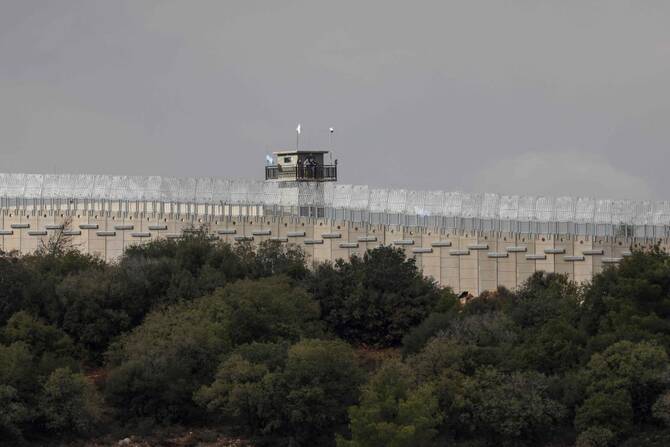
On Friday, the international force confirmed that the Israeli army has built walls within Lebanese territory, close to the UN-demarcated Blue Line.
In October, UNIFIL forces inspected a T-shaped concrete wall built by the Israeli army southwest of the Lebanese border town of Yaroun.
The survey revealed that the wall extended beyond the Blue Line, making more than 4,000 sq. meters of Lebanese land inaccessible to the Lebanese people.
In November, peacekeepers noted the construction of additional T-shaped walls in the area.
The survey indicated that a section of the wall southeast of Yaroun extends beyond the Blue Line, leading to calls for Israel’s withdrawal.
The Lebanese Army Command described the shooting at the peacekeepers as “a violation of Lebanese sovereignty, which is condemned.”
The Israeli attacks are destabilizing Lebanon and obstructing army deployment in the south.
The Lebanese Army Command issued a statement, confirming that it is collaborating with friendly countries to address the continuing breaches by Israel.
These actions require immediate attention, because they signify a serious escalation.
An official political source told Arab News that the attack on UNIFIL was most likely an Israeli message responding to UNIFIL’s disclosure of the Israeli army’s activities around its positions in Lebanon.
The Lebanese army, deployed south of the Litani River, lacks full control over the entire border region due to the Israeli occupation of strategic points in that area.
UNIFIL’s disclosure of Israeli activities has caused discontent in Israel. It is possible that the Lebanese army was aware of these events and informed UNIFIL, which subsequently revealed the information.
UNIFIL consistently emphasizes Israeli offences under the ceasefire agreement in all its statements and during meetings of its mechanism.
Despite Israel’s denial of constructing the wall, Lebanese President Joseph Aoun requested on Friday evening that the foreign ministry instruct Lebanon’s Permanent Mission to the UN to file an urgent complaint with the Security Council.
Aoun requested that the complaint include UN reports that contradict Israel’s denial that they are building a wall and confirming UNIFIL’s notification to Israel about its removal.
Lebanon says Israel's continued presence and activities in Lebanese territory violate UN Resolution 1701 and the country’s sovereignty.


