

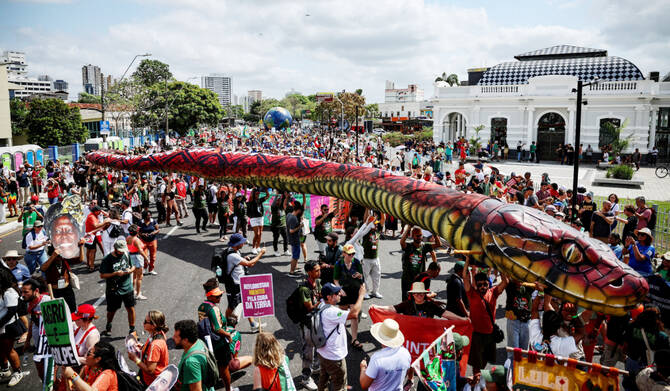

BELEM, Brazil: Some wore black dresses to signify a funeral for fossil fuels. Hundreds wore red shirts, symbolizing the blood of colleagues fighting to protect the environment. And others chanted, waved huge flags or held up signs Saturday in what’s traditionally the biggest day of protest at the halfway point of annual United Nations climate talks.
Organizers with booming sound systems on trucks with raised platforms directed protesters from a wide range of environmental and social movements. Marisol Garcia, a Kichwa woman from Peru marching at the head of one group, said protesters are there to put pressure on world leaders to make “more humanized decisions.”
The demonstrators walked about 4 kilometers (about 2.5 miles) on a route that took them near the main venue for the talks, known as COP30. Protesters earlier this week twice disrupted the talks by surrounding the venue, including an incident Tuesday where two security guards suffered minor injuries.
A full day of sessions was planned at the venue, including talks on how to move forward with $300 billion a year in annual climate financial aid that rich countries agreed last year to give to poor nations to help wean themselves off fossil fuels, adapt to a nastier, warmer world and compensate for extreme weather damage.
Many of the protesters reveled in the freedom to demonstrate more openly than at recent climate talks held in more authoritarian countries, including Azerbaijan, the United Arab Emirates and Egypt. Thousands of people joined in a procession that sprawled across most of the march’s route.
Youth leader Ana Heloisa Alves, 27, said it was the biggest climate march she has been part of. “This is incredible,” she said. “You can’t ignore all these people.”
Alves was at the march to fight for the Tapajos River, which the Brazilian government wants to develop commercially. “The river is for the people,” her group’s signs read.
Pablo Neri, coordinator in the Brazilian state of Para for the Movimento dos Trabajadores Rurais Sem Terra, an organization for rural workers, said organizers of the talks should involve more people to reflect a climate movement that is shifting toward popular participation.
The United States, where President Donald Trump has ridiculed climate change as a scam and withdrawn from the landmark 2015 Paris Agreement that sought to limit Earth’s warming, is skipping the talks.
Demonstrator Flavio Pinto, of Para state, took aim at the US Wearing a brown suit and an oversized American flag top hat, he shifted his weight back and forth on stilts and fanned himself with fake hundred-dollar bills with Trump’s face on them. “Imperialism produces wars and environmental crises,” his sign read.
Vitoria Balbina, a regional coordinator for the Interstate Movement of Coconut Breakers of Babaçu, marched with a group of mostly women wearing domed hats made with fronds of the Babaçu palm. They were calling for more access to the trees on private property that provide not only their livelihoods but also a deep cultural significance. She said marching is not only about fighting and resistance on a climate and environment front, but also about “a way of life.”
The marchers formed a sea of red, white and green flags as they progressed up a hill. A crowd of onlookers gathered outside a corner supermarket to watch them approach, leaning over a railing and taking cellphone photos. “Beautiful,” said a man passing by, carrying grocery bags.
The climate talks are scheduled to run through Friday. Analysts and some participants have said they don’t expect any major new agreements to emerge from the talks, but are hoping for progress on some past promises, including money to help poor countries adapt to climate change.


