

Venture ecosystem rewires real estate sector

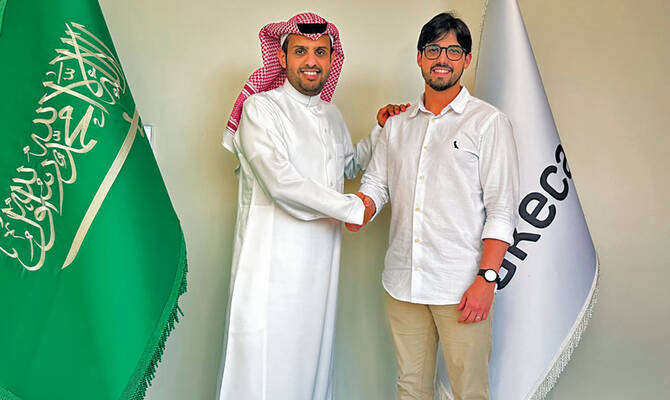
Founded in 2017 by Hassan Al-Balawi and Ishita Sood, WakeCap enables real-time workforce monitoring to improve safety and productivity. (Supplied)
Short Url
Updated 15 November 2025
Follow

Venture ecosystem rewires real estate sector

  • Saudi startup Builtop raises $11m in a funding round led by TAM Capital

RIYADH: Construction, real estate, and digital infrastructure dominated this week’s venture landscape across the Middle East and beyond, with startups securing strategic funding, forging cross-border acquisitions, and unveiling innovative financial tools. 

Builtop, a Saudi digital procurement startup focused on the construction and real estate sectors, has raised $11 million in a funding round led by TAM Capital, with participation from other investors. 

The company, founded in 2024 by Ayman Al-Johani, provides embedded finance tools including “pay-later” trade credit to improve cashflow and streamline project delivery for contractors and suppliers.  The platform integrates digital procurement with AI-driven tools to enhance transparency and operational efficiency. 

The newly raised funds will be used to expand Builtop’s presence across Saudi Arabia, improve its AI-based systems, and develop solutions tailored to large-scale infrastructure projects aligned with Vision 2030. 

WakeCap acquires Brazil’s Trackfy 

WakeCap, a Saudi construction tech company specializing in wearable technology for building sites, has acquired Brazil-based Trackfy, a workforce safety and operational intelligence platform. The acquisition gives WakeCap a foothold in Latin America, establishing Brazil as its new regional headquarters. 

Founded in 2017 by Hassan Al-Balawi and Ishita Sood, WakeCap enables real-time workforce monitoring to improve safety and productivity. 

The deal also extends WakeCap’s platform beyond construction into operations and maintenance, allowing clients to manage projects through the entire facility lifecycle. The acquisition follows WakeCap’s $28 million investment round closed in May. 

Binbar and Joa Capital launch $133.33m fund 

Binbar Investment has signed a strategic partnership with Joa Capital, with Rabeh as technical adviser, to launch the Marhoon Fund — Saudi Arabia’s first direct financing outlet secured through lease and usufruct contracts. 

The SR500 million($133.33 million) fund aims to provide companies with access to alternative financing tools backed by operational assets. 


Hotdesk, Al Maryah Community Bank, Emirates Coin Investment, and Singularity Venture Hub have announced the upcoming launch of DESK Token pending regulatory approval. (Supplied)

Nasser Al-Majed, chairman of Binbar Real Estate, said the company is focused on “creating differentiated real estate products,” and the Marhoon Fund represents a key step in offering direct financing solutions for the Kingdom’s rental market. 

CEO Majed Al-Zahrani added that it “fosters trust among investors, developers, and tenants alike” and that “direct financing backed by usufruct contracts represents a transformative shift.” 

Yousef Al-Yousefi, CEO of Joa Capital, stated the partnership reflects confidence in the real estate market’s strength and is aligned with their mission to “develop innovative financial solutions to support private sector growth.” 

Hotdesk, partners unveil first-of-its-kind real estate investment tech 

In a multi-stakeholder initiative, Hotdesk, Al Maryah Community Bank, Emirates Coin Investment, and Singularity Venture Hub have announced the upcoming launch of DESK Token, described as the world’s first asset-backed hybrid token combining real estate investment and utility. 

The token is expected to launch in the second quarter of 2026, pending regulatory approval. 

Mohamed Khaled, founder and CEO of Hotdesk and co-founder of DESK, said the token aims to “make real estate investment borderless, liquid, and useful in the real world,” enabling users to access yield-generating office property through a blockchain-based model. 

Al Maryah Community Bank CEO Mohammed Khayata emphasized the token’s role in bridging traditional finance and digital assets, while Robert Wils of Singularity Venture Hub described it as “the next evolution of tokenized finance.” 

DESK holders will also have access to coworking spaces via Hotdesk’s global platform and can earn returns in stablecoins or cash. 

DataCamp acquires Optima 

DataCamp, the US- and London-based education tech platform, has acquired Optima, an AI-native adaptive learning startup. 

The UAE-based firm, founded in 2023 by Yusuf Saber, delivers personalized lessons and real-time feedback to learners, helping individuals and enterprises build data and AI skills. 

The company had previously raised $1.1 million in seed funding from COTU Venture and others. 

The acquisition marks DataCamp’s first major expansion into the Middle East and will include the launch of DataCamp Classrooms in the UAE, offering free access to more than 500 interactive courses for students and educators in subjects such as Python, SQL, machine learning, and cloud computing. 

Workey partners with Falak Investment Hub to support platform development 

Saudi Arabia-based Workey has closed a funding round with Falak Investment Hub, a strategic move that will accelerate the launch of its initial platform version and the development of advanced features, including AI-powered services and customized tools for investors. 

Workey offers digital business solutions across more than 200 locations in Saudi Arabia, including bookings for private offices, shared spaces, meeting rooms, and business services. 

The partnership aims to enhance the startup ecosystem in the Kingdom and improve access to workspace and business infrastructure for both local and foreign entrepreneurs. 

Quintas Capital backs Petal Group with $18m 

UAE-based Quintas Capital has completed its first managed equity investment of $18 million in Petal Group, a floral gifting and e-commerce company operating in Ireland and the UAE. 

Founded by Garreth Knowd, Petal Group operates a portfolio of online flower brands including Flowers.ie, BloomMagic.ie, and Flowers.ae. 

The investment will support international expansion through strategic acquisitions and new market entry, focusing on strengthening the Irish–Middle East investment corridor. 

Petal’s proprietary tech platform supports fulfillment and customer experience across its brands. 

Tarmeez and Monsha’at launch $1.06bn financing portfolio 

Tarmeez Capital, in collaboration with Saudi Arabia’s General Authority for Small and Medium Enterprises, has launched a SR4 billion financing portfolio targeting micro, small, and medium-sized enterprises. 

The initiative, unveiled during Biban 2025 in Riyadh, focuses on Islamic finance-based solutions such as sukuk instruments. 

Mansour Al-Saadoun, consultant to Tarmeez’s board and executive management, said: “The launch of this portfolio in partnership with Monsha’at reflects our vision to develop sustainable financing instruments that contribute to supporting economic growth and empowering entrepreneurs and enterprises.” 

The program aims to expand financing access while promoting efficiency and economic sustainability in line with Vision 2030.


Saudi Arabia’s pop-up retail boom is just getting started

Updated 13 March 2026
Follow

Saudi Arabia’s pop-up retail boom is just getting started

  • Positive outlook, operators and experts tell Arab News
  • Sector is forecast to contribute 35% to GDP by 2030

RIYADH: Short-term retail concepts are gathering pace across Saudi Arabia’s consumer market, with over 1.5 million small and medium enterprises operating in the Kingdom.

It is forecast they will increase their contribution to the country’s gross domestic product from 20 percent to 35 percent by the end of this decade.

The pop-up scene and experiential retail market, which is present in the food and beverages sector and has extended to the fashion and accessory space, has an estimated value of $1.2 billion across the GCC, according to Ken Research.

As this niche sector of retail booms, Ken Research points to Saudi Arabia as one of the top three key markets driving growth.

While pop-ups have long been used internationally as a social media marketing concept, their growing presence in the Kingdom can be traced back to a larger shift in the retail ecosystem as a whole.

For many entrepreneurs, pop-ups offer a way to leverage their brand’s creative identity, reach new customers, and build a presence through the trend without the financial constraints of a permanent retail store.

The niche trend offers tenancy flexibility, allows companies to bypass cyclical nature of economies, provides them with price flexibility — proving to be a malleable entryway for businesses. 

The rise of flash business retail concepts also reflects broader changes in the Kingdom’s entrepreneurial landscape, as SMEs continue to expand under the economic diversification goals of Vision 2030.

About 38 percent of active commercial registrations by the end of Q2 2025 were youth owned, signaling an emphasis on trendy approaches to retail, according to Monshaat, the Kingdom’s Small and Medium Enterprises General Authority.

Additionally, around 25,000 new commercial registrations were issued in the wholesale and retail sector in the fourth quarter of 2025.

In the fashion and accessory sectors, for example, the pivot to the ephemeral retail model offers a unique customer experience.

It is driving demand through limited edition pop-ups that play on aesthetics and interactive tactical commerce, all while maintaining limited risk and increased support for smaller enterprises to leverage accessible spaces.

A particular destination that has made space for pop-ups is Riyadh’s Solitaire mall, on its roof.

The outdoor venue hosts booths of diverse sectors, all bringing creative and hands-on retail experiences that are maximizing temporary spaces through the power of brand direction and social media.

As founder of one of the largest pop-ups taking space on the roof, Aya Alhalek, founder of SNIM, known as the first outlet for local attire brands in the Kingdom, spoke to Arab News on the rise of pop-up culture, its importance in the retail space, and the benefits of its growing relevance.

Alhalek said: “We choose pop-ups because there’s always a demand for them, because it brings together different designers and different brands, providing the customer with diverse options whether it’s a British brand or an Indian brand, they are combined in one pop-up.”

“I think this trend is here to stay.”

SNIM pop-up in Riyadh. AN Photo/Basmah Albasrawi

Companies such as SNIM, which prioritize local brand presence throughout the Kingdom, say the format has become an important entry point for emerging brands looking to gain exposure and that the concept is here to stay due to the customer experience and profitability.

Pop-ups are not constrained by the dynamic change of weather in the Kingdom, but rather encouraged to alter temporary installation experiences accordingly and depending on the city, Alhalek said.

“We always have either indoor or outdoor options, and so they differ greatly in terms of winter or summer pop-ups but we adjust accordingly and keep them going but Riyadh is a global hub,” she said.

She added that “the limited time, space and social media marketing of pop-ups helps keep these going.”

Riyadh, in particular, has been a priority due to its ability to attract diverse and international customers to the SNIM pop-ups, which helps platform local brands on a global scale, Alhalek added.

On the preference to lean into pop-up style retail alongside online availability as opposed to brick-and-mortar locations, Rasha AlWazeenani, founder of Nayya Jewellery, told Arab News: “Pop-ups usually bring together a mix of different brands, not just jewelry.”

“Someone might visit to shop for an abaya or another product and end up discovering our pieces along the way. That element of unexpected discovery has introduced our brand to many customers who may not have initially come specifically for jewelry.”

Pop-ups nurture interactive customer experiences which are increasingly relevant to shoppers and the temporary feature of a venture creates a sense of urgency, AlWazeenani said.

“They provide visibility, allow direct interaction with customers, and create an opportunity for people to experience the craftsmanship and details of the pieces up close,” she said.

“The temporary formatting of pop-ups also allows brands to create urgency around limited collections or seasonal launches, which can drive higher customer engagement.”

Nayya Jellewery pop-up in Solitaire Riyadh. Supplied

Analysts also view the pop-up scene as an opportunity for company growth amid the uptick in online shopping and the Kingdom’s expanding economy, the largest in the Arab world.

Mahmoud Mazi, general manager of the retail sector at the Small and Medium Enterprises General Authority, told Arab News the “growth of e-commerce has expanded purchasing channels.”

And this has been “prompting many SMEs to adopt more flexible strategies such as testing markets more quickly or combining a digital presence with physical retail spaces.”

Developers are leaning towards more flexible retail models for various factors and increasingly in major cities, Mazi said.

“Seasonal events are encouraging some property owners and developers to adopt more flexible leasing models, such as short-term rentals or retail kiosks,” Mazi said.

He added that the “growth of experiential and interactive retail has made combining entertainment, dining and cultural activities, with flexible leasable spaces and temporary retail concepts an “attractive operational tool for SMEs.”

The rise and evolution of pop-ups in the Kingdom invariably allows for scaling, evolution, and concept-testing within the retail industry.

The Kingdom’s retail sector continues to expand and the pop-up experiential trend has broadened to focus on lifestyle and entertainment concepts within mixed developments.

This was “redefining market dynamics, including tenant mix and the design of commercial spaces,” Mazi said.