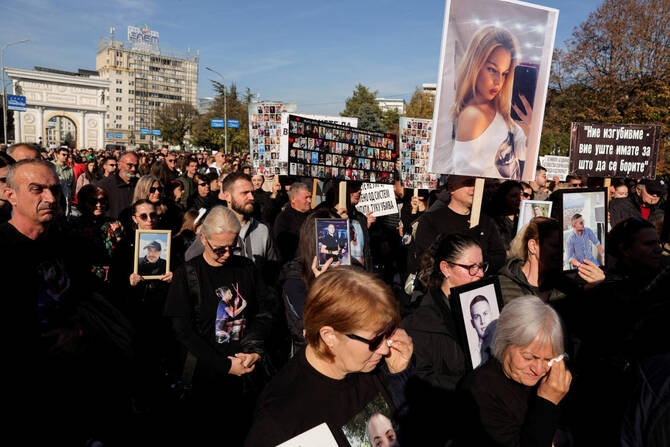
SKOPJE, North Macedonia: Thousands of people took to the streets of North Macedonia’s capital on Saturday demanding justice for the victims of a nightclub fire — the deadliest blaze in the country’s history — ahead of the trial next week of the club owner and others.
The March 16 fire and the ensuing stampede killed 63 people, most of them young revelers, and injured more than 200. It was sparked by a pyrotechnic flame that engulfed the roof of the crowded Pulse club in the eastern town of Kocani.
Protesters, including relatives of the victims, dressed in black and marched to the Criminal Court in Skopje, carrying large banners with photos of their loved ones.
Parents blame corruption and greed for the deaths of their children. Authorities said the venue had numerous and serious safety violations and was operating with the wrong license.
Natalija Gjorgjieska was among the families demanding justice on Saturday. Her husband, musician Andrej Gjorgjieski, was killed in the fire. “We demand the truth. Where did the mistakes occur, who didn’t respond, which institutions were late, who had the responsibility to prevent and did not?” she said.
The prosecution filed indictments for 34 people, among them the club owner, security guards and former mayors of Kocani, as well as representatives of three legal entities, including the security firm and the club owner’s companies. They are accused of “serious crimes against public security.”
Other defendants include inspectors, civil servants and former economy ministers. If found guilty, they face up to 10 years in prison.
Corruption has long plagued North Macedonia. The Berlin-based monitor Transparency International ranked North Macedonia in 88th place globally on its Corruption Perception Index last year, one of the worst rankings in Europe.
Bribes to authorities to skip licensing requirements and skirt safety regulations are commonplace.
The European Union has repeatedly expressed concerns over pervasive corruption in the country, identifying it as a major obstacle to the nation’s accession to the bloc. North Macedonia is a veteran candidate country, waiting for entry into the EU since 2005.

Thousands protest ahead of trial over deadliest fire in North Macedonia’s history
Short Url
https://arab.news/8f6vb
Thousands protest ahead of trial over deadliest fire in North Macedonia’s history
- Protesters, including relatives of the victims, dressed in black and marched to the Criminal Court in Skopje
- Parents blame corruption and greed for the deaths of their children
Russia awaits an answer from the US on New START as nuclear treaty ticks down
- Russian leader Vladimir Putin has proposed keeping the treaty’s limits
- US President Donald Trump has said Putin’s proposal sounded ‘like a good idea’
MOSCOW: Russia on Wednesday said it was still awaiting a formal answer from Washington on President Vladimir Putin’s proposal to jointly stick to the last remaining Russian-US arms control treaty, which expires in less than two months.
New START, which runs out on February 5, caps the number of strategic nuclear warheads that the United States and Russia can deploy, and the deployment of land- and submarine-based missiles and bombers to deliver them.
Putin in September offered to voluntarily maintain for one year the limits on deployed strategic nuclear weapons set out in the treaty, whose initials stand for the (New) Strategic Arms Reduction Treaty.
Trump said in October it sounded “like a good idea.”
“We have less than 100 days left before the expiry of New START,” said Sergei Shoigu, the secretary of Russia’s powerful Security Council, which is like a modern-day politburo of Russia’s most powerful officials.
“We are waiting for a response,” Shoigu told reporters during a visit to Hanoi. He added that Moscow’s proposal was an opportunity to halt the “destructive movement” that currently existed in nuclear arms control.
Nuclear arms control in peril
Russia and the US together have more than 10,000 nuclear warheads, or 87 percent of the global inventory of nuclear weapons. China is the world’s third largest nuclear power with about 600 warheads, according to the Federation of American Scientists.
The arms control treaties between Moscow and Washington were born out of fear of nuclear war after the 1962 Cuban Missile Crisis. Greater transparency about the opponent’s arsenal was intended to reduce the scope for misunderstanding and slow the arms race.
US and Russia eye China’s nuclear arsenal
Now, with all major nuclear powers seeking to modernize their arsenals, and Russia and the West at strategic loggerheads for over a decade — not least over the enlargement of NATO and Moscow’s war in Ukraine — the treaties have almost all crumbled away. Each side blames the other.
In the new US National Security Strategy, the Trump administration says it wants to reestablish strategic stability with Russia” — shorthand for reopening discussions on strategic nuclear arms control.
Rose Gottemoeller, who was chief US negotiator for New START, said in an article for The Arms Control Association this month that it would be beneficial for Washington to implement the treaty along with Moscow.
“For the United States, the benefit of this move would be buying more time to decide what to do about the ongoing Chinese buildup without having to worry simultaneously about new Russian deployments,” Gottemoeller said.
New START, which runs out on February 5, caps the number of strategic nuclear warheads that the United States and Russia can deploy, and the deployment of land- and submarine-based missiles and bombers to deliver them.
Putin in September offered to voluntarily maintain for one year the limits on deployed strategic nuclear weapons set out in the treaty, whose initials stand for the (New) Strategic Arms Reduction Treaty.
Trump said in October it sounded “like a good idea.”
“We have less than 100 days left before the expiry of New START,” said Sergei Shoigu, the secretary of Russia’s powerful Security Council, which is like a modern-day politburo of Russia’s most powerful officials.
“We are waiting for a response,” Shoigu told reporters during a visit to Hanoi. He added that Moscow’s proposal was an opportunity to halt the “destructive movement” that currently existed in nuclear arms control.
Nuclear arms control in peril
Russia and the US together have more than 10,000 nuclear warheads, or 87 percent of the global inventory of nuclear weapons. China is the world’s third largest nuclear power with about 600 warheads, according to the Federation of American Scientists.
The arms control treaties between Moscow and Washington were born out of fear of nuclear war after the 1962 Cuban Missile Crisis. Greater transparency about the opponent’s arsenal was intended to reduce the scope for misunderstanding and slow the arms race.
US and Russia eye China’s nuclear arsenal
Now, with all major nuclear powers seeking to modernize their arsenals, and Russia and the West at strategic loggerheads for over a decade — not least over the enlargement of NATO and Moscow’s war in Ukraine — the treaties have almost all crumbled away. Each side blames the other.
In the new US National Security Strategy, the Trump administration says it wants to reestablish strategic stability with Russia” — shorthand for reopening discussions on strategic nuclear arms control.
Rose Gottemoeller, who was chief US negotiator for New START, said in an article for The Arms Control Association this month that it would be beneficial for Washington to implement the treaty along with Moscow.
“For the United States, the benefit of this move would be buying more time to decide what to do about the ongoing Chinese buildup without having to worry simultaneously about new Russian deployments,” Gottemoeller said.
© 2025 SAUDI RESEARCH & PUBLISHING COMPANY, All Rights Reserved And subject to Terms of Use Agreement.


