Congo, M23 sign framework for peace in Qatar, more steps needed

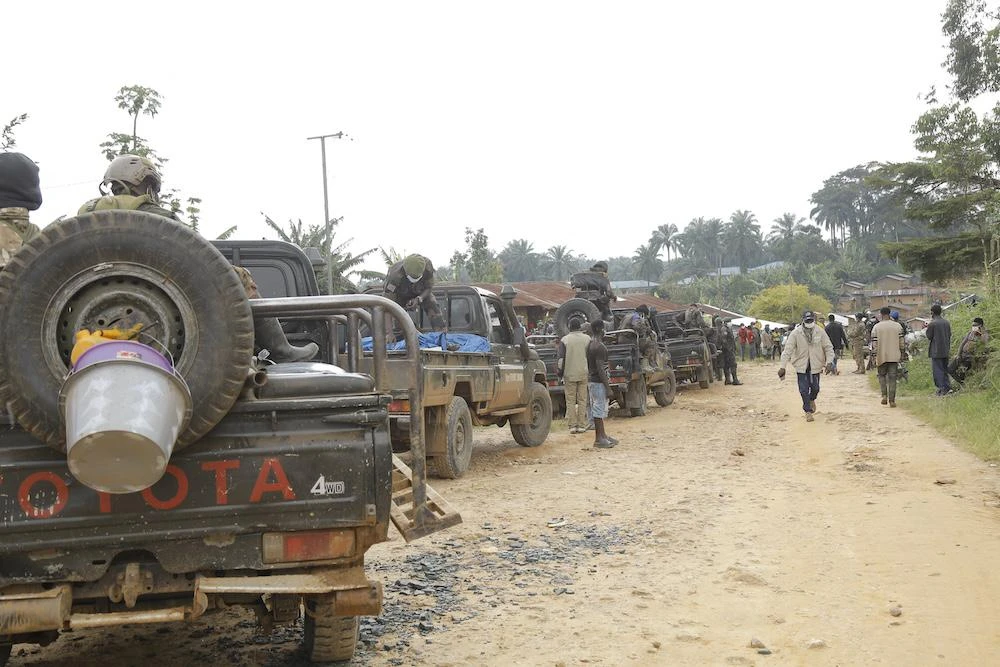
Above, a column of military vehicles transporting soldiers of the Democratic Republic of Congo Armed Forces in Ntoyo on Sept. 10, 2025. (AFP)
Short Url
Updated 15 November 2025
Follow

Congo, M23 sign framework for peace in Qatar, more steps needed

  • The agreement was signed by representatives from both sides at a ceremony in the Qatari capital Doha
  • The framework was described by US and Qatari officials as an important step to peace

DOHA: The Democratic Republic of Congo and the M23 rebel group signed on Saturday a framework agreement for a peace deal aimed at ending fighting in eastern Congo that has killed thousands of people and displaced hundreds of thousands more this year.
The agreement was signed by representatives from both sides at a ceremony in the Qatari capital Doha.
It was the latest of several documents that have been signed in recent months as part of efforts, backed by the United States and Qatar, to end the decades-long conflict in Congo that has often threatened to escalate into a full-blown regional war.
The framework was described by US and Qatari officials as an important step to peace but one of many that lie ahead.

MANY DETAILS REMAIN TO BE WORKED OUT
The top US envoy to the region, Massad Boulos told Reuters the framework covered eight protocols, and that work still needed to be done to agree on how to implement six of them.
Boulos also acknowledged that implementing the first two protocols concerning the exchange of prisoners and the monitoring of a ceasefire, agreed in recent months, had been slow.
“Yes, they were a little bit slow in the first few weeks,” he told reporters after the signing. “Yes, people were expecting to see probably some immediate results on the ground, but this is a process... This is not a light switch that you just switch on and off.”
M23, in the latest of a string of actions supported by neighboring Rwanda, seized Goma, eastern Congo’s largest city, in January and went on to make gains across North Kivu and South Kivu provinces.
Rwanda has long denied allegations that it has helped M23, which has seized more territory in Congo than it has ever previously held.

CONFLICT CONTINUES IN CONGO AS TALKS FORGE AHEAD
In Congo, the violence has continued through the various diplomatic processes in Washington and Doha. On Friday, local officials reported as many as 28 people killed by Islamic State-allied militants in eastern North Kivu province.
Qatar has hosted multiple rounds of direct talks between the Congo government and the rebels going back to April, but they have dealt largely with preconditions and confidence-building measures.
The two sides agreed in July to a declaration of principles that left many key issues at the root of the conflict unresolved, and in October they reached a deal on the monitoring of an eventual ceasefire.
Qatar’s Minister of State for Foreign Affairs Mohammed bin Abdulaziz Al-Khulaifi said Saturday’s agreement set the parties on the path toward peace.
“Peace cannot be enforced by force, but is built through confidence, mutual respect and sincere commitment,” he said.
Thailand launches airstrikes along border with Cambodia as tensions reignite

Updated 4 sec ago
Follow

Thailand launches airstrikes along border with Cambodia as tensions reignite

  • Thai army spokesperson Maj. Gen. Winthai Suvaree said Cambodian troops fired first into Thai territory in multiple areas
  • Thailand used aircraft ‘to strike military targets in several areas to suppress Cambodian supporting fire attacks’
BANGKOK: Thailand launched airstrikes along the disputed border with Cambodia on Monday as both sides accused the other of attacking first.
Tensions have simmered since the Southeast Asian neighbors signed a truce agreement in October pushed by US President Donald Trump after their territorial disputes led to five days of combat in July that killed dozens of soldiers and civilians.
Thai army spokesperson Maj. Gen. Winthai Suvaree said the Cambodian troops fired first into Thai territory in multiple areas. He said one Thai soldier was killed and four other soldiers were wounded, and civilians were being evacuated from the affected areas.
Thailand used aircraft “to strike military targets in several areas to suppress Cambodian supporting fire attacks,” he said.
Cambodian Defense Ministry spokesperson Maly Socheata said the Thai military attacked the Cambodian troops first. She said Cambodia did not retaliate during the initial attacks Monday.
“Cambodia urges that Thailand immediately stop all hostile activities that threaten peace and stability in the region,” she said.
The Cambodian Education Ministry said several schools along the border were ordered closed Monday. Photos and videos posted on its Facebook page showed young students running out of classes to their parents. Some rode on a motorcycles and others were seen walking away hurriedly.
A brief firing incident along the border occurred Sunday. The Thai army said Cambodia fired first and injured two Thai soldiers. It said the Thai troops retaliated, resulting in an exchange of fires for around 20 minutes. Cambodia however said the Thai side fired first and that it did not retaliate.
The US-brokered ceasefire that ended the brief conflict was threatened last month after Thai troops were injured by land mines, leading Thailand to announce that it would indefinitely suspending the implementation of the agreement. Both sides continue to trade accusations over responsibility, even as they are supposed to be cooperating in getting rid of the mines.
Trump said in mid-November he’d stopped a war between them as the tensions simmered.
Thailand and Cambodia have a history of enmity going back centuries, when they were warring empires.
Their modern territorial claims stem largely from a 1907 map drawn when Cambodia was under French colonial rule, which Thailand has argued is inaccurate.
The International Court of Justice in 1962 awarded sovereignty to Cambodia over an area that included the 1,000-year-old Preah Vihear temple, which still rankles many Thais.
The ceasefire does not spell out a path to resolve the underlying basis of the dispute, the longstanding differences over where the border should run.