

WHO, Pakistan team up to protect 112 million children against violence

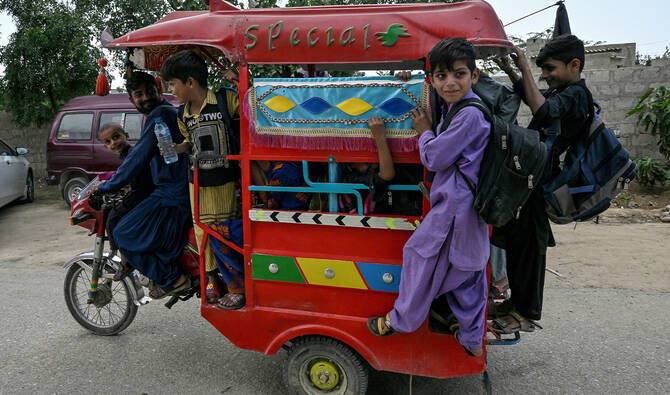
This photo taken on November 13, 2024 shows students travelling on a three-wheeler rickshaw after they left from a community school in Abdullah Goth village on the outskirts of Karachi. (AFP/File)
Short Url
Updated 15 November 2025
Follow

WHO, Pakistan team up to protect 112 million children against violence

  • In Pakistan, over 12.5 million kids are involved in child labor, while displaced children in poor urban settlements face high risks of exploitation
  • The proposed plan aims to reduce violence against children by addressing laws and norms, providing safe environment, caregiver support and stability

KARACHI: Pakistan’s Ministry of Human Rights and the World Health Organization (WHO) have initiated consultations to prepare a Strategic Action Plan on Violence Against Children with the vision of strengthening prevention and protecting 112 million children across the country, they said in a joint statement on Saturday.

In Pakistan, children experience multiple forms of violence – including violent killing, physical violence, sexual violence, psychological violence, and child neglect, according to the statement. 

The WHO-Pakistan consultations with relevant partners and experts began in Karachi and concluded in Islamabad on Friday, with participation from all provinces and self-governed areas.

The plan will be grounded in the principles of the Convention on the Rights of the Child and the INSPIRE framework, an evidence-based package developed by a group of 10 international agencies under the leadership of WHO.

“We recognize that fragmented efforts must now evolve into a cohesive, national, multi-sectoral strategy, one that mobilizes education, health, law enforcement, and community systems together. The National Strategy on Violence Against Children will provide that unified vision, with measurable targets, clear institutional responsibilities, and a robust monitoring and evaluation framework,” said Federal Secretary, Ministry of Human Rights, Abdul Khalique Shaikh.

In Pakistan, only 1 in 3 children under five is registered at birth, which creates further gaps in protection – and more than 12.5 million children are involved in child labor. Displaced children, migrant children, and those living in informal or poor urban settlements face disproportionately high risks of exploitation, early marriage, trafficking and child labor. 

INSPIRE includes seven strategies that have consistently reduced violence against children across many countries by addressing laws, norms, safe environments, caregiver support, financial stability, response services, and life skills.

“Violence against children is a concerning public health issue. This Strategic Action Plan is not just a document. It is the roadmap to protect our children and our grandchildren from a worldwide crisis. Violence is jeopardizing the lives and the future of millions of children ¬– and therefore our own future,” said WHO Representative in Pakistan, Dr. Luo Dapeng. “WHO stands with Pakistan to build together a country where every child is safe and able to thrive.”

Globally, each year, 1 billion children experience physical, sexual, or emotional violence, which can generate lifelong physical and mental health impacts. Every five minutes, a child dies from violence. These deaths are preventable.

“These consultations mark not an end, but the beginning of a coordinated effort to develop a strategic roadmap aligned with the fundamental rights guaranteed by the Constitution of Pakistan, the Sustainable Development Goals (SDGs), and

Pakistan’s international commitments under key UN human rights conventions,” said Dr. Muhammad Arif, director of international cooperation at the Pakistani Ministry of Human Rights.

“Strengthening and integrating existing legal and institutional frameworks is crucial to effectively prevent and respond to violence against children.”


Pakistan terms climate change, demographic pressures as ‘pressing existential risks’

Updated 4 sec ago
Follow

Pakistan terms climate change, demographic pressures as ‘pressing existential risks’

  • Pakistan has suffered frequent climate change-induced disasters, including floods this year that killed over 1,000
  • Pakistan finmin highlights stabilization measures at Doha Forum, discusses economic cooperation with Qatar 

ISLAMABAD: Pakistan’s Finance Minister Muhammad Aurangzeb on Saturday described climate change and demographic pressures as “pressing existential risks” facing the country, calling for urgent climate financing. 

The finance minister was speaking as a member of a high-level panel at the 23rd edition of the Doha Forum, which is being held from Dec. 6–7 in the Qatari capital. Aurangzeb was invited as a speaker on the discussion titled: ‘Global Trade Tensions: Economic Impact and Policy Responses in MENA.’

“He reaffirmed that while Pakistan remained vigilant in the face of geopolitical uncertainty, the more pressing existential risks were climate change and demographic pressures,” the Finance Division said. 

Pakistan has suffered repeated climate disasters in recent years, most notably the 2022 super-floods that submerged one-third of the country, displaced millions and caused an estimated $30 billion in losses. 

This year’s floods killed over 1,000 people and caused at least $2.9 billion in damages to agriculture and infrastructure. Scientists say Pakistan remains among the world’s most climate-vulnerable nations despite contributing less than 1 percent of global greenhouse-gas emissions.

Aurangzeb has previously said climate change and Pakistan’s fast-rising population are the only two factors that can hinder the South Asian country’s efforts to become a $3 trillion economy in the future. 

The finance minister noted that this year’s floods in Pakistan had shaved at least 0.5 percent off GDP growth, calling for urgent climate financing and investment in resilient infrastructure. 

When asked about Pakistan’s fiscal resilience and capability to absorb external shocks, Aurangzeb said Islamabad had rebuilt fiscal buffers. He pointed out that both the primary fiscal balance and current account had returned to surplus, supported significantly by strong remittance inflows of $18–20 billion annually from the Middle East and North Africa (MENA) and Gulf Cooperation Council (GCC) regions. 

Separately, Aurangzeb met his Qatari counterpart Ali Bin Ahmed Al Kuwari to discuss bilateral cooperation. 

“Both sides reaffirmed their commitment to strengthening economic ties, particularly by maximizing opportunities created through the newly concluded GCC–Pakistan Free Trade Agreement, expanding trade flows, and deepening energy cooperation, including long-term LNG collaboration,” the finance ministry said. 

The two also discussed collaboration on digital infrastructure, skills development and regulatory reform. They agreed to establish structured mechanisms to continue joint work in trade diversification, technology, climate resilience, and investment facilitation, the finance ministry said.