

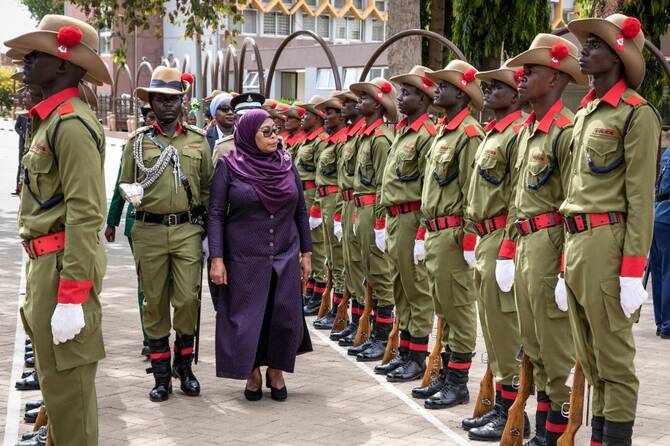

NAIROBI: Tanzanian President Samia Suluhu Hassan on Friday announced an inquiry into the killings that occurred during the election that returned her to power, and called for leniency for some protesters charged with treason.
Hassan retained the presidency with 98 percent of the vote on October 29, according to the electoral commission, after her main opponents were jailed or disqualified.
Allegations of rigging and government repression sparked days of violent protests in which hundreds were killed by security forces, according to the opposition and rights groups, amid a total Internet blackout.
“I am deeply saddened by the incident. I offer my condolences to all the families who lost their loved ones,” Hassan said at the opening session of the new parliament.
“The government has taken the step of forming an inquiry commission to investigate what happened,” she added.
It was the first conciliatory message toward the protesters since the unrest. The government has yet to provide any casualty figures.
Hundreds of protesters have been arrested and charged with treason, which carries the death penalty, but the president indicated there would be leniency as she tries to rebuild the traumatized nation.
“I realize that many youths who were arrested and charged with treason did not know what they were doing,” she said.
“As the mother of this nation, I direct the law enforcement agencies and especially the office of the director of police to look at the level of offenses committed by our youths.
“For those who seem to have followed the crowd and did not intend to commit a crime, let them erase their mistakes,” she said.
- Repression -
Hassan inherited the presidency on the sudden death of authoritarian president John Magufuli in 2021.
She faced strong opposition from within the party, but was feted for easing restrictions on the opposition and media.
That opening proved short-lived, however, as repression returned worse than ever in 2024.
Opposition and rights groups accuse the security forces of a campaign of kidnappings and murders targeting Hassan’s critics that ramped up in the weeks leading up to the election.
Some were high-profile, like former government spokesman and ambassador Humphrey Polepole, reported missing from his blood-stained home on October 6 after resigning in a letter that criticized Hassan’s government.
The violence has led to criticism from Western countries and the United Nations.
A cross-party pair of United States senators on the foreign relations committee issued a statement on Thursday that condemned the Tanzanian elections as “marred by state-sponsored political repression, targeted abductions and manipulation.”
They said a “heavy handed security response (to the protests) resulted in the death of hundreds and the abduction and imprisonment of many more” and called for a reassessment of US ties with Tanzania.
The Legal and Human Rights Center, a leading advocacy group in Tanzania, said Thursday that its team was harassed and intimidated by police while working at the White Sands Hotel in Dar es Salaam.
“The entire hotel was under siege, and our team was the sole target. Laptops and phones were seized,” the group said on X.


