
ISLAMABAD: Pakistan’s foreign office said on Friday a meeting between Prime Minister Shehbaz Sharif’s special assistant on tourism and an Israeli official at a global travel fair in London was not authorized by the government, with the official later saying he did not know he was speaking to an Israeli delegation.
The World Travel Market (WTM) in London is one of the world’s leading travel-trade exhibitions, bringing together tourism boards, airlines, hotel groups, travel-tech firms and tour operators from more than 180 countries. Held annually, it serves as a major hub for business deals, offering a platform where destinations market themselves, companies negotiate partnerships and buyers and sellers secure contracts that shape travel flows for the year ahead.
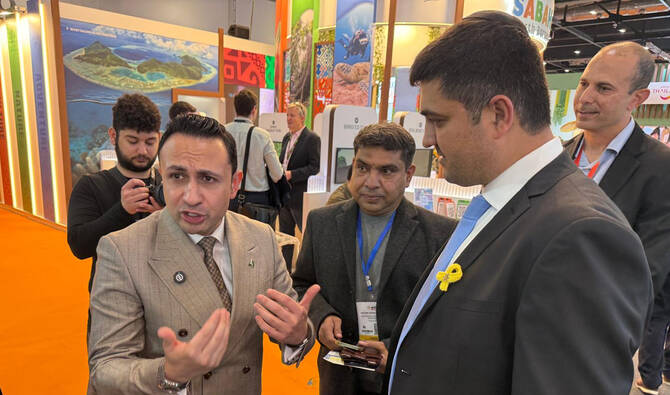
Sardar Yasir Ilyas Khan, the Pakistan prime minister’s coordinator on tourism, was seen in a video that went viral on social media shaking hands and speaking with Michael Izhakov, Director General of Israel’s Ministry of Tourism, at the Pakistan pavilion during the event.
“I can assure you that if at all such a meeting or such an interaction took place, it was without authorization, certainly without information to us and certainly without authorization by the government,” Tahir Andrabi, the foreign office spokesperson, told the media in his weekly news briefing. “I have not seen any such authorization and I have not seen any information as yet.”
Andrabi called it unfair to link the incident with speculation about Pakistan joining the Abraham Accords or recognizing Israel, describing such conclusions as “too far-fetched” and urging the media to avoid unnecessary conjecture.
Speculation over whether Pakistan could eventually join the accords has circulated on social media in recent weeks, particularly after high-level contacts between Pakistani leaders and US President Donald Trump.
Last month, Trump said he expected the accords to expand, expressing hope that more states would normalize relations with Israel.
Pakistani officials, however, have repeatedly rejected such speculation and reaffirmed Islamabad’s position supporting an independent Palestinian state with pre-1967 borders and East Jerusalem as its capital.
Domestic political sentiment in Pakistan also remains strongly opposed to recognition without a just settlement for Palestinians.
Meanwhile, in a statement issued to the media, the prime minister’s aide said he had no knowledge that he was meeting an Israeli delegation.
“Sardar Yasir Ilyas Khan visited London at his own expense, leading a delegation of 31 tourism representatives from Pakistan to participate in the World Travel Market,” the statement said. “During the event, a group of individuals from Israel visited the Pakistan Pavilion unannounced and met the Pakistani delegation without introducing themselves.”
“Despite this unexpected encounter, Sardar Yasir Ilyas Khan remained focused on his mission as a proud Pakistani and true patriot, dedicated to promoting a positive and progressive tourism narrative for Pakistan across the world,” it added.
The foreign office spokesperson was also asked about the upcoming visit of Jordan’s King Abdullah II to Pakistan and the possibility of discussions over Pakistan’s participation in the Gaza Stabilization Force.
The proposed force is expected to be a multinational security mission, drawing heavily on Muslim-majority nations, to help secure key areas of Gaza, support humanitarian access and assist in rebuilding basic administrative and policing structures.
Andrabi said Pakistan and Jordan cooperate closely on multilateral issues, including Palestine.
“I am sure Palestine will feature in discussions that His Majesty will have in Islamabad,” he said. “On the role of the International Stabilization Force, no decision has been taken on Pakistan’s participation.”
The spokesperson added the mandate of the force itself was still under discussion at the UN Security Council.
“I don’t think the Security Council has reached a decision,” he continued. “So this is an ongoing process. We are engaged in it.”