Pakistan’s cabinet approves Gwadar-Oman ferry service to boost trade, tourism

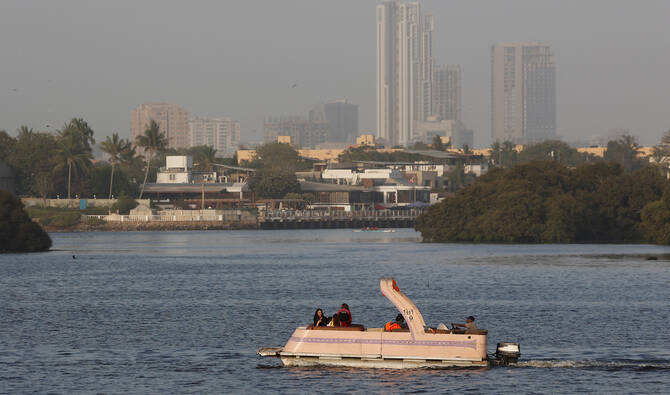
Locals ride on a boat during a hot summer day in Karachi, Pakistan on May 29, 2024. (REUTERS/File)
Short Url
Updated 14 November 2025
Follow

Pakistan’s cabinet approves Gwadar-Oman ferry service to boost trade, tourism

  • In Aug., Pakistan granted its first-ever ferry service license to an international operator, Sea Keepers, for routes connecting with Gulf countries
  • Maritime Affairs Minister Junaid Anwar Chaudhry says an Omani delegation will visit Pakistan to finalize arrangements regarding the ferry service

KARACHI: Pakistan’s federal cabinet has approved a ferry service to Oman from the southwestern Pakistani port of Gwadar, the country’s maritime affairs minister said on Friday, saying the move is aimed at boosting trade and tourism.

The development comes months after Pakistan granted its first-ever ferry service license to an international operator, Sea Keepers, for routes connecting Pakistan with Gulf Cooperation Council (GCC) countries Iran.

Officials had hailed the move as a “historic step,” aligned with Pakistan’s National Maritime Policy, and emphasized the opportunity this license creates for boosting regional connectivity, tourism and economic activity via sea.

Pakistan’s Maritime Affairs Minister Junaid Anwar Chaudhry said Islamabad and Oman will sign a memorandum of understanding (MoU) regarding the ferry link and the service will begin soon.

“An Omani delegation will visit Pakistan to finalize arrangements,” he said in a statement shared by his ministry. “New ferry route is expected to increase trade volume and investment. Travel will be easier for Pakistani expatriates.”

Besides trade, the ferry service will promote tourism and cultural ties, according to the maritime affairs minister. It will also reduce travel costs as compared to air transport.

“New maritime corridors will make Gwadar a new hub of economic activities,” he said. “Regional countries will get access to Central Asian markets [through the ferry link].”

Pakistan is currently making efforts to capitalize on its geostrategic location to boost trade and investment alongside tourism as it slowly recovers from a macroeconomic crisis under a $7 billion International Monetary Fund (IMF) program.

The South Asian country also plans to cut container dwell time at its seaports by up to 70 percent to improve trade competitiveness and ease congestion. Pakistan and Sri Lanka are also considering linking their coastal destinations in a bid to boost marine tourism.


Cross-border clash breaks out between Pakistan and Afghanistan amid rising tensions

Updated 55 min 2 sec ago
Follow

Cross-border clash breaks out between Pakistan and Afghanistan amid rising tensions

  • Border residents say exchange of fire in the Chaman border sector lasted nearly two hours
  • Both governments issue competing statements blaming the other for initiating the violence

ISLAMABAD: Pakistan and Afghanistan witnessed yet another border clash, according to officials in both countries who spoke in the early hours of Saturday, with each side accusing the other of launching “unprovoked” attacks.

Fighting erupted in Pakistan’s southwestern Chaman border sector, with an AFP report saying that residents on the Afghan side of the frontier reported the exchange of fire began at around 10:30 p.m. (1800 GMT) and continued for roughly two hours.

The incident underscored how tensions remain high between the neighbors, who have seen deadly clashes in recent months despite several rounds of negotiations mediated by Qatar and Türkiye that resulted in a tenuous truce in October.

“There has been unprovoked firing by Afghan Taliban elements in the Chaman Sector which is a reckless act that undermines border stability and regional peace,” said a Pakistani security official on condition of anonymity.

“Pakistani troops responded with precision, reinforcing that any violation of our territorial integrity will be met with immediate and decisive action,” he continued.

The official described Pakistan’s response as “proportionate and calibrated” that showed “professionalism even in the face of aggression.”

“The Chaman Sector exchange once again highlights the need for Kabul to rein in undisciplined border elements whose actions are destabilizing Afghanistan’s own international standing,” he added.

Relations between Pakistan and Afghanistan have grown increasingly bitter since the Taliban seized power in Kabul following the withdrawal of international forces in August 2021.

Islamabad accuses the Taliban administration of sheltering anti-Pakistan militant groups such as the Baloch Liberation Army (BLA) and Tehreek-e-Taliban Pakistan (TTP), which have carried out deadly attacks in its western provinces bordering Afghanistan, targeting civilians and security forces.

The Taliban deny the charge, saying Pakistan’s internal security challenges are its own responsibility.

The Pakistani security official said his country remained “committed to peaceful coexistence, but peace cannot be one-sided.”

“Attempts to pressure Pakistan through kinetic adventurism have repeatedly failed and will continue to fail,” he said. “The Chaman response has reaffirmed that message unmistakably.”

He added that Pakistan’s security forces were fully vigilant and that responsibility for any escalation “would solely rest with those who initiated unprovoked fire.”

Mosharraf Zaidi, spokesman for Pakistan’s prime minister, also commented on the clashes in a social media post, saying the Afghan Taliban had “resorted to unprovoked firing along the border.”

“An immediate, befitting and intense response has been given by our armed forces,” he wrote.

Afghan authorities, however, blamed Pakistan for the hostilities.

“Unfortunately, tonight, the Pakistani side started attacking Afghanistan in Kandahar, Spin Boldak district, and the forces of the Islamic Emirate were forced to respond,” Taliban spokesman Zabihullah Mujahid said on X.

Border clashes that began in October have killed dozens of people on both sides.

The latest incident comes amid reports of back-channel discussions between the two governments, although neither has publicly acknowledged such talks.