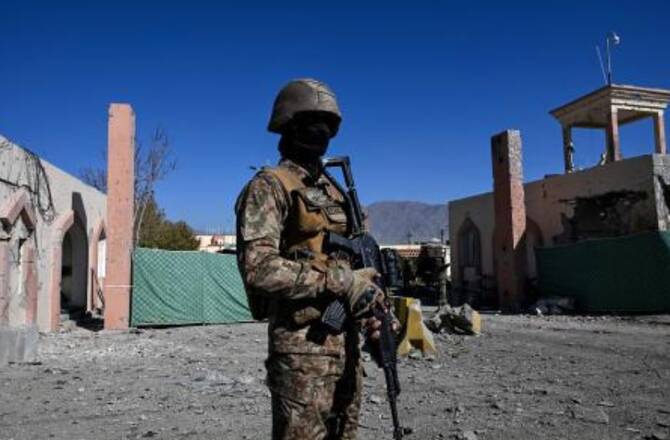
ISLAMABAD: Pakistan’s interior minister said Thursday that Afghan nationals carried out two fatal suicide attacks this week — one targeting a cadet college near the Afghan border and the other outside a court in the capital, Islamabad.
“In both of the suicide bombings, Afghan citizens were involved, and they carried out the attacks,” Interior Minister Mohsin Naqvi said.
There was no immediate comment from Kabul.
On Tuesday a suicide bombing outside a district court in Islamabad killed 12 people and wounded 27 others. Separately on Monday, three soldiers were killed when a suicide bomber and four other militants targeted Cadet College Wana in northwestern Khyber Pakhtunkhwa province.
The attacks underscored Pakistan’s worsening security situation as the government faces growing militancy, tense relations with Kabul and an increasingly fragile truce along the border. Until Tuesday’s attack, the capital had largely been considered safe compared with the country’s conflict-hit northwest.
Prime Minister Shehbaz Sharif on Wednesday offered talks to Afghanistan’s Taliban government in a renewed peace overture. His call in a televised speech on Wednesday followed the collapse of peace negotiations in Istanbul last week. It raised fears that a ceasefire brokered by Qatar and Turkiye could unravel and trigger new border clashes.
Islamabad wants Kabul to rein in the Pakistani Taliban — known as Tehrik-e-Taliban Pakistan, or TTP, which has claimed most of the attacks in Pakistan in recent years. The group has distanced itself from the latest attacks, saying it was not behind them.
Pakistan has long accused the Afghan Taliban of harboring TTP leaders and fighters, an allegation Kabul denies. One TTP breakaway faction, Jamaat-ul-Ahrar, initially claimed responsibility for the Islamabad bombing, before one of its commanders retracted the statement.
Pakistan’s Information Minister Attaullah Tarar said Wednesday that all five attackers in the assault on the Cadet College Wana were killed by security forces. More than 600 people — including 525 cadets, their teachers and staff — were safely rescued, he told reporters.
Tarar said the assailants appeared to be attempting a repeat of the 2014 Peshawar school massacre, when a TTP splinter group killed 154 people, mostly children, at an army-run school.
Tensions between Pakistan and Afghanistan have spiked since last month, when Afghanistan accused Islamabad of launching drone strikes on Oct. 9 that killed several people in the Afghan capital. The strikes sparked cross-border clashes that left dozens of soldiers, civilians and militants dead before Qatar brokered a ceasefire on Oct. 19.
Two subsequent rounds of peace talks in Istanbul ended without progress after Kabul refused to provide written assurances that militants would not use Afghan soil for attacks in Pakistan.
The TTP, which is separate from but allied with the Afghan Taliban, has been emboldened since the Taliban seized power in Afghanistan in 2021.

Pakistan says Afghan nationals carried out this week’s suicide attacks in the capital and northwest
https://arab.news/5h48a
Pakistan says Afghan nationals carried out this week’s suicide attacks in the capital and northwest
- “In both of the suicide bombings, Afghan citizens were involved, and they carried out the attacks,” Interior Minister Mohsin Naqvi said
- Pakistan has long accused the Afghan Taliban of harboring TTP leaders and fighters
Germany blames Russia for cyberattack on air safety, election interference
- “We have been able to clearly identify the handwriting behind it and prove Moscow’s responsibility,” said the spokesman
- “Our intelligence findings prove that the Russian military intelligence service GRU bears responsibility for this attack“
BERLIN: Germany on Friday accused Russia of a cyberattack targeting its air traffic control and spreading disinformation ahead of February’s general election, charges dismissed by Russia as “absurd” and “baseless.”
A German foreign ministry spokesman said security services had proof that hacker groups run by Russia’s military intelligence service GRU were responsible for the attack and influence operations.
“Based on comprehensive analysis by the German intelligence services, we have been able to clearly identify the handwriting behind it and prove Moscow’s responsibility,” said the spokesman.
“We can now clearly attribute the cyberattack against German Air Safety in August 2024 to the hacker collective APT28, also known as Fancy Bear,” he told a regular press briefing.
“Our intelligence findings prove that the Russian military intelligence service GRU bears responsibility for this attack,” added the spokesman.
He also said Russia had sought to influence February’s parliamentary election, which was won by the conservatives of Chancellor Friedrich Merz, with the far-right AfD scoring its best-ever result in second place.
“Second, we can now state definitively that Russia, through the Storm 1516 campaign, sought to influence and destabilize the most recent federal election,” he added at a press conference.
The spokesman said a GRU-supported Moscow think tank and other groups had spread artificially generated or deepfake images and other content, and that the goal was to divide society and “undermine trust in democratic institutions.”
The Russian embassy in Berlin said in a statement sent to AFP that it “categorically rejected” that Russia was behind any of the activity.
“The accusations of Russian state structures’ involvement in these incidents and in the activities of hacker groups in general are baseless, unfounded and absurd,” the statement said.
According to security sources, much of the material spread by the Storm 1516 campaign involved spurious claims about Merz and other prominent politicians such as former foreign minister Annalena Baerbock and former vice chancellor Robert Habeck, both prominent Greens party members.
AFP’s German Fact Check service debunked two of the other claims in the campaign aimed at subverting trust in elections; namely that the AfD had been left off ballots in the city of Leipzig and that votes for the party in Hamburg were destroyed before they could be counted.
- ‘Pay a price’ -
The foreign ministry spokesman said Germany had “absolutely solid proof” that Russia was behind the operations but added that he could not go into detail because this would involve discussing the work of German intelligence services.
The head of the BfV domestic intelligence agency Sinan Selen said in a statement that “the ‘Storm-1516’ campaign shows in a very concrete way how our democratic order is being attacked.”
“This disinformation ecosystem includes pro-Russian influencers with a wide reach, conspiracy theories and right-wing extremist circles,” Selen said.
The German foreign ministry spokesman warned that Berlin would take “a series of countermeasures to make Russia pay a price for its hybrid actions, in close coordination with our European partners.”
Germany would support “new individual sanctions against hybrid actors on a European level,” he said, without saying who they were.
He added that from January, EU countries would “monitor cross-border travel by Russian diplomats within the Schengen Area. The aim is to facilitate better information exchange and minimize intelligence risks.”
Governments across Europe are on high alert over alleged Russian espionage, drone surveillance and sabotage activities, as well as cyberattacks and disinformation campaigns.
Germany has been Ukraine’s second-biggest supplier of aid since Russia launched its 2022 full-scale invasion and has accused Moscow of being behind drone flights near several European airports in recent months.


