

Pakistan, Bangladesh boost defense ties as Islamabad navy chief concludes visit to Chattogram

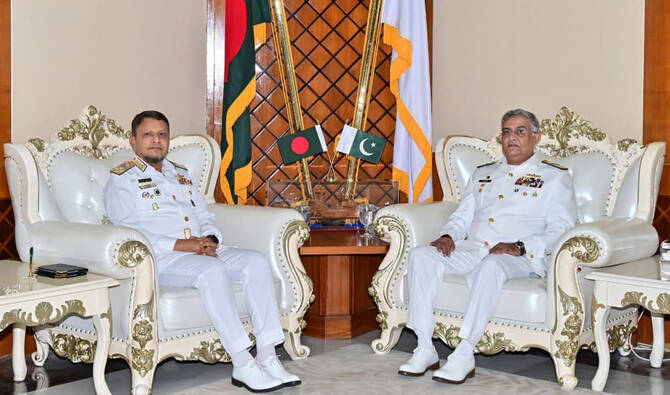
The handout photograph released on November 13, 2025, shows Pakistan’s Chief of Naval Staff, Admiral Naveed Ashraf, meeting Chief of Naval Staff Bangladesh, Admiral M Nazmul Hassan, in Bangladesh. (Facebook/@DgprNavy)
Short Url
Updated 13 November 2025
Follow

Pakistan, Bangladesh boost defense ties as Islamabad navy chief concludes visit to Chattogram

  • Visit comes as Pakistan and Bangladesh cautiously rebuild relations after years of strain following the 1971 war
  • Naval engagement reflects shifting regional alignments as Dhaka recalibrates ties with India after political transition

KARACHI: Pakistan and Bangladesh have stepped up defense engagement with a high-level naval visit to Chattogram, the Pakistan military said on Thursday, marking one of the most visible signs of warming ties between the two South Asian neighbors after years of diplomatic distance.

For decades, relations between Islamabad and Dhaka remained tense following the 1971 civil war that split the two countries, with Bangladesh aligning closely with India and maintaining only limited defense cooperation with Pakistan. But that dynamic has shifted since the fall of Sheikh Hasina’s government earlier this year — a period that saw Dhaka’s ties with New Delhi cool and opened space for renewed political and military outreach with Pakistan.

In this context, Pakistan’s Chief of Naval Staff Admiral Naveed Ashraf’s visit to Bangladesh — and the simultaneous port call of PNS Saif — signals an attempt by both sides to restore working-level coordination and rebuild a relationship long overshadowed by history.

“The next century belongs to the oceans,” Admiral Naveed Ashraf remarked during the visit. “Pakistan must plan today for the ports, trade routes, and maritime industries of tomorrow.”

During the multi-day trip, the naval chief met Bangladesh’s army, navy and air force heads, discussed regional maritime security and professional cooperation, and attended a reception onboard the Pakistani frigate Saif. He also visited the National Defense College and the Bangladesh Naval Academy, appreciating their professional standards and emphasizing the importance of advanced naval education.

While the visit does not represent a formal defense pact, the engagements point to broader strategic recalibration in the Bay of Bengal and Indian Ocean Region. Bangladesh’s armed forces continue longstanding cooperation with India, but the political transition in Dhaka — and the fallout from Sheikh Hasina’s departure to India — have introduced new diplomatic dynamics. Pakistan, meanwhile, has sought to expand military-to-military contacts across the region, particularly in the maritime domain.

The Bay of Bengal and the northern Indian Ocean have gained strategic significance in recent years amid rising competition for sea lanes, energy routes and naval influence. Both Pakistan and Bangladesh have expanded coastal infrastructure and maritime surveillance capacity, making naval diplomacy an increasingly important tool for signalling intent and managing regional relationships.

The Pakistan Navy said the visit aimed to “strengthen bilateral naval ties, foster mutual respect, and advance maritime security cooperation,” projecting the engagement as part of Islamabad’s wider effort to enhance regional connectivity and stability.


Pakistan, global crypto exchange discuss modernizing digital payments, creating job prospects 

Updated 05 December 2025
Follow

Pakistan, global crypto exchange discuss modernizing digital payments, creating job prospects 

  • Pakistani officials, Binance team discuss coordination between Islamabad, local banks and global exchanges
  • Pakistan has attempted to tap into growing crypto market to curb illicit transactions, improve oversight

ISLAMABAD: Pakistan’s finance officials and the team of a global cryptocurrency exchange on Friday held discussions aimed at modernizing the country’s digital payments system and building local talent pipelines to meet rising demand for blockchain and Web3 skills, the finance ministry said.

The development took place during a high-level meeting between Finance Minister Muhammad Aurangzeb, Pakistan Virtual Assets Regulatory Authority (PVARA) Chairman Bilal bin Saqib, domestic bank presidents and a Binance team led by Global CEO Richard Teng. The meeting was held to advance work on Pakistan’s National Digital Asset Framework, a regulatory setup to govern Pakistan’s digital assets.

Pakistan has been moving to regulate its fast-growing crypto and digital assets market by bringing virtual asset service providers (VASPs) under a formal licensing regime. Officials say the push is aimed at curbing illicit transactions, improving oversight, and encouraging innovation in blockchain-based financial services.

“Participants reviewed opportunities to modernize Pakistan’s digital payments landscape, noting that blockchain-based systems could significantly reduce costs from the country’s $38 billion annual remittance flows,” the finance ministry said in a statement. 

“Discussions also emphasized building local talent pipelines to meet rising global demand for blockchain and Web3 skills, creating high-value employment prospects for Pakistani youth.”

Blockchain is a type of digital database that is shared, transparent and tamper-resistant. Instead of being stored on one computer, the data is kept on a distributed network of computers, making it very hard to alter or hack.

Web3 refers to the next generation of the Internet built using blockchain, focusing on giving users more control over their data, identity and digital assets rather than big tech companies controlling it.

Participants of the meeting also discussed sovereign debt tokenization, which is the process of converting a country’s debt such as government bonds, into digital tokens on a blockchain, the ministry said. 

Aurangzeb called for close coordination between the government, domestic banks and global exchanges to modernize Pakistan’s payment landscape.

Participants of the meeting also discussed considering a “time-bound amnesty” to encourage users to move assets onto regulated platforms, stressing the need for stronger verifications and a risk-mitigation system.

Pakistan has attempted in recent months to tap into the country’s growing crypto market, crack down on money laundering and terror financing, and promote responsible innovation — a move analysts say could bring an estimated $25 billion in virtual assets into the tax net.

In September, Islamabad invited international crypto exchanges and other VASPs to apply for licenses to operate in the country, a step aimed at formalizing and regulating its fast-growing digital market.