Syria to help US fight Iran-backed armed groups, envoy says

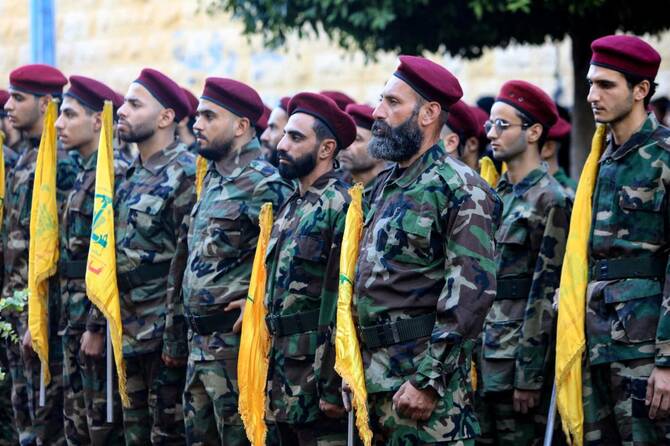
Hezbollah fighters take part in the funeral procession of the movement's commanders Ibrahim Mohammed Kobeissi and Hussein Ezzedine, killed a day earlier in an Israeli strike on Beirut's southern suburbs, on September 25, 2024. (File/AFP)
Short Url
Updated 13 November 2025
Follow

Syria to help US fight Iran-backed armed groups, envoy says

  • Iran’s powerful IRGC and Lebanon’s Hezbollah were key backers of president Bashar Assad before he was ousted last december by a rebel coalition led by Sharaa

DAMASCUS: Syria will play an active role in assisting the United States in fighting armed groups including Iran’s Revolutionary Guards, Hamas and Hezbollah, US special envoy Tom Barrack said on Thursday.
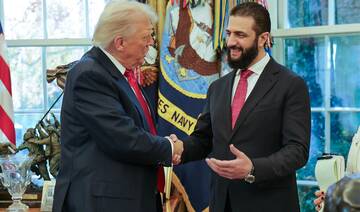
Interim President Ahmed Al-Sharaa, himself a former militant, became the first Syrian leader to visit the White House since his country’s independence in 1946.
Shortly after his visit, the US-led coalition fighting the Daesh group announced that Syria had become its 90th member.
On Thursday, Barrack wrote on X that “Damascus will now actively assist us in confronting and dismantling the remnants of Daesh, the IRGC (Islamic Revolutionary Guard Corps), Hamas, Hizballah, and other terrorist networks.”
Iran’s powerful IRGC and Lebanon’s Hezbollah were key backers of president Bashar Assad before he was ousted last december by a rebel coalition led by Sharaa.
Hamas does not have an armed presence in Syria.
Barrack also said he held a “pivotal” meeting with US top diplomat Marco Rubio, Turkiye’s Hakan Fidan and Syria’s Asaad Al-Shaibani, during which they discussed steps toward “integrating the Syrian Democratic Forces (SDF) into the new Syrian economic, defense and civic structure.”
Backed by Washington, the Kurdish-led SDF played a key role in unseating Daesh from its last strongholds in Syria.
SDF leader Mazloum Abdi told AFP last month that he had reached a “preliminary agreement” with Damascus on the integration of his troops into Syria’s military and security forces.
In a post on X on Tuesday, Abdi said he had discussed with Barrack “our commitment to accelerate the integration of the SDF into the Syrian state.”
Sharaa’s administration and the SDF had signed an agreement in March to integrate into national civilian and military institutions, but it has faced hurdles since.


UN warns clock ticking for Sudan’s children

Updated 5 sec ago
Follow

UN warns clock ticking for Sudan’s children

  • UNICEF says in parts of North Darfur, more than half of all children are acutely malnourished
  • UN-backed experts have said famine is spreading in Sudan’s western Darfur region
GENEVA: The United Nations warned Tuesday that time was running out for malnourished children in Sudan and urged the world to “stop looking away.”
Famine is spreading in Sudan’s western Darfur region, UN-backed experts warned last week, with the grinding war between the army and paramilitary forces leaving millions hungry, displaced and cut off from aid.
Global food security experts say famine thresholds for acute malnutrition have been surpassed in North Darfur’s contested areas of Um Baru and Kernoi.
Ricardo Pires, spokesman for the UN children’s agency UNICEF, said the situation was getting worse for children by the day, warning: “They are running out of time.”
In parts of North Darfur, more than half of all children are acutely malnourished, he told a press conference in Geneva.
“Extreme hunger and malnutrition come to children first: the youngest, the smallest, the most vulnerable, and in Sudan it’s spreading,” he said.
Fever, diarrhea, respiratory infections, low vaccination coverage, unsafe water and collapsing health systems are turning treatable illnesses “into death sentences for already malnourished children,” he warned.
“Access is shrinking, funding is desperately short and the fighting is intensifying.
“Humanitarian access must be granted and the world must stop looking away from Sudan’s children.”
Since April 2023, the conflict between Sudan’s army and the paramilitary Rapid Support Forces has killed tens of thousands, displaced 11 million and triggered what the UN calls one of the world’s worst humanitarian crises.
Shible Sahbani, the World Health Organization’s representative in Sudan, said the country was “facing multiple disease outbreaks: including cholera, malaria, dengue, measles, in addition to malnutrition.”
At the same time, health workers and health infrastructure are increasingly in the crosshairs, he told reporters.
Since the war began, the WHO has verified 205 attacks on health care, leading to 1,924 deaths.
And the attacks are growing deadlier by the year.
In 2025, 65 attacks caused 1,620 deaths, and in the first 40 days of this year, four attacks led to 66 deaths.
Fighting has intensified in the southern Kordofan region.
“We have to be proactive and to pre-position supplies, to deploy our teams on the ground to be prepared for any situation,” Sahbani said.
“But all this contingency planning... it’s a small drop in the sea.”