

Saudi designer revives Al-Faw heritage at Dubai Design Week 

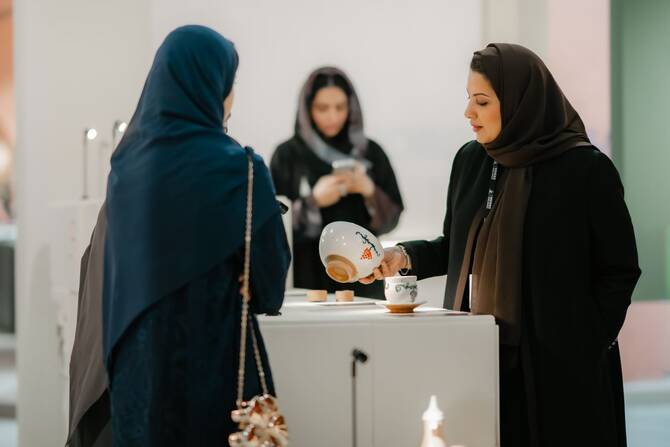
Saudi designer Amal Al-Bednah (right) at Dubai Design Week in November. (Supplied)
Short Url
Updated 13 November 2025
Follow

Saudi designer revives Al-Faw heritage at Dubai Design Week 

  • ‘Every piece tells a story,’ says FAW founder Amal Al-Bednah

DUBAI: Saudi Arabia’s creative heritage took center stage at Dubai Design Week through FAW, a Saudi brand founded by Amal Al-Bednah.  

FAW participated in Dubai Design Week’s Designed in Saudi exhibition, presenting handcrafted pottery inspired by the Saudi archaeological site Al-Faw village. 

Haya Al-Aqeel, designer and craftswoman at FAW, told Arab News that the project was established to highlight the story of Al-Faw through design. “Our designs are inspired by discoveries from the site. We reimagine them in a modern artistic way while staying true to their origins,” she said. 


One of FAW’s creations for Dubai Design Week. (Supplied)

Al-Faw was once the capital of the Kingdom of Kinda. It is located about 100 km south of Wadi ad-Dawasir and roughly 700 km southwest of Riyadh. The archaeological site contains the remains of residential houses, markets, roads, cemeteries, temples, and water wells that provide insight into the region’s early urban and cultural life. 

At Dubai Design Week, FAW showcased two pottery pieces — a bowl and a cup with a matching plate. The items were finished in soft, natural tones of beige and terracotta, with subtle engraved patterns inspired by the carvings and inscriptions found at Al-Faw. 

FAW’s wider collection features a variety of handcrafted items, including ceramic cups, plates and bowls adorned with motifs such as gazelles, grape clusters and ancient jar designs painted in earthy tones. The brand also produces vintage-style leather notebooks embossed with symbols inspired by historical carvings. 

Each FAW piece is made from high-quality clay, shaped and fired by hand, Al-Bednah told Arab News. 

“Saudi Arabia has a rich history that we must benefit from,” she said. “We merge art, beauty, and modern design with our historical roots and identity. Every piece we create tells a story from Al-Faw, each carrying its own meaning and message.” 

The design process begins with research into the site’s architectural details and inscriptions, which are reinterpreted into geometric patterns and subtle textures across the pottery surfaces. “When you believe in the idea you are presenting, you find endless inspiration,” Al-Bednah said. 


Visitors to Dubai Design Week examine FAW’s work. (Supplied)

Al-Aqeel described FAW’s creative approach as “historical heritage presented through a modern artistic challenge.” She added: “Our aim is to build a deep connection between the collector and each piece. We want people to feel that link between the past and the present.” 

FAW also aims to preserve craftsmanship and support new generations of designers. The brand’s mission is “to revive the spirit of Al-Faw and keep heritage alive across generations through training and knowledge-sharing.” Al-Bednah said FAW seeks to maintain continuity between the Kingdom’s history and its evolving creative practices. 

FAW’s products are made entirely in Saudi Arabia, and the brand has begun receiving orders from clients abroad.  

Al-Bednah noted that participation in the Designed in Saudi initiative, launched by the Saudi Architecture and Design Commission, provided valuable exposure. “(Being selected) gave us great confidence,” she said. “It allows Saudi designers and creatives to present their work internationally.” 

She also praised the growth of Saudi Arabia’s design sector in recent years, highlighting the opportunities created under Vision 2030. “Our history is rich,” Al-Bednah said. “Saudi designers are thinking in new ways while continuing to reflect their identity and traditions. The creative sector is expanding, and that progress is encouraging.” 

She added that public initiatives have played an important role in supporting local talent. “I always encourage young Saudis to take advantage of the support available for artists and designers. Vision 2030 has created continuous opportunities for creativity in different areas,” she concluded. 


Robert Duvall: understated actor’s actor, dead at 95

Updated 16 February 2026
Follow

Robert Duvall: understated actor’s actor, dead at 95

  • One of his most memeorable characters was the maniacal, surfing-mad Lt. Gen. William Kilgore in Francis Ford Coppola’s 1979 Vietnam War epic ‘Apocalypse Now’
  • One regret was turning down the lead part in ‘Jaws’ (which went to Roy Scheider) because he instead wanted to play the salty fisherman, a role that went to Robert Shaw

LOS ANGELES: Robert Duvall, a prolific, Oscar-winning actor who shunned glitz and won praise as one of his generation’s greatest and most versatile artists, has died at age 95.
Duvall’s death on Sunday was confirmed by his wife Luciana Duvall in a statement posted Monday on Facebook.
Duvall shone in both lead and supporting roles, and eventually became a director over a career spanning six decades. He kept acting in his 90s.
His most memorable characters included the soft-spoken, loyal mob lawyer Tom Hagen in the first two installments of “The Godfather” and the maniacal, surfing-mad Lt. Gen. William Kilgore in Francis Ford Coppola’s 1979 Vietnam War epic “Apocalypse Now.”
The latter earned Duvall an Oscar nomination and made him a bona fide star after years playing lesser roles. In it he utters what is now one of cinema’s most famous lines.
“I love the smell of napalm in the morning,” his war-loving character — bare chested, cocky and sporting a big black cowboy hat — muses as low-flying US warplanes strafe a beachfront tree line with the incendiary gel.
That character was originally created to be even more over the top — his name was at first supposed to be Col. Carnage — but Duvall had it toned down in a show of his nose-to-the-grindstone approach to acting.
“I did my homework,” Duvall told veteran talk show host Larry King in 2015. “I did my research.”
Duvall was a late bloomer in the profession — he was 31 when he delivered his breakout performance as the mysterious recluse Boo Radley in the 1962 film adaptation of Harper Lee’s novel “To Kill a Mockingbird.”
He would go on to play myriad roles — a bullying corporate executive in “Network” (1976), a Marine officer who treats his family like soldiers in “The Great Santini” (1979), and a washed-up country singer in “Tender Mercies” (1983), for which he won the Oscar for best actor. Duvall was nominated for an Oscar six other times as well.
Duvall often said his favorite role, however, was one he played in a 1989 TV mini-series — the grizzled, wise-cracking Texas Ranger-turned-cowboy Augustus McCrae in “Lonesome Dove,” based on the novel by Larry McMurtry.
Film critic Elaine Mancini once described Duvall as “the most technically proficient, the most versatile, and the most convincing actor on the screen in the United States.”
In her statement Luciana Duvall said, “to the world, he was an Academy Award-winning actor, a director, a storyteller. To me, he was simply everything. His passion for his craft was matched only by his deep love for characters, a great meal, and holding court.”

‘A lot of crap’ 

Born in 1931, the son of a Navy officer father and an amateur actress mother, Duvall studied drama before spending two years in the US Army.
He then settled in New York, where he shared an apartment with Dustin Hoffman. The pair were friends with Gene Hackman as all three worked their way up in showbiz. These were lean times for the future stars.
“Hoffman, me, my brother, three or four other actors and singers had a place on 107th and Broadway in Manhattan, uptown,” Duvall told GQ in 2014.
Duvall said he had few regrets in his career.
But one was turning down the lead part in “Jaws” (which went to Roy Scheider) because he instead wanted to play the salty fisherman, a role that went to Robert Shaw.
Director Steven Spielberg told Duvall he was too young for that part.
Duvall also admitted he took some jobs just for the money.
“I did a lot of crap,” he told The Wall Street Journal in 2017. “Television stuff. But I had to make a living.”
Duvall made his home far from the glitz and chatter of Hollywood — in rural Virginia, where his family had roots.
He and his fourth wife, Argentine-born Luciana Pedraza, 40 years his junior, lived in a nearly 300-year-old farmhouse. Duvall never had children.
He said he went to New York and Los Angeles only when necessary.
“I like a good Hollywood party,” he told the Journal. “I have a lot of friends there. But I like living here.”
And of all his storied roles, Duvall says his favorite was indeed that of the soft-hearted cowboy McCrae in “Lonesome Dove.”
“That’s my ‘Hamlet,’” he told The New York Times in 2014.
“The English have Shakespeare; the French, Moliere. In Argentina, they have Borges, but the Western is ours. I like that.”
