


WASHINGTON : Congress on Wednesday ended the longest government shutdown in US history — 43 days that paralyzed Washington and left hundreds of thousands of workers unpaid while Donald Trump’s Republicans and Democrats played a high-stakes blame game.
The Republican-led House of Representatives voted largely along party lines to approve a Senate-passed package that will reopen federal departments and agencies, as many Democrats fume over what they see as a capitulation by party leaders.
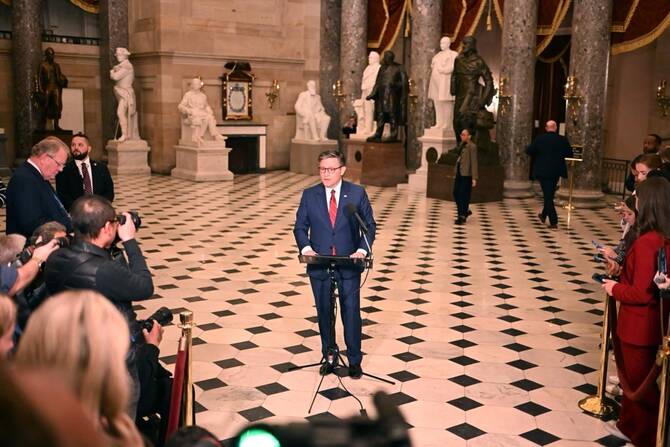
“They knew that it would cause pain, and they did it anyway,” House Speaker Mike Johnson said in a withering floor speech before the vote, pointing the finger for the standoff at the minority party.
“The whole exercise was pointless. It was wrong and it was cruel.”
The package — which Trump is scheduled to sign later Wednesday evening — funds military construction, veterans’ affairs, the Department of Agriculture and Congress itself through next fall, and the rest of government through the end of January.
Around 670,000 furloughed civil servants will report back to work, and a similar number who were kept at their posts with no compensation — including more than 60,000 air traffic controllers and airport security staff — will get back pay.
The deal also restores federal workers fired by Trump during the shutdown, while air travel that has been disrupted across the country will gradually return to normal.
The White House said the president planned to sign the bill in an Oval Office ceremony at 9:45 p.m. .
Trump himself had little to say on the vote, although he took to social media to falsely accuse Democrats of having “cost our Country $1.5 Trillion... with their recent antics of viciously closing our Country.”
The full financial toll of the shutdown has yet to be determined, although the Congressional Budget Office estimates that it has caused $14 billion in lost growth.
Johnson and his Republicans had almost no room for error as their majority is down to two votes.
Democratic leadership — furious over what they see as their Senate colleagues folding — had urged members to vote no and all but a handful held the line.
Although polling showed the public mostly on Democrats’ side throughout the standoff, Republicans are widely seen as having done better from its conclusion.
For more than five weeks, Democrats held firm on refusing to reopen the government unless Trump agreed to extend pandemic-era tax credits that made health insurance affordable for millions of Americans.
Election victories in multiple states last week gave Democrats further encouragement and a reinvigorated sense of purpose.
But a group of eight Senate moderates broke ranks to cut a deal with Republicans that offers a vote in the upper chamber on health care subsidies — but no floor time in the House and no guarantee of action.
Democrats are now deep in a painful reckoning over how their tough stance crumbled without any notable win.
Democratic leadership is arguing that — while their health care demands went largely unheard — they were able to shine the spotlight on an issue they hope will power them to victory in the 2026 midterm elections.
“Over the last several weeks, we have elevated successfully the issue of the Republican health care crisis, and we’re not backing away from it,” House Minority Leader Hakeem Jeffries told MSNBC.
But his Senate counterpart Chuck Schumer is facing a backlash from the fractious progressive base for failing to keep his members unified, with a handful of House Democrats calling for his head.
Outside Washington, some of the party’s hottest prospects for the 2028 presidential nomination added their own voices to the chorus of opprobrium.
California Governor Gavin Newsom called the agreement “pathetic,” while his Illinois counterpart JB Pritzker said it amounted to an “empty promise.” Former transportation secretary Pete Buttigieg called it a “bad deal.”


